


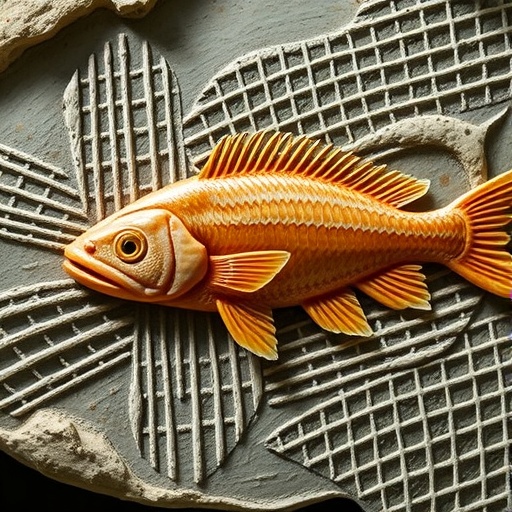
In the wake of the catastrophic asteroid impact roughly 66 million years ago, which famously led to the demise of the non-avian dinosaurs, the aquatic realm—and specifically the evolutionary trajectory of marine fishes—has remained shrouded in mystery. This perplexity chiefly stems from a significant paucity of fossil evidence spanning the first 10 million years following the Cretaceous-Paleogene (K-Pg) extinction event. The gap in the fossil record, often referred to as “Patterson’s Gap,” frustrates paleontologists’ attempts to unravel how modern marine fishes emerged and diversified. However, recent groundbreaking discoveries from a fossil site in Egypt’s Eastern Desert are intricately illuminating this obscure epoch, bridging critical gaps in our understanding of early Paleocene marine ecosystems and fish evolution.
The research, led by doctoral candidate Sanaa El-Sayed of the University of Michigan and undertaken in collaboration with the Mansoura University Vertebrate Paleontology Center (MUVP) in Egypt, reveals the earliest known fossilized skeletons of multiple contemporary fish groups. Dated with remarkable precision to 62.2 million years ago, this fossil deposit dramatically narrows the 10-million-year documentation void and contains some of the earliest representatives of modern fishes like jacks, moonfish, and pipefish—the latter being the group that includes seahorses. These finds signal a rapid diversification and ecological restructuring of marine life after the K-Pg extinction, signifying profound evolutionary shifts in oceanic vertebrates shortly after dinosaurs vanished.
The initial recognition of the site’s significance arose from geological analyses that had dated fossil-rich sediment layers but had not yet brought the full paleontological promise to light. Upon reviewing these geological findings, El-Sayed and her colleagues began targeted excavations, uncovering a diverse fish assemblage comprising 21 distinct species distributed across nine phylogenetic orders. The assemblage predominantly features percomorphs, a clade that dominates modern marine environments yet had been relatively rare during the Mesozoic era. The newfound abundance of these fishes at this temporal nexus underscores a crucial evolutionary transformation in marine vertebrate faunas from the dominance of archaic lineages to the establishment of ecologically and morphologically modern fish communities.
Significantly, this research provides robust evidence countering earlier hypotheses positing that the sparse fossil record in this interval might have been a mere artifact of poor preservation conditions or inadequate sampling. Instead, the fossil assemblage clearly indicates that many fish lineages assumed extinct at the K-Pg boundary indeed vanished as a direct consequence of the mass extinction event. Subsequently, rapid ecological replacement and adaptive radiation by modern fish lineages ensued, shaping marine ecosystems into forms more recognizable to today’s ocean biodiversity.
Matt Friedman, director and curator at the University of Michigan Museum of Paleontology and co-author of the study, emphasizes the importance of clearing the “fog” surrounding this poorly understood transition. The introduction of this well-dated fossil Lagerstätte is a breakthrough for testing evolutionary hypotheses about timing, biogeography, and the ecological dynamics underpinning the modernization of fish faunas. The data support a scenario where ecological opportunities created by extinction catalyzed the explosive emergence of extant groups, reinforcing the K-Pg event as a pivotal evolutionary watershed.
Moreover, biogeographic patterns emerging from the fossil record suggest that the earliest modern fish faunas were predominantly tropical in distribution, with lower representation at higher latitudes in the immediate aftermath of the extinction event. This latitudinal gradient hints at complex environmental and ecological factors governing early post-extinction dispersal and diversification. Speculatively, the tropics may have functioned as a refuge and cradle for diversification, from which modern fish groups gradually colonized broader geographic realms as Earth’s climate regimes evolved throughout the Paleogene.
The discovery underscores the vital necessity of widening the geographic scope of paleontological fieldwork beyond traditionally sampled regions such as Europe and North America. Egypt’s fossil deposits prove to be a treasure trove that adds a critical, previously overlooked piece of the evolutionary puzzle. The site’s excellence lies not only in its age and exceptional fossil preservation but also in its ability to alter prevailing narratives about fish evolution and early Cenozoic marine ecosystems. It serves as a clarion call to deepen exploration in underrepresented but scientifically rich regions around the globe.
Sanaa El-Sayed, originally trained at Mansoura University under the mentorship of Hesham Sallam—the pioneer of vertebrate paleontology in Egypt—not only catalyzed this discovery but also exemplifies the impact of fostering local expertise and international collaboration in advancing paleontological science. The interdisciplinary project brings together paleontologists, geologists, and evolutionary biologists to dissect the aftermath of one of Earth’s most consequential extinctions and reconstruct the oceanic reinvention story.
The research findings, published in the journal Science Advances, present evidence comparable to discovering a Rosetta Stone for the post-K-Pg marine vertebrate record. These fossils are remarkably well-preserved, enabling detailed anatomical analyses that reveal morphological traits linking these Paleocene fishes to their modern descendants. Such insights contribute profoundly to reconstructing traversals of evolutionary lineages and ecological niches reshaped during a time of profound global change.
This research also dovetails with broader questions about ecosystem resilience and adaptive radiations after mass extinction events. Understanding precisely how modern marine vertebrates evolved through one of Earth’s greatest biological turnover episodes can provide analogs for predicting responses to contemporary biodiversity crises. The Egyptian fossil site thus offers not just glimpses of ancient life but also blueprints for interpreting biological recovery, diversification rates, and evolutionary innovation under environmental stress.
As excavations and analyses at the site continue, the team anticipates uncovering even richer faunal assemblages and refining the paleoenvironmental context of this remarkable early Paleocene Lagerstätte. Such work is expected to enhance evolutionary models and provide calibrated timelines for marine vertebrate phylogeny. Ultimately, these endeavors are charting a path through a previously shadowy corridor in Earth’s history, unveiling how modern marine life endured and flourished after a planetary-scale catastrophe upended existing ecosystems.
The collaboration between the University of Michigan and Mansoura University Vertebrate Paleontology Center not only enriches scientific understanding but also strengthens global scientific networks and capacities for future discoveries. The Egyptian site stands as a beacon demonstrating that the fossil record is not static but continues to yield transformative knowledge in the most unexpected places, reshaping our comprehension of Earth’s deep-time biological heritage and the evolutionary origins of today’s marine biodiversity.
News Publication Date: 3-Jun-2026
Web References: DOI: 10.1126/sciadv.aec8978
Cite Scienmag News
Gavin Prescott. (June 3, 2026). Fossil Find Sheds Light on Missing Links in Modern Fish Evolution. Scienmag. https://scienmag.com/fossil-find-sheds-light-on-missing-links-in-modern-fish-evolution/
Gavin Prescott. "Fossil Find Sheds Light on Missing Links in Modern Fish Evolution." Scienmag, 3 June 2026, https://scienmag.com/fossil-find-sheds-light-on-missing-links-in-modern-fish-evolution/. Accessed 3 September 2026.
Gavin Prescott. "Fossil Find Sheds Light on Missing Links in Modern Fish Evolution." Scienmag. June 3, 2026. https://scienmag.com/fossil-find-sheds-light-on-missing-links-in-modern-fish-evolution/


