


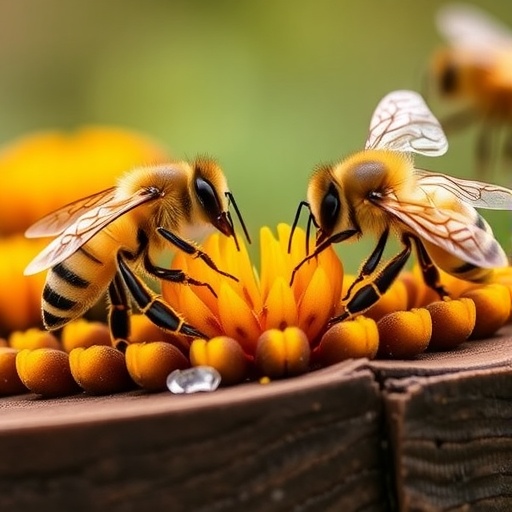
For decades, the developmental fate of a honeybee larva seemed to follow a straightforward narrative: the diet alone dictated destiny, where ample feeding of royal jelly transformed a regular larva into a queen. However, recent groundbreaking research has unveiled a far more intricate mechanism underpinning queen development, painting a richer picture of the elaborate social engineering within the hive. This new understanding transcends the simplistic view of nutrition and introduces an elaborate interplay between environmental construction, physiological specialization, and social cooperation.
At the heart of this emerging paradigm are specialized “queen cells,” sometimes referred to as “royal cribs,” whose unique architecture and materials science are pivotal in shaping the development of a future queen bee. These cells are distinct peanut-shaped chambers, markedly different from the hexagonal cells typical for worker bee larvae. Constructed meticulously by a particular subset of young worker bees, these environments are designed to optimize thermal and humidity regulation, preserving conditions vital for the optimal growth and maturation of larvae destined for royalty.
Heat management within these nurseries is critical. Using advanced thermal imaging techniques, researchers observed that the wax constituting queen cells exhibits uniquely tailored physical and chemical properties. Unlike the denser, more rigid wax used elsewhere in the hive, this wax is more pliable and porous, enabling it to function as an effective insulator. The microenvironment it creates maintains elevated temperatures and humidity levels, conditions shown through behavioral studies to accelerate development and increase larval survival rates.
Complementing wax specialization is the revelation of a new behavioral caste within the hive: the queen cell builders. These workers, typically younger than their counterparts, exhibit altered physiological states marked by elevated body temperature and modified metabolic pathways. Their heightened internal heat contributes actively to the microclimate maintenance within queen cells, ensuring the rapid transformation of larvae into queens. The differentiation of these workers underlines the hive’s complex social stratification, where individual roles are precisely aligned with developmental outcomes.
To dissect the relative contributions of diet versus environment, experimental setups employed materials science and chemical tracing methodologies. Raising larvae in cells fabricated from ordinary worker wax led to significantly decreased survival and reduced queen phenotypes, even when the diet — specifically royal jelly — remained constant. This crucial finding disrupts the long-held assumption that nutrition alone governs caste destiny, emphasizing the indispensable role of the built environment curated by the colony.
Chemical analyses of the queen wax composition revealed fascinating insights. The wax contains specific fatty acids and signaling molecules absent in worker wax, suggesting an evolved biochemical toolkit designed to orchestrate larval development through environmental cues. These chemical signals likely modulate larval gene expression and physiological pathways, interfacing with the nutritional inputs to guide phenotypic differentiation into fertile queens.
The hive’s material ecology extends beyond wax manipulation alone. Through ingenious isotope tracing experiments involving graphite marker particles, the study demonstrated that workers selectively gather, process, and repurpose materials from disparate hive locations to enrich queen cell structures. This highly coordinated engineering effort evokes analogies with human architectural practices, where not only construction but also sourcing and modification of materials are integral to the function of specialized buildings.
The consequences of these added layers of complexity are profound. Queen bees emerge larger, develop faster—approximately 16 days from egg to adult compared to 21 days for workers—and acquire enhanced longevity and reproductive capacity. This speed confers evolutionary advantages, enabling the colony to rapidly replace queens in times of crisis, preserving genetic continuity and colony stability.
Researchers propose that this intricate interplay of physiology, behavior, and materials science reflects a broader principle in biology: organisms are not solely subjects of genetic and nutritional factors, but active engineers of their developmental environments. Honeybee colonies exemplify a superorganism, where collective behavior modulates individual phenotypes through multi-dimensional environmental modification.
The universality of this strategy was confirmed by observing both European and Asian honeybee species, indicating deep evolutionary conservation. Such parallels suggest that environmental engineering as a means to regulate caste differentiation is a fundamental facet of honeybee social biology, shaped over millions of years of eusocial evolution.
This interdisciplinary effort, spanning entomology, genomics, materials science, and behavioral ecology, underscores the power of collaborative science in unraveling complex biological systems. The research, led by former postdoctoral scholars Yu Fang and Yahya Al Naggar at the University of California, Riverside’s Center for Integrative Bee Research, offers not only insights into honeybee society but also broader implications for developmental biology and bioengineering.
Moving forward, the findings pave the way for deeper exploration of how external environmental factors—both biotic and abiotic—influence developmental outcomes across species. It challenges researchers to reconsider developmental plasticity within the context of social and environmental matrices, with potential applications spanning conservation, agriculture, and biomimetic design.
In sum, the transformation from larva to queen in honeybees is not a mere function of royal jelly consumption but rather a sophisticated, society-wide construction project that leverages specialized architecture, material composition, and worker physiology. Honeybee colonies stand as masterful architects of development, embodying complexity that rivals human engineering, and in doing so, provide a captivating model of biological integration and innovation.
News Publication Date: 3-Jun-2026
Web References: https://www.nature.com/articles/s41586-026-10534-3
Cite Scienmag News
Drew Townsend. (June 3, 2026). The True Way Honeybees Crown Their Queens. Scienmag. https://scienmag.com/the-true-way-honeybees-crown-their-queens/
Drew Townsend. "The True Way Honeybees Crown Their Queens." Scienmag, 3 June 2026, https://scienmag.com/the-true-way-honeybees-crown-their-queens/. Accessed 3 September 2026.
Drew Townsend. "The True Way Honeybees Crown Their Queens." Scienmag. June 3, 2026. https://scienmag.com/the-true-way-honeybees-crown-their-queens/


