


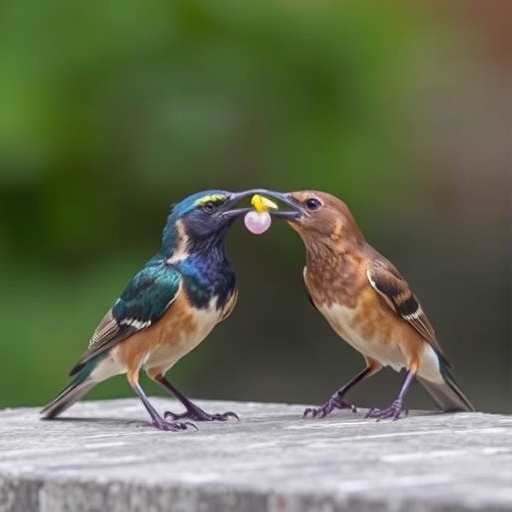
In the urban sprawl of Townsville City, Australia, a remarkable adaptation is unfolding among the male great bowerbirds, revealing a captivating intersection between wildlife behavior and human impact. These avian artisans, renowned for their intricate mating rituals, are now incorporating an eclectic array of human-made objects into their courtship displays, signaling a profound shift in their natural behaviors likely driven by urbanization. The study, conducted by researchers at the University of Exeter, sheds light on how environmental changes brought by human settlements are subtly, yet significantly, transforming animal communication and mating strategies.
Great bowerbirds are distinguished by their unique courtship practice where males build elaborate structures known as bowers—tunnel-like frameworks constructed meticulously from twigs and sticks. These frameworks serve no purpose other than to attract females, functioning as a stage upon which males exhibit their ornamental skillsets. Traditionally, these birds adorned their bowers with natural items such as fruits, seeds, leaves, and flowers, selected primarily for their vibrant colors and contrasts that complement the male plumage. However, the urban bowerbirds display an innovative twist in this age-old tradition by scavenging colorful human refuse to embellish their bowers.
Comprehensive fieldwork compared the decorations amassed by bowerbird populations dwelling in Townsville’s urban environment and those inhabiting nearby rural areas in Queensland. The results revealed stark differences in the types and vibrancy of objects chosen, showcasing that city males collected a more extensive and diverse range of items—largely dominated by artificial debris. These included shards of vividly colored glass, scraps of plastic in brilliant reds and greens, wire pieces, and astonishingly, even an assortment of unusual artifacts like handcuffs and fluorescent mouthguards. Such items were conspicuously absent or scarce in rural bowers, which instead relied more heavily on naturally occurring materials.
The scientific team took special care to analyze these objects through the visual system of female bowerbirds, whose color perception vastly exceeds human capability. Unlike humans, these birds can detect subtle differences in hue and saturation, which plays a vital role in mate selection. This insight allowed the researchers to ascertain that urban items, while varied, often presented sharper visual contrasts compared to the more muted natural materials found in rural settings. Remarkably, red decorations were more vivid and noticeable in city bowers, while green items appeared comparatively duller than those in the countryside, suggesting tailored selection based on context and background.
This behavioral adjustment not only illustrates the bowerbirds’ impressive adaptability but also raises intriguing questions regarding sexual selection in transformed habitats. Although the study did not directly measure female preference, the male birds’ energized response to incorporating anthropogenic materials strongly implies that these objects may enhance their attractiveness during courtship displays. The sheer volume of collected items, with urban males boasting an average of around 90 decorations compared to just 20 for their rural peers, points to greater investment in visual signaling where such materials are plentiful.
On a broader ecological scale, the findings elucidate how urbanization can influence animal behavior beyond habitat displacement or dietary shifts. The availability of novel objects in human environments, including discarded waste and industrial materials, appears to provide a rich new palette for bowerbird ornamentation. This shift may be interpreted as an emergent form of cultural adaptation where traditional displays evolve in response to altered resources, highlighting the complex interplay between wildlife and anthropogenic influences.
Further experimental procedures involved presenting selected objects from both urban and rural bowers to groups of males from each environment. Intriguingly, both cohorts exhibited a marked preference for human-made items, underscoring the inherent appeal of artificial colors and textures over natural ones. This behavioral inclination could be driven by the enhanced conspicuousness of urban decorations, potentially improving mating success through amplified visual signals, although the consequences for reproductive fitness remain to be explored.
The study also documented unexpected finds, such as medical-related items near hospitals and sports equipment close to stadiums, indicating that bowerbirds exploit their environmental context to source materials. Such localized variations demonstrate a remarkable opportunistic strategy, wherein urban males optimize their courtship displays by scavenging environment-specific debris. This phenomenon challenges traditional views on animal ornamentation, suggesting that urban wildlife not only adapts to altered landscapes but also incorporates human artifacts into its evolutionary repertoire.
Despite these captivating insights, the broader implications of this urban-driven behavioral modification are still ambiguous. Researchers caution that the long-term impact on bowerbird populations and ecosystem dynamics is unclear. While the acquisition of human-made materials might enhance mating displays, issues such as toxicity, exposure to pollutants, or dependencies on non-natural items could have unforeseen repercussions on health and survival. Therefore, continued monitoring and in-depth ecological studies are essential to fully understand the consequences of this adaptation.
At its core, this research underscores a critical narrative: human activities are reshaping nature in ways that transcend habitat loss. Through the lens of the great bowerbird’s courtship, we witness a testament to animal resilience and the creative use of anthropogenic materials in natural behaviors. It sparks vital conversations about wildlife conservation and urban planning, urging consideration of how urban ecosystems serve as dynamic, interactive spaces where animals and humans cohabit and influence one another.
Published in the prestigious journal Royal Society Open Science, this groundbreaking study titled “Urbanization alters courtship signals in male great bowerbirds” is a vivid portrayal of how urban environments can redefine evolutionary trade-offs and behavioral ecology. Funded by the Natural Environment Research Council GW4+ Doctoral Training Partnership, the research stands at the forefront of integrating sensory ecology, behavioral biology, and urban wildlife studies, providing a foundation for future investigations into the consequences of global urban expansion.
The meticulous work by Caitlin Evans and colleagues from the University of Exeter contributes significantly to ethology and organismal biology by revealing how male great bowerbirds embrace human influence to enhance their reproductive success. As urban ecosystems continue to burgeon worldwide, understanding such behavioral shifts becomes essential to safeguarding biodiversity within increasingly anthropogenic habitats, offering a compelling glimpse into nature’s adaptability and evolutionary ingenuity.
News Publication Date: 2-Jun-2026
Web References: http://dx.doi.org/10.1098/rsos.260109
Cite Scienmag News
Gavin Prescott. (June 3, 2026). Urban Birds Captivate Females Using ‘Borrowed’ Human Objects, Study Finds. Scienmag. https://scienmag.com/urban-birds-captivate-females-using-borrowed-human-objects-study-finds/
Gavin Prescott. "Urban Birds Captivate Females Using ‘Borrowed’ Human Objects, Study Finds." Scienmag, 3 June 2026, https://scienmag.com/urban-birds-captivate-females-using-borrowed-human-objects-study-finds/. Accessed 3 September 2026.
Gavin Prescott. "Urban Birds Captivate Females Using ‘Borrowed’ Human Objects, Study Finds." Scienmag. June 3, 2026. https://scienmag.com/urban-birds-captivate-females-using-borrowed-human-objects-study-finds/


