


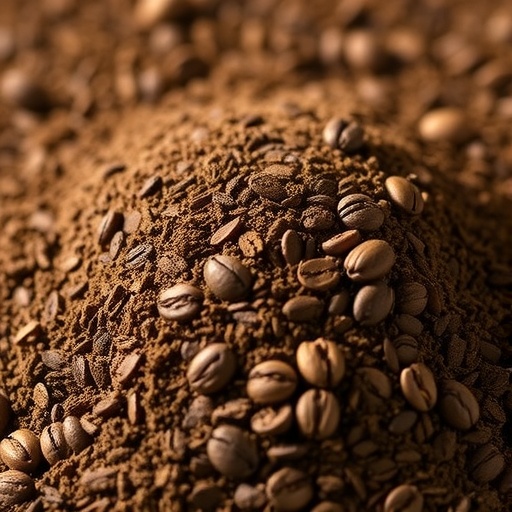
In a groundbreaking development poised to reshape the future of sustainable materials, researchers have uncovered an innovative method to convert one of the world’s most ubiquitous waste products—spent coffee grounds—into a high-performance, biodegradable thermal insulation material. This pioneering work promises to mitigate environmental waste concerns while providing an eco-friendly alternative for thermal management across a broad spectrum of industries including building construction, packaging, and renewable energy systems.
The research, spearheaded by Sung Jin Kim and Seong Yun Kim, culminated in the creation of a fully green composite that harnesses the potential of biochar derived from spent coffee grounds integrated with ethyl cellulose, a naturally sourced polymer. This synergy yielded an extraordinary thermal conductivity of 0.04 W m⁻¹ K⁻¹, a figure that places this novel composite on par with commercial expanded polystyrene (EPS), a widely used but petroleum-based insulation material. Unlike EPS, however, the new composite distinguishes itself through its renewable components and demonstrated biodegradability when exposed to enzymatic treatment, marking a significant stride in environmental responsibility.
The motivation behind this research stems from the persistent global burden posed by coffee waste. Despite the prodigious quantities of spent coffee grounds generated daily, these residues primarily end up in landfills or are incinerated, raising environmental concerns associated with waste management and carbon emissions. The authors’ approach leverages carbonization, a simple yet effective process to convert the coffee waste into biochar—a porous carbon-rich material. By meticulously calibrating the carbonization temperature and atmospheric conditions, they identified that biochar produced at 700 °C under ambient conditions optimally balanced high porosity with moderate graphitic structuring, essential characteristics for superior thermal insulation performance.
The intrinsic mechanism behind this insulation lies in the microstructure of biochar. Its highly porous nature traps air within the pores, significantly impeding heat transfer through conduction. Achieving this porous network’s stability during composite fabrication posed a formidable challenge, as conventional polymer matrices tend to infiltrate and fill void spaces, thereby compromising insulation efficacy. Innovatively, the team deployed a pore restoration technique involving premixing biochar with propylene glycol before its integration with ethyl cellulose. This strategic step successfully preserved the porosity by preventing pore collapse and polymer intrusion, ensuring that the composite maintained its critical insulating architecture.
Extensive thermal characterization revealed that the resulting composite, designated as EC/SB700/PG-25, exhibits a drastic reduction in thermal conductivity—approximately one-sixth that of pure ethyl cellulose. Such performance enhancement validates the design principle, highlighting the composite’s potential as a sustainable substitute for EPS without sacrificing insulation functionality. Complementing experimental results, finite element modeling elucidated that the lauded thermal performance arises synergistically from three key parameters: the porous matrix’s inherent air entrapment, the thermal interfacial resistance between biochar particles and polymer, and the fine-tuned graphitic domains within the biochar contributing to controlled phonon scattering.
A compelling facet of this research is the composite’s biodegradation behavior, which stands in stark contrast to conventional insulation materials notorious for persistence in landfills. The composite exhibited accelerated degradation in the presence of cellulase enzymes, attributed to enhanced water and enzyme infiltration facilitated by the biochar-polymer interfacial zones. This rapid breakdown heralds a reduction of long-term ecological footprints and offers a practical solution to the mounting challenge of insulating material disposal.
To examine practical applications, the researchers integrated their biochar composite into a scaled-down building-integrated photovoltaic (BIPV) system, serving as a thermal management layer. Their experiments confirmed that the biochar composite effectively reduced heat transfer beneath photovoltaic cells, mirroring the performance of traditional EPS insulators. Controlling thermal load in BIPV systems is critical to maintaining efficiency, and this demonstration underscores the composite’s feasibility for real-world energy-saving technologies.
Professor Seong Yun Kim emphasized the dual advantage of this innovation, highlighting its contribution to circular economy principles by simultaneously tackling waste valorization and energy efficiency. Such materials are not merely substitutes but represent transformative solutions that align environmental sustainability with high-performance engineering requirements, potentially altering the insulation market’s trajectory away from fossil fuel dependency.
The broader implications for construction, packaging, and transportation industries are profound. With global efforts intensifying to mitigate climate change, materials that reduce energy consumption during operation and alleviate waste management burdens offer compelling benefits. Utilizing abundant agricultural and food processing residues such as coffee grounds addresses both resource scarcity and ecological impact, advancing a holistic approach to material science challenges.
This breakthrough aligns with the ongoing shift towards green chemistry and materials science, where bio-based, non-toxic, and renewable feedstocks gain prominence. The incorporation of ethyl cellulose, sourced from natural polymers, further cements the composite’s circular credentials and compatibility with existing biodegradation pathways. The intuitive processing steps and ambient carbonization conditions also suggest scalability, enhancing the material’s appeal for industrial adoption.
In summary, the transformation of spent coffee grounds into a highly porous biochar combined with ethyl cellulose culminates in a biodegradable, sustainable, and thermally efficient composite. This material matches or exceeds the insulation standards of petroleum-derived counterparts while offering a conscientious environmental profile. As nations, companies, and consumers increasingly demand greener alternatives, such innovations may pave the way for next-generation building materials that marry high-performance with ecological stewardship.
News Publication Date: 10 March 2026.
Web References:
http://dx.doi.org/10.1007/s42773-026-00584-1
References:
Kim, S.J., Kim, S.Y. Highly porous biochar from spent coffee ground for fully green thermal insulating composites with thermal conductivity of 0.04 W m⁻¹ K⁻¹. Biochar 8, 73 (2026).
Keywords
biochar, spent coffee grounds, thermal insulation, biodegradable composites, ethyl cellulose, porous materials, renewable materials, waste upcycling, green building materials, energy efficiency, sustainable composites, carbonization
Cite Scienmag News
Denise Maddox. (June 2, 2026). Transforming Used Coffee Grounds into Eco-Friendly Insulation. Scienmag. https://scienmag.com/transforming-used-coffee-grounds-into-eco-friendly-insulation/
Denise Maddox. "Transforming Used Coffee Grounds into Eco-Friendly Insulation." Scienmag, 2 June 2026, https://scienmag.com/transforming-used-coffee-grounds-into-eco-friendly-insulation/. Accessed 4 September 2026.
Denise Maddox. "Transforming Used Coffee Grounds into Eco-Friendly Insulation." Scienmag. June 2, 2026. https://scienmag.com/transforming-used-coffee-grounds-into-eco-friendly-insulation/


