


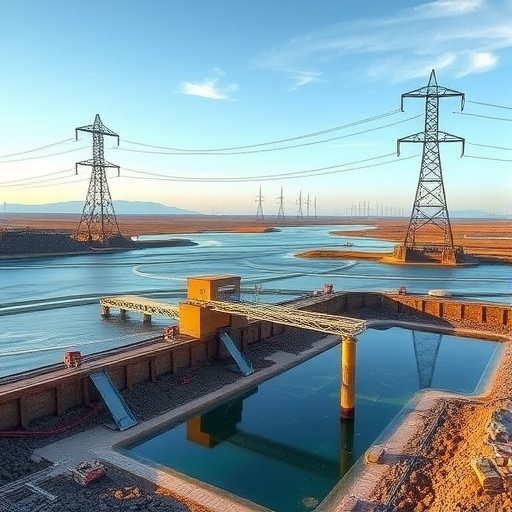
In a landmark advancement at the convergence of environmental science and energy technology, researchers Ye, Jin, Han, and colleagues have unveiled a revolutionary method for extracting uranium directly from wastewater sources through a spontaneous electrochemical process. This not only cleanses hazardous effluents but remarkably generates net electrical energy, flipping traditional resource extraction paradigms on their head. The implications of this breakthrough, published as an author correction in Nature Water (2026), are poised to redefine sustainable nuclear fuel recovery and wastewater treatment, providing an innovative dual-purpose solution to some of the planet’s most pressing challenges.
Uranium, a critical element for nuclear energy and advanced medical isotopes, has historically been sourced through mining operations that are costly, environmentally intrusive, and energy-intensive. Traditional extraction methods often involve chemical leaching and significant waste generation, compounding ecological damage. The process developed by this team represents a paradigm shift by harnessing electrochemical potentials inherent in uranium-laden wastewater systems, enabling uranium ions to spontaneously migrate and deposit onto electrodes while simultaneously producing usable electric power. This net gain of electricity during extraction is unprecedented.
The researchers’ fundamental approach hinges on the electrochemical gradient naturally present between uranium ions in complex aqueous matrices and the engineered electrode surfaces. By fine-tuning the electrode materials and system configuration, the team achieved a spontaneous redox reaction where uranium(VI) species are reduced and selectively deposited without external voltage input. This self-driven electrodeposition enables continuous uranium recovery while producing a measurable electrical current, revealing a self-sustaining operational mode where energy harvested offsets the system’s power demands.
Central to this innovation is the strategic use of carbon-based electrodes modified with catalytic nanostructures. These electrodes display heightened electrochemical selectivity towards uranium species, facilitating rapid ion transport and robust deposition kinetics. The team’s meticulous materials engineering allows the device to perform optimally even in complex wastewater environments containing competing ions and organic matter, which previously impeded selective uranium recovery efforts.
Beyond pure chemistry, the research integrates advanced fluid dynamics and electrochemical modeling to design reactor geometries that enhance mass transfer and minimize energy loss. By optimizing flow paths and electrode spacing, they ensure maximal contact between the uranium ions and catalytic surfaces, driving the reaction kinetics and maximizing electricity output. This systems-level integration of materials science and engineering principles exemplifies the holistic approach necessary to translate laboratory chemistry into practical, scalable technology.
In extensive laboratory trials, the system demonstrated remarkable performance metrics. Uranium extraction efficiencies exceeded 85% within hours, with continuous energy generation measured in microwatt to milliwatt ranges depending on scale and feed uranium concentration. Importantly, the method operates effectively at ambient temperatures and pH conditions typical of various uranium-contaminated effluents from mining runoff, nuclear facility wastewater, and industrial discharge, highlighting broad applicability.
The dual benefits of contaminant removal and energy generation create a compelling economic and environmental proposition. Where conventional treatment of uranium-laden wastewater incurs substantial costs and energy consumption, this innovative technique potentially offers a net positive energy balance, reducing operational expenditures and carbon footprints. Moreover, by recovering uranium from low-grade sources once considered unfeasible, it contributes to resource circularity and mitigates dependence on primary mining.
An additional facet of this technology is its modularity. The electrochemical cells can be fabricated as compact, stackable units that scale efficiently from small decentralized installations treating localized wastewater to larger industrial-scale setups. This flexibility supports deployment across diverse environments and infrastructural constraints, making it attractive for application in mining camps, nuclear remediation sites, and urban industrial zones alike.
The environmental ramifications extend beyond uranium recovery. By effectively removing uranium contaminants, the technology safeguards aquatic ecosystems and human health from radioactive exposure and chemical toxicity. This positions the process as a powerful tool in achieving compliance with increasingly stringent environmental regulations governing radioactive effluents and heavy metal pollution, ensuring safer water quality standards.
While the initial findings are groundbreaking, the authors acknowledge ongoing challenges to optimize the economic viability and operational resilience at industrial scales. Key areas for future investigation include long-term electrode durability, fouling mitigation, and integration with waste treatment workflows. Advances in electrode material science and system automation are anticipated to further elevate performance and cost-effectiveness.
The scientific community has greeted this study with enthusiasm, recognizing its potential to catalyze a new class of green energy and resource recovery technologies. By coupling wastewater remediation with spontaneous electricity generation, the research exemplifies the power of interdisciplinary innovation to address complex sustainability issues. It opens exciting pathways for analogous applications in recovering other valuable metals from industrial effluents.
The publication in Nature Water underscores the rigorous peer review and global significance of this contribution. It elevates the conversation about uranium’s role not only as a nuclear fuel but as a candidate for circular economy strategies enabled by electrochemical sciences. As implementation exploration accelerates, this technology could transform how the world manages radioactive waste and secures its critical material supply chains.
In summary, Ye, Jin, Han, and their collaborators have delivered a transformative approach to uranium extraction that simultaneously purifies wastewater and harvests electrical energy spontaneously. This dual-function paradigm promises to disrupt conventional practices, melding environmental stewardship with energy innovation to forge sustainable pathways forward. The ongoing research and developmental momentum inspired by these findings will doubtlessly shape the future landscape of nuclear materials management and environmental remediation technology.
Cite Scienmag News
Violet Maxwell. (June 1, 2026). Uranium Extracted from Wastewater, Generating Electricity. Scienmag. https://scienmag.com/uranium-extracted-from-wastewater-generating-electricity/
Violet Maxwell. "Uranium Extracted from Wastewater, Generating Electricity." Scienmag, 1 June 2026, https://scienmag.com/uranium-extracted-from-wastewater-generating-electricity/. Accessed 3 September 2026.
Violet Maxwell. "Uranium Extracted from Wastewater, Generating Electricity." Scienmag. June 1, 2026. https://scienmag.com/uranium-extracted-from-wastewater-generating-electricity/


