


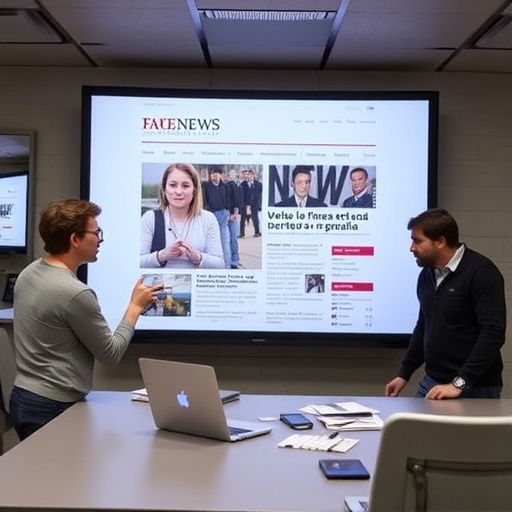
In an era where misinformation spreads with alarming ease, the battle against fake news has become a critical frontier in public discourse. A recent study conducted on a sample of 100 Italian college students provides compelling evidence that the effectiveness of fake news recognition improves significantly when individuals engage in collaborative group discussions rather than relying solely on individual reflection. This research illuminates the cognitive benefits of social argumentation, offering a novel approach to the pervasive challenge of distinguishing credible information from falsehood in today’s digitally dominated information landscape.
The investigation, published in PLOS One, reveals that group argumentation facilitates enhanced critical scrutiny of information, enabling participants to better identify and reject fake news. Unlike passive individual reading or reflection, this collective processing encourages diverse viewpoints and critical exchange, which leads to deeper reasoning about the veracity of news content. By comparing the outcomes of independent assessment versus collaborative evaluation, the study underscores the importance of social dynamics in cognitive processing related to misinformation detection.
Central to the research is the concept of “group argumentation,” a structured form of dialogue where individuals actively challenge each other’s assumptions and reasoning. This method contrasts sharply with solitary reflection, where cognitive biases and heuristics might remain unchecked. The group setting compels participants to articulate their understanding and critically evaluate contrasting opinions. Such discourse triggers metacognitive processes and cognitive conflict, fostering a more analytic mindset that is essential for counteracting the intuitive appeal of fake news.
Participants in the study were exposed to a variety of news headlines and articles that included both factual and fabricated information. The experimental structure divided them into two cohorts: one engaged in group discussions, and the other processed the information individually. The group discussions were characterized by argument-driven exchanges focused on evaluating the credibility of the content, weighing evidence, and delineating logical consistencies or fallacies. This interactive intellectual engagement proved to be a potent mechanism for improving the accuracy of news judgment.
Neurological theories supporting this phenomenon suggest that group argumentation activates higher-order executive functions in the brain, involving critical thinking, skepticism, and inhibitory control to suppress impulsive beliefs. When individuals deliberate in groups, they recruit social cognitive processes—such as perspective-taking and theory of mind—that enrich their evaluative capacity. These cognitive operations not only improve information processing but also build resilience against cognitive biases like confirmation bias that often fuel the acceptance of fake news.
Moreover, the study’s cross-sectional design, focused on college-aged participants in Italy, highlights the role of education level and cognitive maturity in mediating the effectiveness of group discussions. The findings raise intriguing questions about the scalability of this intervention across different demographic groups and educational contexts. If group argumentation can be institutionalized in educational or public policy frameworks, it could serve as a tool for civic education and media literacy to strengthen democratic deliberation.
A striking outcome of this research is the implication that simply providing individuals with factual corrections or encouraging solitary critical thinking may be insufficient to combat the spread of misinformation effectively. Instead, the authors point to the compelling power of dialogic engagement where ideas and evidence are contested collectively. This aligns with broader social theories of knowledge construction, emphasizing that truth-seeking is inherently a social endeavor, benefiting from collective intelligence and diversity of thought.
The study also touches on the psychological impact of group-based discourse in fostering not only better judgment but also greater confidence in one’s ability to discern truth from falsehood. This sense of efficacy is critical because skepticism without direction can lead to cynicism and disengagement. Through collaborative reasoning, participants developed a calibrated skepticism that is constructive rather than paralyzing, equipping them with practical strategies for navigating the complex information ecosystems of digital media.
Importantly, the researchers clarify that the group dynamics must be carefully managed to avoid echo chambers or groupthink, which can reinforce false beliefs rather than dispel them. The quality of argumentation—defined by openness, critical engagement, and evidence-based reasoning—is the key driver of improved outcomes. This suggests that interventions should not merely promote discussion but foster a culture of reasoned debate and intellectual humility.
While the sample was limited to 100 participants and the cultural context was Italian academia, the implications resonate broadly in the global context of misinformation. The study invites further research into how different social configurations, cultural norms, and communication platforms influence the effectiveness of group argumentation as a countermeasure to fake news. It also points to potential applications in designing algorithms and social media interactions that encourage constructive dialogue rather than polarization.
In conclusion, this innovative study substantiates the hypothesis that social interaction, specifically through group argumentation, substantially enhances the ability to detect and resist fake news. It propels a shift in the conversation about misinformation strategies—from individual cognition focused solutions to collective cognitive engagements. By harnessing the power of reasoned dialogue and critical discussion, societies might better equip themselves to maintain an informed citizenry resilient to the perils of false information.
The study was conducted without specific external funding, reflecting an academic pursuit driven by intrinsic motivation to tackle a pressing societal issue. The authors have declared no competing interests, underscoring the impartiality and scientific integrity of their findings. As misinformation continues to challenge democratic societies worldwide, this research offers a hopeful, actionable pathway grounded in human cognitive and social capabilities.
News Publication Date: 27-May-2026
Web References: http://dx.doi.org/10.1371/journal.pone.0348391
Cite Scienmag News
Courtney Benton. (May 27, 2026). Small study of 100 Italian college students finds “fake news” easier to spot in group discussions. Scienmag. https://scienmag.com/small-study-of-100-italian-college-students-finds-fake-news-easier-to-spot-in-group-discussions/
Courtney Benton. "Small study of 100 Italian college students finds “fake news” easier to spot in group discussions." Scienmag, 27 May 2026, https://scienmag.com/small-study-of-100-italian-college-students-finds-fake-news-easier-to-spot-in-group-discussions/. Accessed 6 September 2026.
Courtney Benton. "Small study of 100 Italian college students finds “fake news” easier to spot in group discussions." Scienmag. May 27, 2026. https://scienmag.com/small-study-of-100-italian-college-students-finds-fake-news-easier-to-spot-in-group-discussions/


