


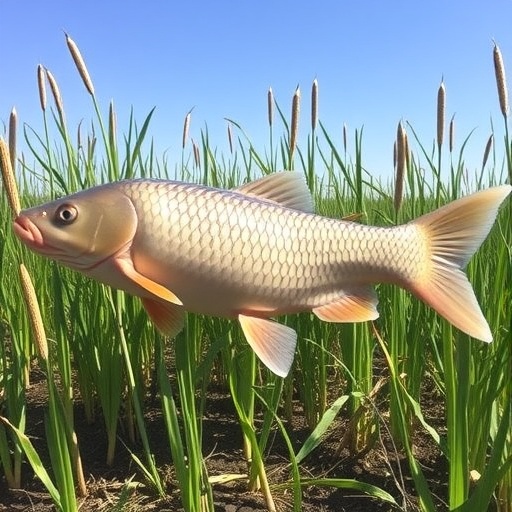
In a groundbreaking advancement for aquaculture and genetic breeding, a team of scientists led by Professor Gao Zexia at Huazhong Agricultural University has successfully developed a strain of grass carp devoid of intermuscular bones (IBs) through targeted gene editing of the runx2b gene. This achievement marks a significant leap forward in addressing a critical industry bottleneck that has hampered fish processing and consumption safety worldwide.
Fish occupy a pivotal role as a premier source of high-quality animal protein, holding great promise for enhancing global dietary regimes. Despite their importance, a major limitation in about 70% of farmed fish species is the presence of intermuscular bones—a network of thin, needle-like bones embedded within the muscle tissue. These IBs not only pose risks during consumption, causing choking hazards and digestive challenges, but also limit the efficiency and application of modern fish processing technologies. Hence, breeding IB-free fish has long been identified as a paramount goal in aquatic genetic improvement programs.
The research team’s focus on the developmental biology and molecular regulation of IBs began over a decade ago, culminating in a pioneering elucidation of the genetic pathways underpinning IB formation in cyprinid fish. Central to these mechanisms is the runx2b gene, a pivotal transcription factor that orchestrates bone development, particularly influencing the ossification process of intermuscular bones. By employing the revolutionary CRISPR/Cas9 genome editing technique, the team precisely disrupted the runx2b gene in one-cell-stage grass carp embryos, generating targeted mutations in the F0 generation.
Subsequent breeding and genetic crossing of these F0 mutants yielded an F1 generation exhibiting heritable absence of IBs. Through rigorous phenotypic screening and selective mating, an F2 generation was established, conclusively demonstrating stable inheritance of the IB-free trait. This strategic molecular breeding pipeline not only bypasses the lengthy timelines and uncertainties of conventional selective breeding but also harnesses gene editing to produce novel, high-value germplasm resources rapidly.
Grass carp, the most extensively farmed fish species globally with projected production of 6.2 million tons in 2024, was chosen as the model for this study due to its widespread economic and nutritional significance. Traditionally burdened by approximately 118 intermuscular bones, these fish suffer from reduced consumer acceptability and processing challenges. The runx2b gene-edited grass carp revealed not only complete elimination of IBs but also exhibited normal development of the rest of the skeletal system, confirming that the editing was specifically targeted without detrimental off-target effects on major bone structures.
Comprehensive biochemical and nutritional analyses demonstrated that the absence of IBs did not alter the moisture, protein, lipid, amino acid, or fatty acid profiles in the muscle tissue when compared to wild-type control fish. Sensory qualities including free amino acid composition and flavor potential remained unaffected, indicating that meat quality was preserved post gene editing. Intriguingly, the IB-free fish displayed enhanced textural properties, with significantly increased gel strength, cohesiveness, and resilience—characteristics desirable for both consumer experience and industrial processing.
At the physiological level, the researchers observed a subtle shift in muscle composition, notably a decrease in calcium content and an increase in potassium concentration in the edited fish. These changes likely reflect adaptive mineral homeostatic mechanisms compensating for the absence of intermuscular skeletal supports. To investigate molecular alterations accompanying these physiological adaptations, the team conducted multi-omics analyses encompassing transcriptomics and metabolomics of muscle tissue.
Their molecular profiling revealed extensive remodeling of pathways integral to muscle function, particularly calcium signaling and muscle contraction pathways. Notably, genes associated with fast-twitch muscle fibers were upregulated, suggesting a phenotypic shift favoring enhanced contraction speed and metabolic efficiency. This remodeling is hypothesized to counterbalance the structural deficit caused by IB removal, enabling the fish to maintain normal locomotor performance and activity levels despite skeletal alterations.
Beyond scientific novelty, this study establishes a versatile and replicable technical framework integrating gene identification, precise genetic editing, controlled breeding, and rigorous safety and quality evaluations. Such a comprehensive system sets a new benchmark for aquatic genetic improvement endeavors, offering a blueprint for the development of fish strains with optimized traits tailored for modern aquaculture needs.
The broader implications of this research resonate across the global fish farming industry. By generating IB-free grass carp that retain nutritional and sensory attributes while enhancing processing performance, this innovation promises to elevate product safety, streamline industrial processing, and expand market potential. Moreover, it addresses consumer concerns over bone-related injuries and enhances the overall eating quality of farmed fish, supporting public health objectives related to protein intake.
This success derives from a collaborative effort between Huazhong Agricultural University—a leading institution in freshwater fish genetics and breeding—and Guangdong Haid Group Co., Ltd., a global agricultural technology enterprise dedicated to sustainable aquaculture development. Their combined expertise and resources effectively bridged fundamental research and practical application, accelerating the translation of gene editing techniques into viable commercial germplasm resources.
Looking forward, this breakthrough opens exciting avenues for genetic improvement of other aquaculture species. The universality of runx2b as a key regulatory target for IB formation suggests the potential for broad-spectrum application across multiple species with similar bone development pathways. Integration of such gene editing approaches with conventional breeding pipelines could revolutionize aquatic animal genetics, underpinning sustainable, efficient, and consumer-friendly fish production systems worldwide.
In conclusion, the generation of IB-free grass carp through runx2b gene editing marks a transformative milestone in aquaculture genetics. It addresses a long-standing industry challenge by harnessing cutting-edge molecular biology tools, while maintaining or improving key quality traits, ensuring fish welfare, and aligning with consumer demand for safer, more convenient seafood products. This pioneering research exemplifies how modern genetic technologies can foster innovation that benefits producers, consumers, and the environment alike, paving the way for the next generation of aquaculture excellence.
Web References: DOI: 10.1007/s11427-025-3215-8
Cite Scienmag News
Juliet Wilcox. (May 27, 2026). Groundbreaking Breakthrough: World’s First Intermuscular Bone-Free Grass Carp Developed. Scienmag. https://scienmag.com/groundbreaking-breakthrough-worlds-first-intermuscular-bone-free-grass-carp-developed/
Juliet Wilcox. "Groundbreaking Breakthrough: World’s First Intermuscular Bone-Free Grass Carp Developed." Scienmag, 27 May 2026, https://scienmag.com/groundbreaking-breakthrough-worlds-first-intermuscular-bone-free-grass-carp-developed/. Accessed 4 September 2026.
Juliet Wilcox. "Groundbreaking Breakthrough: World’s First Intermuscular Bone-Free Grass Carp Developed." Scienmag. May 27, 2026. https://scienmag.com/groundbreaking-breakthrough-worlds-first-intermuscular-bone-free-grass-carp-developed/


