


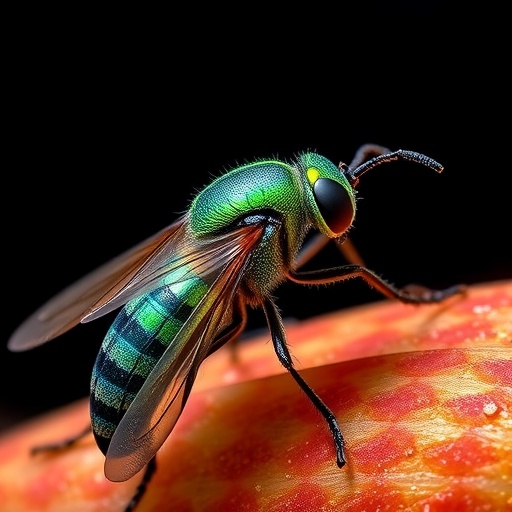
In a groundbreaking fusion of artificial intelligence and entomology, an international team of researchers is developing a mobile application capable of identifying disease-carrying insects based solely on their wing patterns. This advancement signals a major leap forward in the fight against neglected tropical diseases (NTDs), which afflict over a billion people worldwide, primarily in economically disadvantaged regions across Africa, Asia, and Latin America. The project combines high-resolution microscopic imaging with cutting-edge machine learning techniques to revolutionize vector surveillance, empowering health workers and scientists with unprecedented diagnostic speed and precision.
Neglected tropical diseases, such as leishmaniasis, dengue, and schistosomiasis, continue to exert a significant toll on global health, causing chronic suffering, long-term disabilities, and in severe cases, mortality. Among these, leishmaniasis stands out as a particularly insidious infection. Transmitted through the bite of infected sandflies, leishmaniasis is caused by parasites of the genus Leishmania and manifests in various clinical forms, ranging from cutaneous ulcers to fatal visceral infection. Presently, over ninety validated species of sandflies act as vectors, each with unique morphological traits that traditionally require expert identification through time-consuming and delicate microscopic examination.
To mitigate these challenges, the research initiative harnesses the power of high-resolution microscopy to capture detailed images of sandfly wings—a distinguishing anatomical feature with species-specific patterns. These images serve as training data for sophisticated machine learning algorithms designed to discern subtle differences imperceptible to the human eye. By translating wing morphology into quantifiable digital data points, the AI model learns to classify sandfly species rapidly and accurately, overcoming the bottlenecks inherent in classical entomological methods.
The resulting mobile application aims to be a transforming tool in the field, enabling field scientists, epidemiologists, and healthcare workers to swiftly identify sandfly species on-site without requiring extensive taxonomic expertise. This capacity for rapid identification allows for more targeted vector control strategies, enabling interventions to focus on the most prevalent or dangerous species in a given locale. Precise targeting reduces unnecessary pesticide use, diminishes ecological disruption, and conserves resources, while also facilitating immediate responses to emerging outbreaks. Beyond real-time application, the app is envisioned as an educational resource, enhancing vector identification skills among medical students and novice personnel, thus strengthening the broader healthcare infrastructure.
Professor Tossapon Boongoen of Aberystwyth University’s Department of Computer Science, a leading member of the collaborative team, emphasizes the critical need for such innovations in an era marked by shifting insect habitats and emerging disease threats. Climate change has expanded the geographical ranges and altered the migration patterns of many vector species, complicating epidemiological forecasting and response strategies. By providing granular, species-level identification, the technology empowers health authorities to trace the provenance and transmission pathways of disease clusters with greater fidelity, enhancing the efficacy of public health campaigns.
Current vector identification methodologies rely heavily on morphological keys and manual dissection, requiring substantial expertise, time, and laboratory infrastructure. Such prerequisites are often unavailable in the remote and resource-limited settings where many NTDs are endemic, hindering timely diagnosis and containment efforts. The AI-driven system circumvents these limitations by automating recognition processes, reducing reliance on scarce human expertise, and accelerating diagnostic throughput—attributes that are essential for managing diseases in fragile healthcare environments.
Moreover, the AI framework holds the potential to uncover previously undocumented or cryptic species that might contribute to disease transmission yet remain undetected using traditional techniques. By continuously learning and adapting from new image data inputs, the system can evolve, highlighting novel vector species and shifting epidemiological patterns that may pose future health risks. This dynamic adaptability ensures that disease control strategies can remain nimble in the face of ecological and evolutionary changes.
Long-term ambitions for this technological platform extend beyond leishmaniasis vectors. The researchers foresee expanding the database and model capabilities to encompass a broader array of arthropod species responsible for transmitting other significant infectious agents, including mosquitoes linked to dengue, malaria, and Zika virus. This scalable approach presents a unifying framework for vector surveillance, potentially integrating diverse vector-borne disease control programs under a common technological umbrella.
The methodology involves the integration of state-of-the-art image processing algorithms and convolutional neural networks (CNNs), a class of deep learning models particularly adept at image recognition tasks. The research leverages detailed wing venation patterns, scale textures, and other micro-morphological features as input variables, allowing the AI to construct a multidimensional feature space where species differentiation becomes statistically robust. Training the model requires extensive labeled datasets curated from varied geographic locations to ensure generalizability and resilience against morphological variability induced by environmental factors.
Collaboration is the backbone of this ambitious project, uniting expertise from computational science, entomology, epidemiology, and public health. Partners include the Centre of Excellence in Vector Biology and Vector Borne Diseases at Chulalongkorn University in Thailand, Liverpool School of Tropical Medicine in the UK, Naresuan University in Thailand, Institut Pasteur in France, Charles University in the Czech Republic, and the Artificial Intelligence Association of Thailand. This international consortium exemplifies the multidisciplinary and global nature of responses required to address NTD challenges.
Funding for the initiative comes from the Academy of Medical Sciences, underpinning the importance placed on innovative, AI-driven solutions in modern medical science. The integration of such advanced technologies into front-line disease control represents a paradigm shift with profound implications for global health. By creating accessible, accurate, and rapid diagnostic tools, this project contributes to closing the gap in healthcare disparity experienced in under-resourced regions, bringing precision epidemiology to the frontlines of tropical disease containment.
In essence, this pioneering research exemplifies how artificial intelligence and technological innovation can empower communities vulnerable to tropical diseases. Through rapid, AI-enhanced vector identification, health workers can anticipate and respond to disease threats with heightened precision and urgency. The ambition is not only to curb existing disease burdens but to preemptively adapt to the evolving landscape of vector-borne diseases, ensuring resilience against future outbreaks and safeguarding global health.
News Publication Date: Not specified
Web References: Not specified
Cite Scienmag News
Gavin Prescott. (May 26, 2026). App Uses Insect Wing Identification to Combat Tropical Disease Threat. Scienmag. https://scienmag.com/app-uses-insect-wing-identification-to-combat-tropical-disease-threat/
Gavin Prescott. "App Uses Insect Wing Identification to Combat Tropical Disease Threat." Scienmag, 26 May 2026, https://scienmag.com/app-uses-insect-wing-identification-to-combat-tropical-disease-threat/. Accessed 4 September 2026.
Gavin Prescott. "App Uses Insect Wing Identification to Combat Tropical Disease Threat." Scienmag. May 26, 2026. https://scienmag.com/app-uses-insect-wing-identification-to-combat-tropical-disease-threat/


