


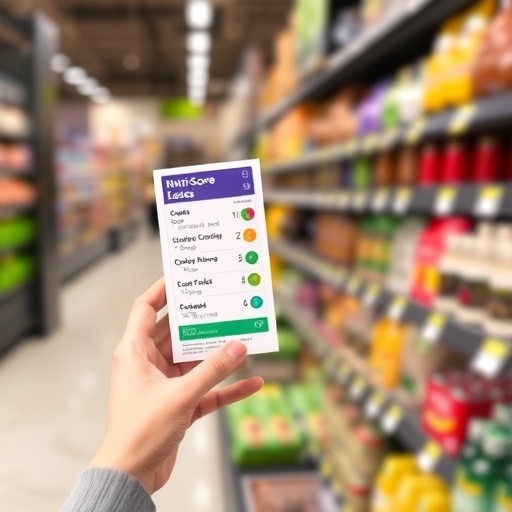
In an age where consumers are inundated by an overwhelming array of choices in grocery stores, the demand for clear, concise, and effective nutritional information has never been higher. The Nutri-Score labeling system, a front-of-pack nutrition label adopted by several European countries, stands as a critical tool designed to simplify health-conscious decisions at the supermarket. This color-coded system ranks foods on a five-level scale, using a traffic light color gradient from dark green (rating A, indicating a highly favorable nutritional profile) to red (rating E, signaling a less favorable nutritional profile). Despite its promising concept, understanding how consumers visually interact with these labels and how it influences their purchasing decisions has remained underexplored until a recent eye-tracking study led by researchers at Göttingen University, in partnership with Osnabrück University of Applied Sciences, the German Institute of Food Technology, and Giessen University.
This pioneering study was motivated by a crucial question: does the color and placement of Nutri-Score labels impact consumer attention and buying behavior? To probe this, the researchers employed eye-tracking technology to monitor the gaze patterns of 199 participants in Germany, creating a controlled supermarket simulation environment. Participants were divided into four distinct groups, each exposed to different label presentations: a fully multi-colored Nutri-Score label on both the product package and shelf price tag, a grayscale label on both, a single multi-colored label only on the package (reflecting current supermarket standards), or no label at all. This meticulous design allowed the team to dissect the nuances of consumer engagement with nutritional labels and their correlation with actual purchase choices.
The data unveiled compelling evidence supporting the superiority of the polychrome, traffic-light colored Nutri-Score labels in capturing consumer attention. Labels rendered in vibrant color garnered significantly longer and more frequent visual fixations compared to their grayscale counterparts. This enhanced visibility on both the front of the package and the shelf price tags not only attracted more eyes but also facilitated quicker recognition of the nutritional information. Such findings underscore the psychological impact of color coding in visual cognition and decision-making, highlighting how sensory cues can efficiently convey complex nutritional data within fractions of a second during grocery shopping.
Interestingly, the study further revealed that consumer behavior was influenced by the specific color ratings viewed. Products bearing a dark green “A” rating or a yellow “C” rating attracted more prolonged and repeated glances, which tended to culminate in the selection of those products. This suggests that positive and moderately favorable nutritional signals effectively promote healthier choices in buying decisions. Conversely, the red “E” rating, which denotes unfavorable nutritional content, did not function as a sufficient deterrent. Even when participants frequently viewed this negative rating, such products were still commonly chosen, indicating that the red color failed to act as the intended warning signal strong enough to override consumer preferences or habits.
These insights hold profound implications for public health policy and retail marketing. Dr. Isabelle Weiß, the lead author from Göttingen University, emphasized that the five-colored Nutri-Score labels are markedly more discernible on price tags than the grayscale versions, thereby enhancing shoppers’ ability to evaluate nutritional quality across a range of products quickly. This increased visibility fosters more informed and health-conscious consumer behavior. Study director Dr. Clara Mehlhose noted the imperative for simple, immediately recognizable nutritional guidance systems in supermarkets, stating that the use of multicolored labeling can facilitate quicker comprehension and, consequently, healthier decision-making.
The methodology employed—using eye-tracking to monitor visual engagement—adds a robust and objective dimension to nutritional labeling research. This technique captures not only where consumers look but also how long, illustrating attentional dynamics that verbal surveys or conventional observational studies might miss. By simulating an authentic shopping environment, the researchers created conditions closely resembling real-world purchasing scenarios, lending ecological validity to their findings. Such innovative research methods could serve as a template for future studies aimed at optimizing consumer information systems in retail contexts beyond food labeling.
Moreover, the findings stress that color coding alone is not enough; the design and placement of labels are pivotal. The dual presence of colored Nutri-Score indicators on both the product packaging and the adjacent shelf price tags proved particularly effective in catching the consumer’s eye. These points of visual contact act synergistically, reinforcing the nutritional message and easing comparative shopping, which is often hampered by limited time and cognitive overload in the aisles.
The study’s revelation concerning the weak deterrent effect of the red “E” rating points towards a need for complementary strategies to curb the purchase of nutritionally poor products. Possible interventions could include enhanced consumer education, stricter marketing regulations on less healthy products, or redesigns of warning labels to increase their psychological impact. Highlighting such gaps underlines that labeling is a powerful tool but still part of a broader behavioral ecosystem requiring multifaceted approaches to shape healthier eating patterns.
Importantly, this research underscores that consumer attention does not automatically equate to informed decision-making. While colorful labels do attract and sustain gaze more effectively, the ultimate purchase behavior depends on complex factors including individual preferences, habits, and external influences such as pricing or brand loyalty. Nonetheless, improving the salience and clarity of nutritional information is a critical first step toward empowering consumers, reducing information asymmetry, and promoting public health.
Given these results, both retailers and policymakers should consider widespread adoption of traffic-light colored Nutri-Score labels across all product packaging and shelf price tags. Enhanced visual communication of nutritional data holds the potential to foster healthier eating habits on a broad scale, aligning commercial practices with public health goals. Encouraging manufacturers to embrace this labeling system could standardize and simplify grocery shopping experiences across different markets.
The study was funded by LI Food, the Landesinitiative Ernährungswirtschaft des Niedersächsischen Ministeriums für Wirtschaft, Verkehr und Bauen, highlighting the importance of regional economic and agricultural initiatives supporting nutritional research. Its publication in the journal Food Quality and Preference further establishes the study’s academic credibility and invites ongoing discourse on optimizing nutritional labeling to combat diet-related health challenges.
In summation, the eye-tracking study conducted by the research teams in Germany illuminates the vital role of color and label placement in dietary decision-making. The polychrome Nutri-Score system, with its intuitive traffic-light scheme, emerges not only as a tool for conveying nutritional quality but as a powerful nudge capable of directing consumer choices toward healthier options. The challenge moving forward lies in leveraging these insights to refine labeling standards, educate consumers, and implement holistic strategies fostering improved nutrition across diverse populations.
News Publication Date:
26-May-2026
Web References:
https://doi.org/10.1016/j.foodqual.2026.105933
Keywords
Public policy; Regulatory policy; Food policy; Food science; Food industry; Nutrition; Nutritional physiology; Foods; Economics research; Marketing; Marketing research
Cite Scienmag News
Daisy Hatcher. (May 26, 2026). Vibrant Nutri-Score Labels Boost Shopper Attention More Than Grey, Study Finds. Scienmag. https://scienmag.com/vibrant-nutri-score-labels-boost-shopper-attention-more-than-grey-study-finds/
Daisy Hatcher. "Vibrant Nutri-Score Labels Boost Shopper Attention More Than Grey, Study Finds." Scienmag, 26 May 2026, https://scienmag.com/vibrant-nutri-score-labels-boost-shopper-attention-more-than-grey-study-finds/. Accessed 6 September 2026.
Daisy Hatcher. "Vibrant Nutri-Score Labels Boost Shopper Attention More Than Grey, Study Finds." Scienmag. May 26, 2026. https://scienmag.com/vibrant-nutri-score-labels-boost-shopper-attention-more-than-grey-study-finds/


