


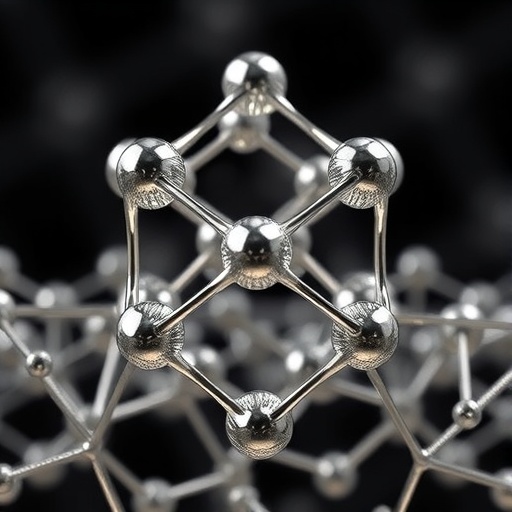
In a groundbreaking advance for quantum technology and materials science, researchers have developed a revolutionary bottom-up synthesis method for creating ultrasmall, uniform nanodiamonds using molecular nanographenes as precursors. These nanodiamonds, measuring merely 3 to 4 nanometers, exhibit exceptional structural and compositional purity, overcoming long-standing challenges associated with traditional synthesis routes. The study, led by Liang, Ender, Forero-Martinez, and colleagues, offers a scalable and chemically precise platform to produce nanodiamonds with bespoke colour centre incorporation — a critical step toward realizing the next generation of quantum sensors, nanoscale imaging devices, and quantum communication units.
Nanodiamonds harboring colour centres have become quintessential building blocks for diverse quantum applications due to their unmatched quantum coherence properties and optical stability. However, the conventional methods for synthesizing these nanodiamonds, often involving top-down approaches like milling or ion implantation, yield non-uniform particles with inconsistent size, morphology, and defect states. These inconsistencies severely limit their integration into microscale devices and quantum architectures, where reproducibility and precision are paramount. The innovative strategy employing hydrogen-terminated molecular nanographenes as chemically confined precursors marks a paradigm shift in nanodiamond engineering.
At the core of this synthesis technique is the high-pressure, high-temperature (HPHT) transformation of well-defined nanographenes into crystalline nanodiamonds. Nanographenes themselves are ultralarge polycyclic aromatic hydrocarbons characterized by a planar sp² carbon network terminated by hydrogen atoms. This molecular precision ensures that during conversion, the carbon atoms remain confined within a chemically defined framework, thereby enabling unparalleled control over the resulting nanodiamond size and surface chemistry. The single sp² surface reconstruction discovered in the product nanodiamonds underscores the synthesis’s ability to yield structurally uniform and highly crystalline materials on a milligram scale—a feat previously deemed unattainable.
This bottom-up synthesis opens a new horizon not only in size control but also in functional tailoring of nanodiamonds. By strategically incorporating silicon- and germanium-containing molecular nanographenes into the precursor mixtures, the researchers achieved simultaneous formation and doping of nanodiamonds with silicon-vacancy (SiV⁻) and germanium-vacancy (GeV⁻) colour centres during the HPHT process. Importantly, this avoids traditional post-synthesis ion implantation or irradiation, techniques that are often detrimental due to induced lattice damage and impurity clustering. Such in-situ insertion of colour centres represents a chemical engineering marvel, potentially enhancing emitter yield and quantum state fidelity.
From a quantum technology perspective, the ability to produce monodisperse, molecularly defined nanodiamonds with embedded colour centres holds profound implications. The ultrasmall size of these particles aligns perfectly with the demands of biological quantum sensing, where minimal invasive markers improve cellular viability and reduce background noise. Furthermore, the coherent spin states associated with SiV⁻ and GeV⁻ centres possess narrow optical linewidths and enhanced photostability, characteristics essential for high-precision nanoscale magnetometry, quantum computation qubits, and single-photon emission sources.
One of the standout features of this methodology is its modularity. Because the molecular nanographene structure determines both the spatial confinement of carbon and the hydrogen content crucial for surface termination, researchers can theoretically design precursor molecules to customize nanodiamond size, shape, and surface electronic properties—from the ground up. This level of molecular design control is unprecedented in nanomaterials synthesis, offering a new toolkit for engineering quantum materials tailored for specific applications, from quantum information processing devices to biomedical imaging probes.
Moreover, this study demonstrates the scalability of the synthesis approach. Producing milligram quantities of structurally consistent and fluorescent nanodiamonds addresses a critical bottleneck in practical quantum device fabrication, where batch-to-batch variability often leads to unreliable results. The reproducibility and upscaling potential hold promise for commercial quantum technologies and widespread deployment in nanoscale sensing.
The implications extend beyond quantum technologies. Nanodiamonds also play a significant role in nanoscale nuclear magnetic resonance (NMR) spectroscopy, leveraging their spin properties to probe chemical environments with atomic resolution. The enhanced crystallinity and uniform size distribution achieved via the nanographene route are expected to improve sensor sensitivity and spectral resolution dramatically. Additionally, their role as single-photon sources suggests potential uses in quantum cryptographic systems requiring high-purity photon streams.
Fundamentally, this research underlines the power of molecular precursors as templates for bottom-up material synthesis. The precise chemical confinement inherent in nanographenes prevents the heterogeneous nucleation and uncontrolled growth that plagued earlier nanodiamond fabrication methods. This not only ensures uniformity in size and shape but also minimizes defects and impurity clustering, thus enhancing quantum coherence times and optical stability of the resulting nanodiamond particles.
The discovery also prompts exciting opportunities for further tuning of colour centre chemistry. Beyond silicon and germanium, the conceptual framework may be extended to other group-IV or transition metal dopants, opening avenues for exploring novel quantum emitters with tailored optical and spin properties. This bottom-up strategy thus provides a versatile platform potentially capable of synthesizing a broad palette of quantum nanomaterials in a highly controlled manner.
Finally, this work exemplifies a significant advance in design-driven quantum materials science, wherein the synergy between chemical precision and high-pressure physics creates a new class of molecular nanodiamonds. By merging the domain knowledge of synthetic organic chemistry with quantum materials technology, researchers have charted a transformative route that may accelerate quantum technology maturation and pave the way for future quantum sensors, imaging agents, and information processors manufactured with molecular-level precision.
As the quantum landscape rapidly evolves, such modular and scalable approaches to nanodiamond fabrication will be instrumental in bridging the gap between laboratory prototypes and real-world quantum devices. The integration of bottom-up molecular design with high-pressure synthesis stands as a beacon for future quantum materials research, promising a new standard for material quality, versatility, and performance with precision control at the atomic scale.
Cite Scienmag News
Denise Maddox. (May 26, 2026). Nanographene Enables Bottom-Up Nanodiamond Synthesis. Scienmag. https://scienmag.com/nanographene-enables-bottom-up-nanodiamond-synthesis/
Denise Maddox. "Nanographene Enables Bottom-Up Nanodiamond Synthesis." Scienmag, 26 May 2026, https://scienmag.com/nanographene-enables-bottom-up-nanodiamond-synthesis/. Accessed 5 September 2026.
Denise Maddox. "Nanographene Enables Bottom-Up Nanodiamond Synthesis." Scienmag. May 26, 2026. https://scienmag.com/nanographene-enables-bottom-up-nanodiamond-synthesis/


