


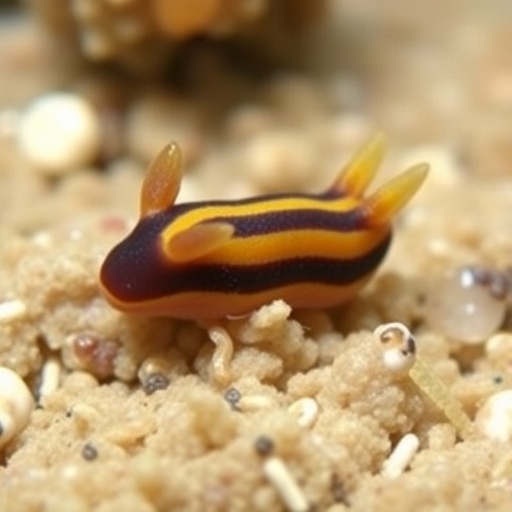
In the precarious coastal waters of Keelung, Taiwan, researchers have identified an extraordinary new species of sea slug, scientifically designated as Thecacera sesama. This diminutive nudibranch, scarcely larger than a grain of rice, is distinguished by its translucent body adorned with striking black and yellow speckles. The discovery, originating from a serendipitous underwater observation during a recreational dive in 2019, has profound implications for marine biodiversity study and highlights the untapped complexity of Taiwan’s marine ecosystems.
The origin of Thecacera sesama‘s nomenclature traces back to a local cultural reference. The species’ moniker derives from the Taiwanese nickname “sesame,” indicative of its minuscule size and sesame seed-like appearance. This fusion of vernacular terminology with scientific classification reflects a growing trend to integrate local ecological knowledge into formal taxonomy, enhancing the relevance and resonance of newly described species within their indigenous context.
Measuring an astonishingly small maximum length of under three millimeters, T. sesama exemplifies one of nature’s more elusive marine invertebrates. Its discovery was facilitated by Ho-Yeung Chan, a graduate student involved in the study. Remarkably, the recognition of this creature as a novel species was not immediate; it was only after consultation with a renowned sea slug specialist, connected through social media channels, that the distinctiveness of T. sesama became evident. This modern approach to scientific collaboration—leveraging digital platforms—demonstrates the evolving nature of taxonomic research in the 21st century.
Fieldwork to understand Thecacera sesama presented formidable logistical challenges attributable to the adverse oceanographic and meteorological conditions endemic to the region. Coastal Taiwan is subject to intense typhoons during summer and robust monsoonal winds in winter, with sea temperatures sometimes plummeting below 16°C. Such harsh environmental parameters restrict viable research dives to a mere four months annually, complicating efforts to observe and document such a fragile species in situ.
Ecologically, T. sesama exhibits noteworthy behavioral specialization. The species’ lifecycle revolves around four primary activities: feeding, searching, reproducing through mating, and oviposition on bryozoans. Bryozoans, commonly referred to as moss animals, constitute colonial filter-feeding invertebrates ubiquitous in marine habitats. Intriguingly, the bryozoan species serving as the substrate and food source for T. sesama may itself represent a previously undocumented taxon, underscoring the interconnectedness and hidden complexity within marine biodiversity.
Molecular phylogenetic analyses underpin the taxonomic classification of Thecacera sesama. By examining sequences from mitochondrial 16S ribosomal DNA and cytochrome c oxidase I (COI) genes, researchers established clear genetic delineations distinguishing T. sesama from other closely related polycerid nudibranchs. These genetic markers are instrumental in contemporary systematics, offering insights into evolutionary relationships that transcend morphological ambiguity often encountered in minuscule and cryptic marine species.
The coloration of Thecacera sesama is more than aesthetic; it potentially serves as a form of aposematic signaling, warning predators of chemical defenses. Bright pigmentation in nudibranchs is frequently correlated with the sequestration of toxins derived from their prey, providing an evolutionary advantage. The vivid black and yellow patterning on T. sesama aligns with this paradigm, suggesting sophisticated ecological interactions between the nudibranch and its environment.
From a marine ecological perspective, nudibranchs such as T. sesama occupy pivotal roles in the trophic web. As both predators of sessile invertebrates and prey for larger fauna, they contribute to the regulation of benthic community dynamics. Their presence and diversity serve as important bioindicators of reef health and ecosystem stability, making discoveries like T. sesama crucial for conservation biology and environmental monitoring efforts.
The revelation of Thecacera sesama is not an isolated event but part of a broader pattern of uncovering hidden marine diversity, particularly in biodiverse yet underexplored regions like Taiwan’s coastal waters. The researchers emphasize that many marine microfauna remain undocumented due to their diminutive size and cryptic habitats. Advancements in molecular techniques and increased exploration may unveil a wealth of previously unknown species, reshaping our understanding of marine biodiversity and biogeography.
This research underscores the importance of interdisciplinary collaboration, combining traditional taxonomy, molecular biology, and citizen science facilitated by digital communication. The integration of amateur divers’ observations and academic expertise exemplifies a model for accelerated species discovery and biodiversity assessment. Through this synergy, new frontiers in marine taxonomy and ecology can be explored more efficiently and inclusively.
The full account of Thecacera sesama‘s discovery and characterization is documented in an open-access article published in ZooKeys on May 11, 2026. The study elucidates detailed morphological descriptions, habitat characterizations, behavioral observations, and rigorous phylogenetic analyses. This publication marks a significant advancement in the understanding of Polyceridae systematics and offers a valuable baseline for future marine biodiversity research in East Asia.
Ultimately, the identification of Thecacera sesama epitomizes the dynamic nature of marine science, wherein even the tiniest organisms elude detection and classification for decades. It celebrates the intersection of chance discovery, cutting-edge science, and local ecological knowledge, contributing vital pieces to the vast puzzle of marine life and inspiring continued exploration beneath the ocean’s surface.
News Publication Date: 11-May-2026
Web References:
- National Taiwan Ocean University
- National Museum of Natural Science
- National Taipei University of Education
- ZooKeys Journal
- Full Research Article with DOI
References: Chan, H.-Y., Lin, H., et al. (2026). Thecacera sesama sp. nov. (Nudibranchia, Polyceridae) from Taiwan, evident from morphology and phylogenetic analyses of the 16S rDNA and cytochrome c oxidase I gene. ZooKeys.
Cite Scienmag News
Drew Townsend. (May 26, 2026). New Tiny Sesame Sea Slug Species Discovered in Northern Taiwan Waters. Scienmag. https://scienmag.com/new-tiny-sesame-sea-slug-species-discovered-in-northern-taiwan-waters/
Drew Townsend. "New Tiny Sesame Sea Slug Species Discovered in Northern Taiwan Waters." Scienmag, 26 May 2026, https://scienmag.com/new-tiny-sesame-sea-slug-species-discovered-in-northern-taiwan-waters/. Accessed 5 September 2026.
Drew Townsend. "New Tiny Sesame Sea Slug Species Discovered in Northern Taiwan Waters." Scienmag. May 26, 2026. https://scienmag.com/new-tiny-sesame-sea-slug-species-discovered-in-northern-taiwan-waters/


