


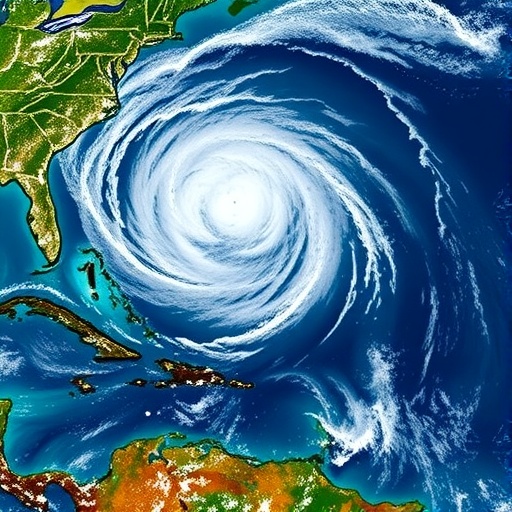
The vast expanse of the world’s oceans plays a critical role in the Earth’s carbon cycle, serving as a major sink for anthropogenic carbon dioxide emissions. It is estimated that oceans absorb between 20 to 30 percent of the CO₂ produced by human activities, acting as a buffer to mitigate the accelerating pace of climate change. However, this carbon exchange across the air-sea interface is anything but static, being influenced by a host of physical, chemical, and biological processes. Among these, intense weather events like tropical cyclones emerge as powerful disruptors of the upper ocean’s carbon dynamics, introducing complexities that scientists are only beginning to unravel.
Recent research, published in Nature Geoscience, addresses this intricate link between tropical cyclones and oceanic carbon fluxes by synthesizing a diverse array of observational data. The study reveals a dualistic influence of tropical cyclones on carbon transfer: during the passage of these intense storms, there is a significant efflux of CO₂ from the ocean to the atmosphere. This release can be attributed to the strong winds and turbulent mixing that enhance gas exchange, effectively pushing stored carbon back into the air. Conversely, after the cyclone has passed, a contrasting phenomenon occurs where the ocean experiences an influx of CO₂, associated primarily with what are known as “cold wakes.”
Cold wakes are created when tropical cyclones churn the upper ocean, mixing colder, carbon-disequilibrated waters from below to the surface. This upwelling introduces waters with higher dissolved CO₂ concentrations into contact with the atmosphere, creating favorable conditions for enhanced carbon uptake by the ocean. Physically, this process is linked to the vertical temperature gradient in the ocean—essentially the temperature difference between surface waters and deeper layers. When this gradient is steep, cold wakes become more pronounced, intensifying the ocean’s post-storm absorption of CO₂.
Despite the CO₂ influx triggered post-cyclone, the study finds that the net effect of tropical cyclones on ocean carbon is one of outgassing. The initial efflux during storm passage outweighs the subsequent influx, meaning that tropical cyclones, on balance, lead to a release of ocean carbon back into the atmosphere. This outcome challenges any simplistic view that intense storms might enhance the ocean’s role as a carbon sink by driving mixing alone.
Notably, this net outgassing has been on the decline over the past three decades. Quantitatively, carbon outgassing induced by tropical cyclones has decreased from approximately 0.09 ± 0.02 petagrams of carbon (PgC) annually in the 1990s down to around 0.05 ± 0.01 PgC annually in the 2010s. These figures, extracted through sophisticated data synthesis and modeling approaches, suggest a substantial shift in the interactions between cyclones and the ocean carbon system over recent decades.
One of the key drivers behind this downward trend appears to be the escalating vertical temperature gradient in the upper ocean, itself a consequence of anthropogenic climate warming. As surface waters warm more rapidly than subsurface layers, the stratification of the ocean strengthens, setting the stage for colder, deeper waters to be brought up more starkly post-cyclone. This enhanced stratification increases the intensity of cold wakes, which in turn boosts the ocean’s capacity to absorb CO₂ after cyclonic events. Ironically, this process counters the earlier dominance of carbon outgassing, pushing the balance toward increased post-storm carbon uptake.
The implications of these findings are profound. If such warming-driven stratification trends continue—and climate models project they will, especially under high greenhouse gas emissions scenarios—the nature of tropical cyclone-induced carbon fluxes may invert altogether. Instead of being a source of atmospheric CO₂, cyclone-driven processes could progressively become a net sink, enhancing the ocean’s ability to sequester anthropogenic carbon. This shift carries broad consequences for our understanding of the global carbon budget and for strategies aimed at climate mitigation.
Moreover, intensified carbon uptake following tropical cyclones would likely amplify localized ocean acidification. Acidification, the reduction in pH driven by higher dissolved CO₂, poses serious threats to marine ecosystems, from coral reefs to plankton populations that form the base of many oceanic food webs. Thus, areas repeatedly affected by cyclones could face escalating acidification pressures, with uncertain ecological ramifications.
This research underscores the complexity and dynamism of Earth’s climate system, where feedback loops between physical climate processes and biogeochemical cycles evolve over time in response to human influences. Tropical cyclones, long regarded primarily as destructive meteorological phenomena, now emerge as influential actors in the regulation of ocean carbon cycling, modulated by the very climate change that alters their frequency and intensity.
Understanding this nuanced interplay demands an integrated approach, blending physical oceanography, atmospheric science, and biogeochemical modeling with extensive observational networks. The study leverages satellite data, in situ ocean measurements, and air-sea flux observations, combined with advanced computational models, to dissect these processes. Such synthesis points the way forward in quantifying the multifaceted roles extreme weather events play in the Earth system.
The findings also bolster the argument for comprehensive climate monitoring and targeted research focused on extreme events. As climate change progresses, it will increasingly shape not only the atmosphere but also the ocean’s behavior as a carbon sink or source. Anticipating these shifts will be essential for refining carbon budgets, improving climate projections, and informing mitigation policies.
In practical terms, these insights may influence how policymakers and scientists interpret the oceans’ capacity to absorb anthropogenic carbon in future scenarios. Whereas the ocean has previously been modeled as a relatively steady carbon sink, emerging evidence from tropical cyclone dynamics suggests a more variable and evolving role subject to changing climate forcings.
Future investigations will need to delve deeper into regional variations, as tropical cyclone patterns vary widely across basins. The interplay between cyclone intensity, frequency, and ocean carbon responses might differ substantially between the Atlantic, Pacific, and Indian Oceans, with local ecological and chemical impacts potentially diverging.
Furthermore, the role of biological feedbacks in these processes warrants closer examination. While this study focuses primarily on physical and chemical mechanisms, biological responses to storm-induced mixing and acidification could either amplify or dampen carbon fluxes. Phytoplankton blooms, microbial respiration rates, and marine food web dynamics might all respond differently under changing storm regimes and ocean conditions.
This pioneering work builds a compelling narrative about how the accelerating pulse of tropical cyclones through a warming planet reshapes not only weather and climate but also the fundamental processes governing global carbon balance. As humanity seeks pathways to curb climate change, recognizing and quantifying the full spectrum of natural and anthropogenic feedback is more vital than ever.
The ocean’s role as an atmospheric carbon moderator is more than a simple container of dissolved gases—it is a complex, responsive system whose interactions with climate extremes like tropical cyclones carry both challenges and unforeseen opportunities for the Earth’s future. By unveiling these intricate linkages, this research underscores the necessity for adaptive climate science that anticipates evolving feedbacks, informing global strategies to mitigate and manage the cascading effects of climate change worldwide.
Cite Scienmag News
Violet Maxwell. (May 25, 2026). Tropical Cyclone Impact on Ocean Carbon Outgassing Declines. Scienmag. https://scienmag.com/tropical-cyclone-impact-on-ocean-carbon-outgassing-declines/
Violet Maxwell. "Tropical Cyclone Impact on Ocean Carbon Outgassing Declines." Scienmag, 25 May 2026, https://scienmag.com/tropical-cyclone-impact-on-ocean-carbon-outgassing-declines/. Accessed 3 September 2026.
Violet Maxwell. "Tropical Cyclone Impact on Ocean Carbon Outgassing Declines." Scienmag. May 25, 2026. https://scienmag.com/tropical-cyclone-impact-on-ocean-carbon-outgassing-declines/


