


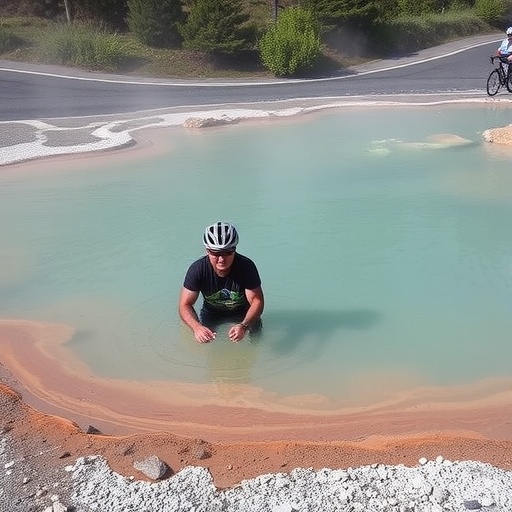
In a groundbreaking study published in Communications Earth & Environment, researchers Slagter, Myers, Guido, and their colleagues have unveiled compelling evidence of arsenic-cycling metabolic processes preserved within hot spring silica deposits. This discovery not only shifts paradigms in our understanding of biogeochemical cycles involving arsenic but also illuminates potential avenues for exploring early microbial life on Earth and possibly other planetary bodies.
Arsenic, a ubiquitous metalloid known primarily for its toxicity, has recently been recognized for its role in certain metabolic pathways. Microorganisms capable of utilizing arsenic in respiration or energy metabolism challenge traditional notions centered on elements such as carbon, nitrogen, and sulfur. The newly discovered metabolic imprints in silica sinter deposits formed in hydrothermal systems extend this understanding deep into geologic time, offering a rare window into ancient microbial ecology.
Hot spring environments are characterized by high temperatures and rich chemical gradients, conditions that foster diverse microbial life. Silica precipitation occurs as these waters cool, encapsulating biological and chemical signatures in a sort of natural archive. Analysis of these silica deposits has enabled the research team to detect molecular and isotopic markers that bear the unmistakable imprint of arsenic-mediated metabolic activity.
The study utilized advanced spectroscopic and microscopic techniques to probe the mineralogical and chemical composition of the silica sinters. Organic molecules associated with arsenic metabolism, including arsenite oxidase enzymes and related biomolecules, were identified with a precision that confirms biological origin. Isotopic fractionation of arsenic also provided clues to metabolic cycling, which is distinct from purely abiotic chemical processes.
Biogeochemical cycling of arsenic involves microbes that can either oxidize arsenite (As(III)) to arsenate (As(V)) or reduce arsenate to arsenite. These redox reactions are energetically favorable under specific environmental conditions and allow microbes to harness energy for growth. The hot spring silica deposits encapsulated evidence of both oxidation and reduction phases, indicating a dynamic arsenic metabolic ecosystem.
This metabolic versatility is significant because it suggests that early lifeforms adapted to arsenic-laden environments by exploiting arsenic redox reactions. This aligns with hypotheses that arsenic played a crucial role in the evolution of early metabolisms in anoxic or low-oxygen environments where traditional electron acceptors were scarce. Such insights may recalibrate models of early Earth habitability and the evolutionary pathways available to primordial microbes.
Moreover, the geochemical context of silica sinter deposits aligns well with astrobiological interests. Silica-rich deposits have been identified on Mars, prompting speculation that similar metabolic processes could have once existed on the red planet if life ever arose there. The study’s findings thus resonate beyond terrestrial biology, stimulating interdisciplinary discussions within planetary science and the search for extraterrestrial life.
The team’s findings emerged from extensive field sampling of hydrothermal hot springs in geologically active regions. By methodically correlating microbial community analyses with geochemical measurements and mineralogy, they constructed a comprehensive portrait of arsenic cycling preserved in silica matrices. The robustness of this approach rests on integrating biology, chemistry, and geology—a testament to the necessity of multidisciplinary efforts in uncovering Earth’s ancient biosignatures.
In the lab, cutting-edge analytical instruments such as synchrotron-based X-ray absorption spectroscopy allowed the researchers to characterize arsenic speciation within the silica deposits at microscopic scales. This precision revealed heterogeneity in arsenic oxidation states tightly linked to fossilized microbial structures, reinforcing the conclusion that these signals represent past metabolic activity rather than post-depositional alteration.
These discoveries also illuminate the complex interplay between microbial communities and their inorganic environment in shaping mineral deposits. The metabolic transformations of arsenic by microbes alter local geochemistry in ways that influence silica precipitation kinetics and morphology, thereby recording biological activity in exquisite detail. Understanding this feedback loop adds another dimension to interpreting ancient mineralogical records.
The implications of this research extend into environmental sciences as well. Arsenic contamination remains a global health concern, particularly in groundwater systems. Insights from natural microbial arsenic cycling pathways offer potential bioremediation strategies that harness or mimic these processes. By studying ancient metabolisms preserved in silica, scientists gain perspectives on the resilience and evolution of arsenic-utilizing microbes that might inspire novel approaches to detoxification.
Furthermore, the study challenges the established paradigm that largely considers arsenic solely as a toxin. It reinforces a nuanced view wherein arsenic acts as both a hazard and a vital element in microbial energy circuits. This duality underscores the evolutionary ingenuity of life in exploiting diverse chemical resources in its environment, shaping Earth’s surface chemistry and biosphere over billions of years.
The researchers emphasize that interpreting biosignatures in mineral deposits requires careful discrimination between biotic and abiotic contributions. Their integrated analytical framework sets a new standard for identifying authentic metabolic relics in geologic materials. As such, this work promises to inform future studies targeting biosignatures not just on Earth but in extraterrestrial contexts where direct biological sampling remains challenging.
This pivotal discovery also invites scientists to revisit other silica-rich deposits worldwide with renewed scrutiny. Geological formations once dismissed as inert records might harbor untapped biological archives of critical evolutionary events. By expanding the catalog of metabolic pathways preserved in the rock record, researchers can reconstruct a more complete narrative of life’s ancient innovations and environmental interactions.
The study illustrates the power of modern analytical techniques combined with conceptual advances in geomicrobiology. It bridges scales from molecular biology to planetary geology, demonstrating how life modifies and is recorded by its physical surroundings. These insights deepen our appreciation for the complexity and diversity of metabolic strategies life employs to survive and thrive in extreme environments.
Ultimately, the identification of arsenic-cycling metabolism in hot spring silica deposits represents a frontier in understanding Earth’s deep-time biosphere. It solidifies arsenic’s status as a critical element in biogeochemical cycles and opens exciting new research pathways in microbial ecology, Earth history, and astrobiology. The resonant impact of this study promises to invigorate scientific discourse and inspire future explorations into the origins and boundaries of life itself.
Cite Scienmag News
Daisy Hatcher. (May 22, 2026). Arsenic Cycling Metabolism Found in Hot Spring Silica. Scienmag. https://scienmag.com/arsenic-cycling-metabolism-found-in-hot-spring-silica/
Daisy Hatcher. "Arsenic Cycling Metabolism Found in Hot Spring Silica." Scienmag, 22 May 2026, https://scienmag.com/arsenic-cycling-metabolism-found-in-hot-spring-silica/. Accessed 3 September 2026.
Daisy Hatcher. "Arsenic Cycling Metabolism Found in Hot Spring Silica." Scienmag. May 22, 2026. https://scienmag.com/arsenic-cycling-metabolism-found-in-hot-spring-silica/


