


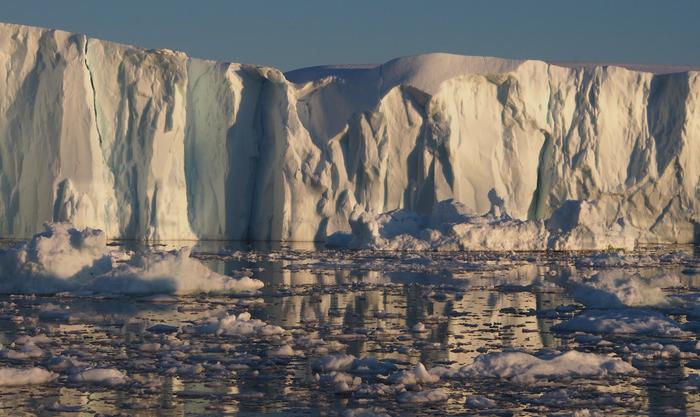
The University of Texas at Austin has embarked on a mission to explore the underwater edges of Greenland’s coastal glaciers to learn more about future sea level rise.

Credit: European Space Agency
The University of Texas at Austin has embarked on a mission to explore the underwater edges of Greenland’s coastal glaciers to learn more about future sea level rise.
The four-week expedition conducted with international partners will investigate processes that control how these giant glaciers melt and what that means for the future of the Greenland ice sheet, which has about 23 feet (7 meters) of potential sea level rise locked away in its ice.
Joining the researchers is a robotic submersible that will gather measurements of the glaciers’ underwater walls and sediment-laden meltwater, a feat that’s never been attempted up close. The scientists will also conduct extensive surveys of the seafloor and gather sediment cores that will let them wind back the clock to see how past periods of climate change affected glaciers.
A key research question is the role of sediments in slowing glacial melt, said the expedition’s chief scientist Ginny Catania, a research professor at the University of Texas Institute for Geophysics (UTIG) and UT’s Department of Earth and Planetary Sciences. UTIG is leading the expedition and is part of the UT Jackson School of Geosciences.
“Most of the ice sheet has retreated, but there are a few glaciers that have not retreated next to glaciers that have retreated a lot. And it could be because sediments are stabilizing the glaciers,” Catania said.
The researchers think that the glaciers are protected from warm ocean currents by underwater walls, called moraines, that pile up from sediment carried from beneath the glacier itself. These buttressing walls also form when glaciers advance, bulldozing the seafloor ahead of them.
But how effective are they at slowing melt, how quickly do they form, and how long do they persist? Answering those questions should give scientists a much better idea of the future of the ice sheet both in Greenland and Antarctica, where sediment may also play a role in stabilizing glaciers. These answers, in turn, can help with predicting how quickly sea level will rise in the coming years.
“This is a big mission to try to capture as much information about how the glaciers behave underwater with these really sophisticated tools that we haven’t been able to use in the past,” Catania said.
The robotic submersible Nereid Under Ice (NUI) is key to collecting the data that can answer these questions. NUI was developed and is operated by engineers at the Woods Hole Oceanographic Institution, who are on board for the mission. It is specially designed to navigate the treacherous, icy environment of the glacial fjord, where it will use its sensors and samplers to measure sediments flowing out from under the ice and to conduct unprecedented, up-close geophysical surveys of the ice and seafloor.
Similar measurements will be made by an XOcean sea surface drone and larger instruments aboard the expedition’s vessel, the Marine Institute of Ireland’s RV Celtic Explorer. Researchers will also gather data from the glaciers’ surface using aerial drones.
What the expedition reveals about future sea level rise will be vital for coastal communities around the world, said Catania, who also leads a Texas coastal research effort.
“A lot of the research needs to be in understanding how the coast is going to respond to this inundation and what governments can do about it,” she said.
Catania’s expedition team is made up of 24 researchers, engineers and students from seven institutions, including UT, Woods Hole, University of Florida, Oregon State University, Rutgers University, Tufts University and Aarhus University, Denmark. They’re supported by the Celtic Explorer’s 15-strong crew.
The expedition, which was first announced in 2022, is funded by the Keck Foundation and the National Science Foundation.
More information about the expedition’s science goals and personnel can be found at the project’s expedition website.
Mission updates including a photo gallery are available ig.utexas.edu/greenland-blog and on social media under the handle @utgeophysics.
Method of Research
Observational study
Subject of Research
Not applicable
Cite Scienmag News
Violet Maxwell. (July 31, 2024). Scientists set sail to study Greenland glaciers from underwater. Scienmag. https://scienmag.com/scientists-set-sail-to-study-greenland-glaciers-from-underwater/
Violet Maxwell. "Scientists set sail to study Greenland glaciers from underwater." Scienmag, 31 July 2024, https://scienmag.com/scientists-set-sail-to-study-greenland-glaciers-from-underwater/. Accessed 4 September 2026.
Violet Maxwell. "Scientists set sail to study Greenland glaciers from underwater." Scienmag. July 31, 2024. https://scienmag.com/scientists-set-sail-to-study-greenland-glaciers-from-underwater/

