


A groundbreaking advancement has emerged from a collaborative research team led by Professors Hyung Mo Jeong and Ji Hoon Lee, hailing respectively from Sungkyunkwan University and Kyungpook National University. This joint effort has culminated in the development of an exceptionally efficient, non-precious metal catalyst for water splitting. The core innovation lies in the precise atomic-level control of chemical bond spacing, which enables the typically inert lattice oxygen atoms deep within the catalyst structure to actively participate in the oxygen evolution reaction (OER).
Water electrolysis represents a pivotal technology for generating hydrogen fuel without emitting greenhouse gases, positioning it at the forefront of carbon-neutral energy solutions. While the concept is promising, the practical implementation faces a significant hurdle: the oxygen evolution reaction progresses at a sluggish pace, limiting the overall efficiency of water splitting. Traditionally, researchers have turned to noble metals like iridium and ruthenium to catalyze this reaction efficiently. However, the scarcity and high cost of these precious metals impede the scalability and economic viability of water electrolysis as a widespread green energy solution.
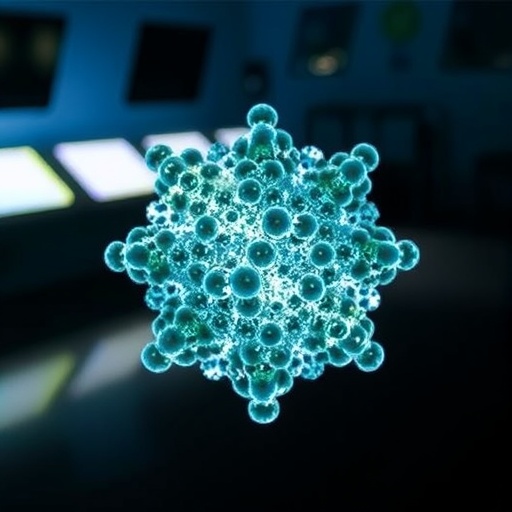
To address these challenges, the research team adopted a novel “top-down materials design strategy.” This method involves precise electrochemical fragmentation of bulk cobalt oxide into ultra-fine nanoclusters under 2 nanometers in size. This dramatic reduction in scale allowed for atomic-level manipulation of the crucial interaction between cobalt metal atoms and oxygen atoms, specifically contracting the chemical bond length by about 0.1 angstroms—a seemingly minuscule alteration with profound implications.
The adjustment of the cobalt-oxygen bond distance to an engineered length of 2.03 angstroms was rigorously confirmed using cutting-edge structural analysis techniques at the Pohang Accelerator Laboratory. Their analysis revealed that this precise bond length is optimal for unlocking a previously unexploited reaction mechanism leveraging lattice oxygen. This is a transformative insight because lattice oxygen ordinarily remains chemically dormant within the catalyst matrix, manifesting negligible reactivity under conventional conditions.
By strengthening the metal-oxygen interaction, the researchers successfully coerced the lattice oxygen atoms into direct involvement in the catalytic process. This mechanistic shift facilitates an accelerated oxygen evolution reaction pathway, dramatically enhancing the catalyst’s functional performance. Remarkably, the newly developed cobalt oxide nanocatalyst operates at energy levels lower than those required by commercial iridium catalysts, a milestone that challenges the prevailing assumption that precious metals are indispensable for efficient OER catalysis.
Beyond catalytic activity, durability and stability are critical parameters for practical applications. Testing under high current density conditions demonstrated that this catalyst maintains operational stability beyond 100 continuous hours without degradation. Such robust longevity under rigorous electrochemical stress attests to the material’s readiness for real-world deployment. In addition, the catalyst showcased excellent charging stability when integrated into prototype zinc-air battery systems, attesting to its versatility across multiple next-generation energy technologies.
Professor Hyung Mo Jeong emphasized the significance of achieving atomic-level control over bond distances, highlighting that such precise tuning can fundamentally alter catalytic reaction pathways rather than solely serving as a replacement for precious metals. He underscored that this work establishes a vital scientific benchmark for advancing eco-friendly energy devices, accelerating the drive to commercialize affordable green hydrogen technologies worldwide.
The implications of this research extend far beyond water splitting. By engineering materials at the nanoscale to harness lattice oxygen participation, new avenues open for designing revolutionary catalysts tailored for a broad spectrum of energy and environmental applications. This lattice oxygen mechanism challenges existing paradigms in catalysis science and provides a novel toolkit for enhancing reaction kinetics and lowering activation energy barriers efficiently.
The research was supported by the Ministry of Science and ICT along with the National Research Foundation of Korea, signaling strong institutional backing for innovative clean energy solutions. The full study was published in “Applied Catalysis B: Environment and Energy,” an esteemed international journal specializing in environmental and energy materials, ensuring wide dissemination among experts and stakeholders eager to adopt breakthrough advancements.
This pioneering work not only offers an economically feasible alternative to precious metal catalysts but also paves the way for sustainable hydrogen production that meets the global climate targets. By capitalizing on atomic-scale engineering and the untapped reactivity of lattice oxygen, this technology redefines the frontier of catalysis with immediate implications for broadening the accessibility of green energy infrastructures.
Future research inspired by these findings is expected to delve deeper into the interplay of nanocluster size, bond contraction, and electronic structure to further tailor catalytic performance across a wider range of oxide materials. Such endeavors will contribute to charting a more sustainable and resilient energy future by enabling scalable, cost-effective hydrogen fuel production.
In summation, the demonstration of chemical bond contraction inducing an active lattice oxygen mechanism during the oxygen evolution reaction signifies a paradigm shift in catalysis science. This breakthrough heralds a new era of materials designed at atomic precision to unlock hidden reactive species and maximize energy efficiency, propelling the global transition towards a clean hydrogen economy.
Web References:
Keywords
Water Electrolysis, Oxygen Evolution Reaction, Lattice Oxygen Mechanism, Cobalt Oxide Nanoclusters, Chemical Bond Contraction, Non-Precious Metal Catalysts, Green Hydrogen Production, Nanomaterials, Electrochemical Catalysis, Atomic-Scale Engineering, Energy Materials, Zinc-Air Batteries
Cite Scienmag News
Bethany Barker. (May 21, 2026). SKKU Research Team Unveils “Hidden Oxygen” Mechanism to Develop Next-Generation Green Hydrogen Catalyst. Scienmag. https://scienmag.com/skku-research-team-unveils-hidden-oxygen-mechanism-to-develop-next-generation-green-hydrogen-catalyst/
Bethany Barker. "SKKU Research Team Unveils “Hidden Oxygen” Mechanism to Develop Next-Generation Green Hydrogen Catalyst." Scienmag, 21 May 2026, https://scienmag.com/skku-research-team-unveils-hidden-oxygen-mechanism-to-develop-next-generation-green-hydrogen-catalyst/. Accessed 4 September 2026.
Bethany Barker. "SKKU Research Team Unveils “Hidden Oxygen” Mechanism to Develop Next-Generation Green Hydrogen Catalyst." Scienmag. May 21, 2026. https://scienmag.com/skku-research-team-unveils-hidden-oxygen-mechanism-to-develop-next-generation-green-hydrogen-catalyst/


