


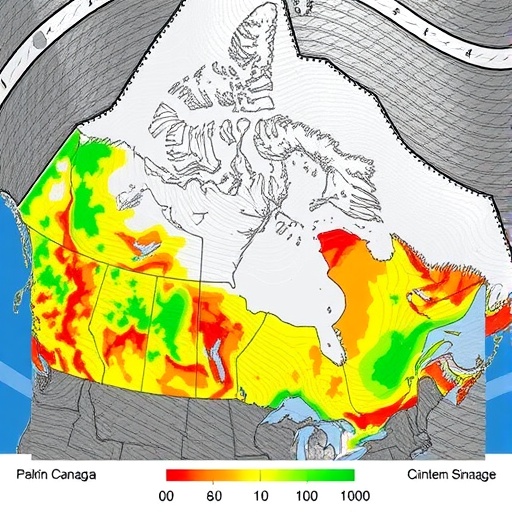
New research from Canada has unveiled a hidden and persistent environmental footprint caused by methane leakage from old, abandoned oil and gas wells. This groundbreaking study challenges the conventional approach of relying solely on surface methane measurements, revealing that emissions from legacy wells are more extensive and enduring beneath the ground than previously understood. By applying a multi-disciplinary investigative framework, scientists have illuminated how these ghost wells continue to contribute to greenhouse gas emissions and environmental damage, posing challenges for regulators and environmental risk managers worldwide.
At the core of this innovative study is a legacy petroleum well in British Columbia, Canada, where researchers conducted repeated methane flux surveys on the surface. These surveys documented methane emissions that were spatially localized and temporally variable, appearing as patchy surface releases of gas that might easily escape detection in routine monitoring efforts. Yet, the story beneath the surface was far more complex. Using shallow geophysical measurements alongside detailed soil geochemical analyses, the team was able to detect a more expansive subsurface anomaly, indicative of ongoing methane migration and contamination spreading through the surrounding soils.
This dual-scale investigative approach has provided what the authors describe as the first direct field evidence that emissions from legacy petroleum wells form a nested footprint, visible both at the surface and deeper underground. Surface methane readings alone, they argue, provide an incomplete and potentially misleading assessment of the scale and persistence of leakage. The subsurface electrical anomalies and broader chemical signatures in soils reveal an extensive environmental footprint that standard surface monitoring fails to capture.
Canada presents an especially urgent context for this research, given its vast number of inactive, orphaned, and abandoned oil and gas wells. Many of these wells have not been adequately assessed or remediated, leading to growing concern about their role as ongoing sources of methane emissions—a potent greenhouse gas with significant implications for climate change. This study highlights the critical need for more comprehensive monitoring protocols that integrate surface, subsurface, and soil assessments for a more accurate and holistic picture.
Published in the renowned journal Geophysical Research Letters, the methodology of the study involved repeated field campaigns combining advanced methane and carbon dioxide flux measurements with geophysical surveys sensitive to subsurface electrical resistivity changes. These geophysical data, when paired with soil chemical data, identified anomalous zones consistent with persistent hydrocarbon leakage pathways, elucidating how methane migrates through the subsurface environment rather than simply releasing at prominent surface points.
Dr. Aaron Cahill, Associate Professor of Applied Geoscience and Environmental Risk at Heriot-Watt University and lead author on the paper, explained that legacy wells are often deceptive when it comes to surface gas measurements. Methane emissions at the surface can be patchy, variable over time, and influenced by local soil microbial activity which can consume or alter methane concentrations. However, beneath the surface, persistent leakage leaves a broader and more enduring environmental impact that requires integration of multiple investigative techniques for detection and interpretation.
The researchers emphasize that understanding this nested leakage footprint is vital for policymakers, regulators, and companies attempting to identify wells that pose ongoing environmental liabilities. Conventional surveys that rely solely on surface methane flux measurements risk underestimating the true extent and environmental impact of these legacy wells. The study suggests that coupling surface gas surveys with geophysical imaging and soil geochemistry may become the new standard in well monitoring and risk assessment protocols.
Beyond legacy wells, these findings carry significant implications for other industries where gas leakage and containment is a concern, particularly in carbon capture and storage (CCS). CCS projects rely on permanently sequestering CO2 underground, and detecting subtle leakage pathways before they manifest as surface emissions is critical for verifying the integrity of storage sites over time. The science developed from legacy well research could enhance monitoring strategies to better ensure long-term containment.
This research represents a leap forward in both conceptual understanding and practical approach to methane emissions from abandoned wells. The multi-scale geophysical and geochemical toolkit developed offers a powerful template for comprehensive environmental assessment, advocating for an interdisciplinary synthesis to tackle the complex challenge of methane leakage in aging petroleum infrastructure.
Methane’s potency as a greenhouse gas—approximately 80 times more impactful than carbon dioxide over a 20-year period—makes the findings of this study all the more urgent from a climate perspective. Legacy wells that leak even small amounts of methane continuously over many years act as a hidden but significant source of climate-warming emissions. Improved detection and characterization protocols will be essential for national emissions inventories and international climate commitments.
In a broader context, the persistence of methane leakage from old wells serves as a stark reminder of the long-term environmental consequences of fossil fuel infrastructure. Even after economic production ends, these wells can continue to compromise environmental and public safety for decades or longer. Recognizing and addressing this legacy is a critical piece in the global energy and climate transition puzzle.
As the research community digests these new findings, the message is clear: to safeguard environmental health and accurately track methane emissions, we must look beyond the surface. Integrative approaches that combine advanced geophysical techniques and soil chemistry with traditional gas flux measurements are indispensable for revealing the hidden footprints of legacy oil and gas wells worldwide.
Cite Scienmag News
Violet Maxwell. (May 20, 2026). New Canadian Field Data Reveals Hidden Leakage Signatures from Old Wells. Scienmag. https://scienmag.com/new-canadian-field-data-reveals-hidden-leakage-signatures-from-old-wells/
Violet Maxwell. "New Canadian Field Data Reveals Hidden Leakage Signatures from Old Wells." Scienmag, 20 May 2026, https://scienmag.com/new-canadian-field-data-reveals-hidden-leakage-signatures-from-old-wells/. Accessed 5 September 2026.
Violet Maxwell. "New Canadian Field Data Reveals Hidden Leakage Signatures from Old Wells." Scienmag. May 20, 2026. https://scienmag.com/new-canadian-field-data-reveals-hidden-leakage-signatures-from-old-wells/


