


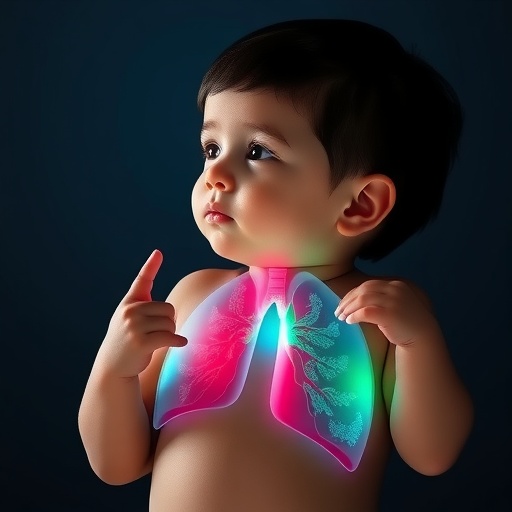
In the realm of pediatric respiratory diseases, necrotizing pneumonia (NP) stands out as a particularly severe and complex condition. Recently, a groundbreaking study led by Ding, Hou, Sun, and colleagues has shed new light on the management of NP, particularly focusing on the utilization of multiple bronchoalveolar lavages (BALs) as a therapeutic intervention. Through a rigorous and innovative approach involving LASSO regression, this research aims to uncover the risk factors that predispose children with NP to require repeated BAL procedures, offering a predictive model that could revolutionize clinical decision-making.
Necrotizing pneumonia, characterized by progressive lung tissue necrosis and cavitation, often leads to prolonged illness and complicated treatment courses in pediatric patients. Bronchoalveolar lavage, an invasive but critical procedure involving the washing of lung segments to remove debris and infectious agents, has been deployed as a key therapeutic and diagnostic tool. However, the decision matrix behind performing multiple BALs remains poorly defined, with significant implications for patient outcomes, healthcare resource allocation, and procedural risks.
The research team employed the Least Absolute Shrinkage and Selection Operator (LASSO) regression technique, a sophisticated statistical tool designed to enhance the accuracy of predictive models by selecting the most relevant variables while penalizing less significant ones. This methodology is particularly well-suited to clinical data sets that include numerous potential predictors, enabling the distillation of complex interactions into actionable insights. By applying LASSO regression, the study effectively navigated the multifactorial landscape of NP, identifying risk profiles with unprecedented precision.
One of the key findings of this investigation is the delineation of clinical and laboratory parameters significantly associated with the likelihood of undergoing multiple BALs. Variables such as initial inflammatory markers, extent of lung damage seen on imaging, and the presence of specific microbiological pathogens were integral to the risk stratification model. Highlighting these factors not only aids in understanding disease progression but also assists clinicians in anticipating the therapeutic course, potentially leading to earlier intervention strategies.
Importantly, the study’s predictive model does not merely catalog risk factors but translates them into a practical tool. By integrating patient data upon hospital admission, healthcare providers can utilize the model to estimate the probability of requiring multiple BALs, enabling more personalized care plans. This anticipatory guidance may reduce the incidence of delayed treatments, decrease hospital stays, and improve overall prognoses for pediatric patients battling NP.
It is also worth noting that the predictive capacity of the model was validated with a separate cohort, reinforcing its robustness and generalizability. This validation process underscores the potential for broad clinical adoption and prompts further research into refining prediction tools for other complicated infectious diseases beyond NP.
The implications of these findings extend beyond the immediate clinical setting. From a healthcare systems perspective, understanding and predicting the need for multiple BALs in NP patients can optimize resource utilization. Bronchoscopy suites, often limited in capacity, can be better scheduled and managed, mitigating procedural backlogs. Moreover, risk stratification could guide the allocation of intensive care resources, ultimately improving cost-effectiveness while maintaining high standards of care.
Technologically, this study exemplifies the integration of advanced biostatistical methods into front-line medical research. LASSO regression, once primarily a tool for machine learning and data science, is now proving indispensable in transforming voluminous clinical data into models that can meaningfully influence patient management. This convergence of computational techniques and clinical insight represents a paradigm shift in pediatric infectious disease research.
The study also raises important considerations about the biological underpinnings of necrotizing pneumonia. The association of specific laboratory markers and pathogen profiles with repeated BAL procedures provides clues into the pathogenetic mechanisms driving disease severity and recovery. Such insights may eventually inform targeted therapies that could reduce the dependency on invasive procedures like BAL.
Ethically, minimizing the number of invasive procedures children endure is a critical goal. Repeated BALs, while beneficial, carry inherent risks including anesthesia complications and procedural trauma. A predictive model allows clinicians to balance these risks more effectively against clinical benefits, striving toward minimally invasive but maximally effective therapeutic strategies.
Furthermore, this research paves the way for longitudinal studies that track long-term outcomes in children undergoing multiple BALs. Understanding how early identification of risk factors impacts recovery trajectories, lung function, and quality of life will be essential in fully realizing the benefits of predictive modeling in pediatric pulmonology.
As this model gets integrated into clinical practice, it will be pivotal to develop user-friendly interfaces and training programs to ensure its effective utilization by healthcare teams worldwide. Accessibility and ease of integration into existing electronic health record systems will determine the real-world impact of this innovative tool.
In conclusion, Ding and colleagues’ study represents a significant advancement in pediatric respiratory medicine by bridging sophisticated statistical analysis with pragmatic clinical challenges. Their risk prediction model for multiple bronchoalveolar lavages in children with necrotizing pneumonia not only enhances our understanding of disease complexity but also provides a tangible framework for improving patient care. This work exemplifies how data-driven insights can lead to safer, more efficient, and more personalized medical interventions.
Looking ahead, the integration of artificial intelligence and machine learning algorithms may further refine such predictive models, incorporating genomic, proteomic, and real-time clinical data. This multidimensional approach holds promise for transforming the landscape of pediatric critical care and infectious disease, spearheading a future where prediction and prevention supersede reaction.
The research community eagerly anticipates subsequent studies deploying this model in diverse populations and healthcare settings, validating its efficacy and uncovering additional predictors. Such efforts are vital as global health systems increasingly grapple with severe pediatric infections and the imperative to optimize limited healthcare resources responsibly.
The ongoing convergence of technological innovation and clinical expertise, as evidenced by this study, heralds a new era in neonatal and pediatric care—one where precision medicine is not just a theoretical ideal but a practical reality improving outcomes for the most vulnerable patients.
Cite Scienmag News
Denise Maddox. (May 20, 2026). Risk Model Predicts Multiple Lung Lavages in Children. Scienmag. https://scienmag.com/risk-model-predicts-multiple-lung-lavages-in-children/
Denise Maddox. "Risk Model Predicts Multiple Lung Lavages in Children." Scienmag, 20 May 2026, https://scienmag.com/risk-model-predicts-multiple-lung-lavages-in-children/. Accessed 3 September 2026.
Denise Maddox. "Risk Model Predicts Multiple Lung Lavages in Children." Scienmag. May 20, 2026. https://scienmag.com/risk-model-predicts-multiple-lung-lavages-in-children/


