


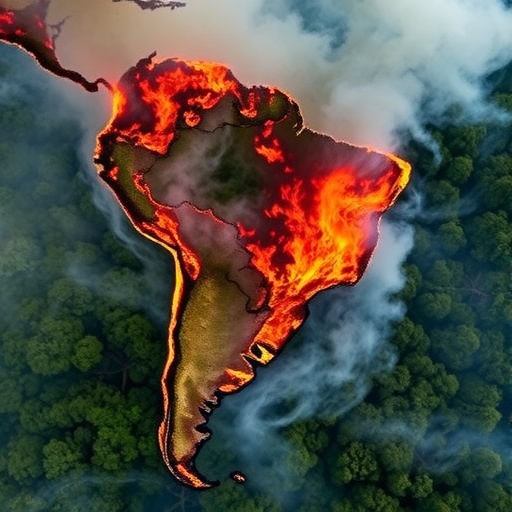
In a groundbreaking study published in Nature Geoscience, researchers have unveiled the prolonged and intensified impacts of deforestation and fire on evapotranspiration dynamics across the vast and ecologically critical biomes of tropical South America. This research combines high-resolution, data-constrained hydrological modeling to dissect the synergistic effects of anthropogenic disturbances and climate-driven droughts on the water and energy exchanges that underpin ecosystem functionality from 2003 to 2020.
Evapotranspiration, the combined process of water evaporation from soil and plant transpiration, plays a central role in modulating local and regional climates by regulating water availability, energy fluxes, and carbon cycling. In the expansive Amazon basin and its adjoining biomes, these fluxes are delicately balanced, largely driven by the dense canopy of deep-rooted tropical trees that efficiently recycle moisture back into the atmosphere. However, decades of deforestation and increasing fire incidences have chipped away at this natural moisture recycling mechanism, with serious implications for ecosystem resilience and climate feedbacks.
The study sharply delineates the longevity of evapotranspiration declines induced by deforestation, revealing they persist 21 to 22 percent longer than reductions caused by fires or droughts when these occur independently. These prolonged effects signal a worrying degradation in the forest’s ability to restore its hydrological function post-disturbance. This finding points to the enduring scars left by human land-use change, which may hamper the Amazon’s capacity to regulate its own microclimate and maintain moisture transport to downwind regions, exacerbating drought severity.
More alarmingly, when deforestation, fires, and drought events co-occur, their combined impact on evapotranspiration loss is not merely additive but synergistic, intensifying the reductions by 36 percent and extending their persistence by 66 percent beyond the duration of average individual disturbances. This compounded stress scenario disrupts established seasonal water flux patterns and can precipitate shifts in biome stability, leading to cascading effects on regional biodiversity and carbon storage.
The spatial heterogeneity of these processes is starkly evident when zooming out to include the diverse array of South American biomes beyond the Amazon rainforest. The study highlights that grasslands and savannas within the Cerrado biome are particularly vulnerable to extended drought periods, with evapotranspiration recovery often stretching beyond seven years. The slow recuperation period suggests that these ecosystems might be on the brink of functional tipping points, from which recovery may be increasingly untenable under future climate scenarios.
In contrast, the Pantanal wetlands display a remarkable resilience attributed to their sustained moisture availability. This hydrological buffering enables rapid recovery of evapotranspiration fluxes following drought episodes, underscoring the critical role of landscape hydrology in determining ecosystem response trajectories. Such biome-dependent differences underscore the necessity of targeted conservation and restoration strategies that recognize the unique hydrological and climatic sensitivities of each biome.
From a biogeochemical standpoint, the study brings to light the paradox of vegetation productivity trends within these stressed ecosystems. Despite observed “greening” trends, presumably from increased leaf area or altered species composition, actual vegetation productivity declines under conditions of compounded stress. This decoupling suggests shifts in species composition towards less productive, drought-tolerant species or physiological limitations imposed by restricted water availability, challenging assumptions that greening necessarily equates to ecosystem health or carbon sequestration capability.
The implications of these findings extend beyond biophysical fluxes to the broader resilience and ecological stability of South American tropical ecosystems. Recurrent disturbances from human activity erode the system’s capacity to recover from climatic extremes, setting a trajectory toward reduced biodiversity, altered habitat structures, and diminished ecosystem services critical to both local livelihoods and global climate regulation.
Methodologically, the integration of high-resolution, data-constrained hydrological modeling with field observations represents a significant advance, allowing researchers to parse out the nuanced temporal and spatial scales over which human disturbances and droughts affect evapotranspiration. This robust approach facilitates more accurate attribution of anthropogenic impacts versus natural climatic variations, critical for designing effective land management policies.
One of the most crucial insights from the study is the identification of evapotranspiration as a sensitive indicator and mediator of land–atmosphere coupling that is vulnerable to human impacts. Maintaining this coupling is essential for sustaining regional rainfall regimes, particularly in the Amazon where recycled moisture supports vast rainforests and agricultural productivity downstream. Disruption in this feedback loop due to deforestation and fire could precipitate a feedback cascade leading to forest dieback and regional drying.
The study’s findings arrive at a time of increasing global concern over tropical forest loss and its ramifications on climate change mitigation efforts. While fire and drought are natural elements within many tropical systems, their heightened frequency and severity under anthropogenic warming, coupled with human land-use pressures, create a precarious scenario for ecosystem persistence. The pronounced and enduring impacts of deforestation exposed here underscore the necessity of stringent protection and reforestation strategies.
Looking ahead, the research provides pivotal guidance in shaping sustainable land-use transitions across South American tropical ecosystems. By isolating the human footprint on evapotranspiration dynamics, policymakers and conservationists can prioritize interventions that preserve or restore deep-rooted tree cover, limit fire incidence, and bolster biome resilience against prolonged drought. Such actions are vital not just for ecosystem health but for maintaining atmospheric moisture transport networks that underpin regional climate stability.
This study also invites a re-examination of land management practices, advocating for integrated approaches that align hydrological, ecological, and atmospheric considerations. Incorporating evapotranspiration dynamics into land-use planning can enhance the design of protected areas and restoration initiatives, ensuring they effectively maintain water cycling and vegetation productivity under changing environmental conditions.
In sum, this comprehensive analysis reveals the insidious and compounded effects of human disturbances on South America’s tropical biomes, spotlighting evapotranspiration as a linchpin of ecosystem resilience and climate-land interactions. It serves as a clarion call for urgent action to safeguard these critical ecosystems before irreversible decline sets in, with consequences extending far beyond regional boundaries.
The ability to unravel complex ecological feedbacks using state-of-the-art hydrological models linked with observational data holds promise for expanding such research into other vulnerable forested regions globally. As tropical forests worldwide face mounting pressures, insights from this study illuminate pathways toward enhanced resilience in a warming world, reinforcing the vital nexus of human stewardship and scientific understanding.
By clarifying how deforestation and fire extend the hydrological disruptions caused by drought beyond previously estimated durations, this research reshapes our understanding of tropical ecosystem vulnerability. It compels a paradigm shift recognizing that effective climate adaptation and mitigation require sustained investment in preserving ecosystem functions intimately tied to evapotranspiration and moisture cycling.
The study’s authors emphasize that “isolating the human footprint on evapotranspiration is pivotal to guide sustainable land-use transitions,” highlighting the critical balance between development needs and ecosystem conservation. As South America confronts accelerating environmental change, the insights presented here offer a scientifically grounded foundation upon which to build resilient and climate-informed policies vital to the future of one of Earth’s most precious natural treasures.
Cite Scienmag News
Violet Maxwell. (May 19, 2026). Deforestation, Fire Prolong Evapotranspiration Decline in South America. Scienmag. https://scienmag.com/deforestation-fire-prolong-evapotranspiration-decline-in-south-america/
Violet Maxwell. "Deforestation, Fire Prolong Evapotranspiration Decline in South America." Scienmag, 19 May 2026, https://scienmag.com/deforestation-fire-prolong-evapotranspiration-decline-in-south-america/. Accessed 3 September 2026.
Violet Maxwell. "Deforestation, Fire Prolong Evapotranspiration Decline in South America." Scienmag. May 19, 2026. https://scienmag.com/deforestation-fire-prolong-evapotranspiration-decline-in-south-america/


