


In the vast and dynamic expanses of the world’s oceans, DNA is omnipresent—distributed not only within the cells shed from skin, scales, mucus, feces, and blood of marine organisms, but also as free-floating fragments suspended in the water. This environmental DNA (eDNA) has emerged over the past decades as a groundbreaking tool, enabling researchers to non-invasively detect and catalog species presence in marine habitats. Particularly in deep and remote aquatic environments where traditional observation methods are hampered by logistical challenges, eDNA analysis offers a powerful and cost-effective lens into biodiversity.
Historically, eDNA methodologies have excelled at providing a snapshot of species richness: that is, identifying which species occur within a defined area. While this represents a foundational aspect of biodiversity assessment, it is only the tip of the iceberg. The complexity of marine ecosystems demands richer, more nuanced metrics to inform conservation strategies. Ecologists and marine biologists have long sought to extract information on population abundance, community evenness, and genetic diversity directly from eDNA samples. These variables offer critical insight into the health, viability, and evolutionary resilience of populations, enabling better predictions of their adaptability to environmental change.
Recent research, published in the esteemed journal Frontiers in Marine Science, brings this ambition one giant leap closer to reality. The pioneering study conducted by Dr. Frederick Archer and his team at the NOAA/NMFS Southwest Fisheries Science Center details a sophisticated approach for leveraging repeated eDNA sampling to estimate not just biodiversity at the species level, but also the underlying genetic diversity within large dolphin populations. Such an advance represents a paradigm shift in marine genetic monitoring, particularly for social cetaceans living in expansive schools, where conventional genetic sampling methods are often impractical.
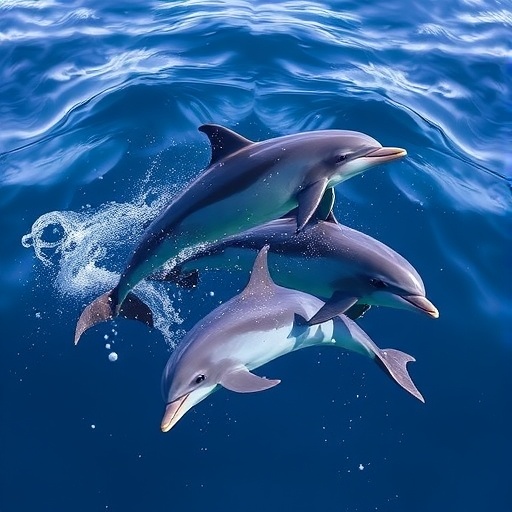
The study’s focal region, Santa Catalina Island—situated approximately 47 kilometers off the coast of Long Beach, California—provided an ideal natural laboratory. Between October and December 2021, researchers conducted boat-based surveys targeting 15 dolphin schools. These groups included the locally dominant species: long-beaked common dolphins (Delphinus capensis), short-beaked common dolphins (Delphinus delphis), common bottlenose dolphins (Tursiops truncatus), and Risso’s dolphins (Grampus griseus). By strategically collecting two-liter seawater samples within a close 10-meter proximity to these animals, they effectively captured mitochondrial eDNA shed into the ocean environment.
Back in the laboratory, the team employed high-throughput sequencing techniques specifically honed to extract mitochondrial DNA from the collected samples. Mitochondrial DNA, due to its maternally inherited and high-copy-number nature, serves as an ideal target for assessing genetic variation. Rigorous quality control measures ensured the fidelity of the sequencing data, minimizing contamination and false positives. Through computational comparison with comprehensive public genetic databases, the sequences were assigned to species and analyzed for intraspecific genetic diversity patterns.
Remarkably, the analysis identified 836 distinct mitochondrial sequence variants across 126 seawater samples. Of these, a substantial 76% were from cetacean species, with toothed whales constituting 60% of the detected DNA sequences. Critically, approximately 29% of the sequences matched the visually observed species from the surveyed dolphin schools, demonstrating the reliability of eDNA in reflecting local population genetics. Notably, the long-beaked common dolphin exhibited the highest levels of genetic diversity, followed closely by the short-beaked common dolphin. In contrast, both Risso’s and bottlenose dolphins showed comparatively lower genetic variation in the study area, suggesting differing population structures or historical demography.
The implications of these findings are profound. By establishing that repeated eDNA sampling can reliably estimate genetic diversity metrics, this method offers a novel tool for assessing the adaptive capacity and demographic status of marine mammal populations. Genetic diversity underlies a population’s resilience to environmental disturbances such as climate change, pollution, and habitat alteration. Therefore, tracking this parameter is essential for informed species management and conservation policy.
Importantly, the researchers emphasized the practical parameters for effective eDNA sampling. Their data suggest that collecting between 60 and 72 liters of seawater per survey provides sufficient material to capture a representative genetic snapshot of long-beaked common dolphins’ diversity. However, they caution that this volume is likely species-specific, influenced by biological and ecological factors. Variables such as water temperature and salinity affect rates of skin cell sloughing, while behavioral facets—including swimming speed, respiratory blow frequency, feeding, defecation, group size, and social interaction—modulate DNA shedding rates and patterns.
For instance, cetaceans engaging in frequent breaching or body rubbing may release more genetic material into surrounding waters, increasing the detectability of their DNA. Similarly, the airborne blow expelled during respiration carries mitochondrial DNA, offering an alternative eDNA source that may be harnessed in future studies. The complex interplay between these biological processes and environmental conditions creates a dynamic matrix that shapes eDNA abundance and quality.
The study’s authors advocate for immediate integration of eDNA genetic diversity monitoring into conservation frameworks. With the enhanced resolution afforded by repeated eDNA sampling, scientists and managers will be able to track fine-scale temporal changes in species composition within discrete oceanic locales. This capability is invaluable for detecting the presence of rare or elusive species, which often evade traditional visual survey methodologies. Furthermore, longitudinal data streams can elucidate the impacts of anthropogenic stressors—ranging from pollution to underwater noise pollution—on habitat use and population structure.
Initiating robust eDNA surveillance programs promises to revolutionize our understanding of marine ecosystem dynamics. By providing actionable data on how genetic diversity fluctuates in response to environmental change, policymakers will be better equipped to design adaptive management strategies. Such insights will not only safeguard the genetic heritage of charismatic marine megafauna like dolphins but also contribute to the broader goal of marine biodiversity conservation amid accelerating global change.
In sum, the work of Dr. Archer and his colleagues marks a pivotal advancement in marine molecular ecology. Their innovative approach transforms environmental DNA from a mere indicator of species presence into a multifaceted tool capable of revealing the genetic fabric of thriving oceanic populations. As these techniques mature, they hold tremendous promise for non-invasive, scalable, and real-time genetic monitoring of marine life, aligning scientific inquiry with urgent conservation imperatives.
—
News Publication Date: 19-May-2026
Web References: http://dx.doi.org/10.3389/fmars.2026.1756593
Cite Scienmag News
Margaret Porter. (May 19, 2026). Scientists Can Now Monitor America’s Dolphin Populations Using DNA Floating in Seawater. Scienmag. https://scienmag.com/scientists-can-now-monitor-americas-dolphin-populations-using-dna-floating-in-seawater/
Margaret Porter. "Scientists Can Now Monitor America’s Dolphin Populations Using DNA Floating in Seawater." Scienmag, 19 May 2026, https://scienmag.com/scientists-can-now-monitor-americas-dolphin-populations-using-dna-floating-in-seawater/. Accessed 4 September 2026.
Margaret Porter. "Scientists Can Now Monitor America’s Dolphin Populations Using DNA Floating in Seawater." Scienmag. May 19, 2026. https://scienmag.com/scientists-can-now-monitor-americas-dolphin-populations-using-dna-floating-in-seawater/


