


In a recent study published in Engineering, a research team from the Shenzhen Engineering Research Laboratory for Sludge and Food Waste Treatment and Resource Recovery has introduced a pioneering method to tackle the critical global issue of phosphorus (P) scarcity. Their innovative approach leverages municipal wastewater to produce phosphorus vital for the manufacture of lithium iron phosphate (LiFePO4) batteries, a key component in the rapidly growing electric vehicle market.

Credit: Yijiao Chang et al.
In a recent study published in Engineering, a research team from the Shenzhen Engineering Research Laboratory for Sludge and Food Waste Treatment and Resource Recovery has introduced a pioneering method to tackle the critical global issue of phosphorus (P) scarcity. Their innovative approach leverages municipal wastewater to produce phosphorus vital for the manufacture of lithium iron phosphate (LiFePO4) batteries, a key component in the rapidly growing electric vehicle market.
As the demand for LiFePO4 batteries surges due to their application in lithium-ion batteries (LIBs), the scarcity of phosphorus has become a pressing concern. Phosphorus is essential for producing high-performance cathode materials for these batteries. The researchers have devised an environmentally friendly and cost-effective solution by recovering phosphorus from municipal wastewater, transforming it into a valuable resource for battery production.
Transforming Waste into Wealth: The New Recovery Method
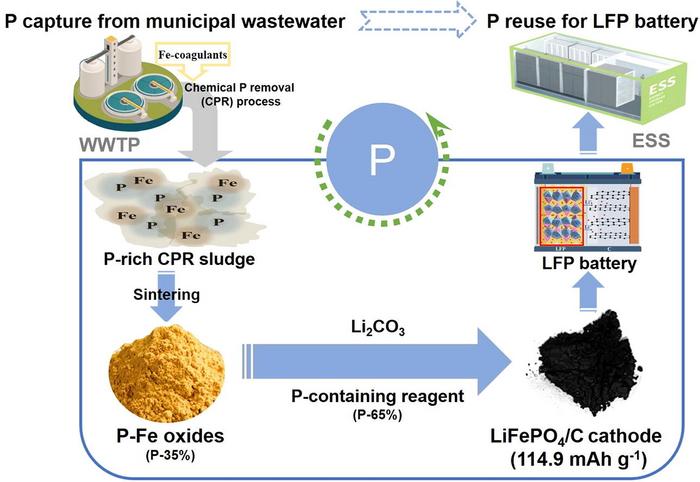
The team’s novel method involves using sludge from Fe-coagulant-based chemical phosphorus removal (CPR) processes in wastewater treatment. This sludge, rich in phosphorus and iron, undergoes a sintering treatment followed by acid washing to yield purified P–Fe oxides (Fe2.1P1.0O5.6). These oxides are then utilized as a substitute for up to 35% of the FePO4 reagent typically used in synthesizing LiFePO4 cathodes.
The resulting carbon-coated LiFePO4 (LiFePO4/C) cathodes exhibit impressive performance characteristics. They achieve a specific discharge capacity of 114.9 mA·h·g−1 at 17 mA·g−1 and maintain a remarkable cycle stability of 99.2% after 100 cycles. This enhanced performance is attributed to the beneficial impurities from the sludge, which contribute to a more stable crystal structure in the cathodes.
Economic and Environmental Impact
Unlike traditional phosphorus recovery methods, which primarily produce P-fertilizers, this innovative approach converts 100% of the phosphorus from CPR sludge into high-value LiFePO4/C cathodes. This process not only addresses the global phosphorus scarcity but also offers a sustainable solution to managing urban waste.
The economic benefits are substantial. The researchers calculated that the phosphorus recovered from municipal wastewater could meet up to 35% of the phosphorus demand in China’s LIBs industry. This positions the new recovery method as a highly cost-effective alternative to conventional phosphorus reuse routes.
A Pathway to Sustainable Development
The significance of this research extends beyond just technological advancement. By converting wastewater sludge into a critical component for clean energy storage, the team’s approach supports both environmental sustainability and the global push for cleaner energy solutions. The recovery process reduces urban waste, decreases dependency on finite phosphorus resources, and contributes to the development of sustainable technologies. It provides a dual benefit of addressing phosphorus scarcity while enhancing the performance of LiFePO4 batteries, thereby supporting the transition to a more sustainable and energy-efficient future.
The paper “Green and high-yield recovery of phosphorus from municipal wastewater for LiFePO4 batteries,” authored by Yijiao Chang, Xuan Wang, Bolin Zhao, Anjie Li, Yiru Wu, Bohua Wen, Bing Li, Xiao-yan Li, Lin Lin. Full text of the open access paper: https://doi.org/10.1016/j.eng.2024.05.018. For more information about the Engineering, follow us on X (https://twitter.com/EngineeringJrnl) & like us on Facebook (https://www.facebook.com/EngineeringJrnl).
Journal
Engineering
Article Title
Green and high-yield recovery of phosphorus from municipal wastewater for LiFePO4 batteries
Article Publication Date
19-Jun-2024
Cite Scienmag News
Denise Maddox. (July 31, 2024). New method recovers phosphorus from wastewater to power the future of lithium-iron phosphate batteries. Scienmag. https://scienmag.com/new-method-recovers-phosphorus-from-wastewater-to-power-the-future-of-lithium-iron-phosphate-batteries/
Denise Maddox. "New method recovers phosphorus from wastewater to power the future of lithium-iron phosphate batteries." Scienmag, 31 July 2024, https://scienmag.com/new-method-recovers-phosphorus-from-wastewater-to-power-the-future-of-lithium-iron-phosphate-batteries/. Accessed 5 September 2026.
Denise Maddox. "New method recovers phosphorus from wastewater to power the future of lithium-iron phosphate batteries." Scienmag. July 31, 2024. https://scienmag.com/new-method-recovers-phosphorus-from-wastewater-to-power-the-future-of-lithium-iron-phosphate-batteries/

