


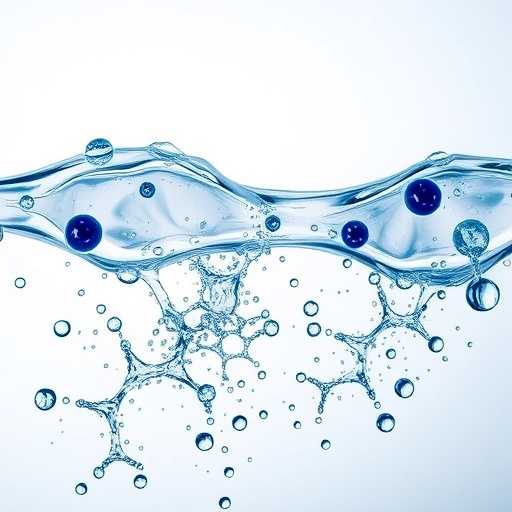
Water, one of the most ubiquitous and vital substances on Earth, exhibits behaviors that continue to fascinate scientists across many disciplines. Despite its apparent simplicity, water’s molecular dance defies straightforward description. Recent research from TU Wien, in collaboration with the University of Vienna and the University of Oslo, uncovers critical insights into how water molecules organize themselves around charged particles, shedding light on phenomena relevant to fields as diverse as electrochemistry, biological membranes, and energy storage technologies.
Traditionally, water has been misconstrued in popular culture, especially regarding claims about “water memory” or “water clusters” that attempt to attribute mystical qualities to this substance. These pseudoscientific notions suggest that water can somehow record and retain information through long-lasting structural arrangements. However, rigorous experimental evidence disproves such claims and reveals a more nuanced reality grounded in physics and chemistry. Water molecules, while dynamic and ever-changing, do form transient, structured arrangements that influence the behavior of ions and molecules in aqueous environments—but these are fleeting, existing on nanosecond timescales at most.
At the heart of this research lies the complex interaction between ions and water molecules. Ions in a solution do not travel in isolation; rather, they are encased in a hydration shell formed by water molecules aligned by electrostatic forces. This shell is far from static. For instance, small ions like lithium possess a strong electric field that induces a high degree of ordering of the surrounding water molecules. Conversely, larger ions like cesium, with lower charge density, exert a weaker influence, resulting in a comparatively disordered hydration environment. This discrepancy underpins significant differences in how these ions interact with surfaces.
The study’s authors emphasize that the structural order within the hydration shell is not akin to the fixed atomic lattices found in crystals. Instead, the molecular arrangements of water exhibit a statistical order characterized by incessant vibrations and reconfigurations. Bonds between water molecules form and break in rapid succession—a continuous molecular choreography. These constraints create a lower entropy state around certain ions, which in turn affects their thermodynamic properties and ultimately their propensity to adsorb onto charged surfaces.
Building on this understanding, the research delves into ion adsorption phenomena at the atomic scale, crucial for technologies such as batteries, fuel cells, and sensors. Using a combination of high-resolution atomic force microscopy, molecular dynamics simulations, and advanced spectroscopic methods, the researchers constructed a comprehensive thermodynamic framework. This framework accounts not only for classical electrostatic attraction but also integrates the entropic considerations arising from the ordering of water molecules and their dynamic interactions with ions.
A groundbreaking outcome of this model is the realization that ions influencing the water structure more strongly tend to attach less readily to surfaces due to the energetic cost of disrupting the ordered hydration shell. The lower entropy state around these ions renders their adsorption less spontaneous, despite the electrostatic forces favoring such interactions. This subtle balance between energy and entropy challenges simplistic interpretations solely based on charge attraction and offers a deeper, quantitative understanding of the interfacial processes.
These insights also overturn simplistic notions often circulated in non-scientific domains that attribute any unusual water behavior to “memory” or other esoteric properties. Instead, the behaviors observed are intrinsic physical phenomena arising from the fundamental properties of water and ions. The transient “dance” of water molecules around ions is governed by well-understood principles of statistical mechanics and thermodynamics, not pseudo-memories or elusive configurations that defy physical laws.
From a broader perspective, the implications of this research stretch well beyond academic curiosity. Predicting ion adsorption with greater accuracy enhances the design of electrodes and catalysts, optimizing energy transfer and reaction efficiency in electrochemical devices. It also improves our theoretical understanding of biological processes where ion transport and surface interactions are fundamental—for example, in nerve signaling, cellular ion channel function, and membrane dynamics.
This study represents a significant advance in the field of surface science and physical chemistry. By precisely quantifying how the dynamic interplay between ion charge and water structure governs surface adhesion, researchers can now develop more predictive models. Such advances potentially accelerate innovations in material science, environmental chemistry, and nanotechnology, where controlling interactions at interfaces is paramount.
The methodology combining atomic force microscopy and molecular dynamics simulations demonstrates the power of integrating experimental and computational techniques to characterize phenomena invisible to classical measurement tools. This synergy reveals nanoscale details about water structuring and ionic interactions, paving the way for new research avenues exploring liquid interfaces, solvation dynamics, and surface chemistry with unprecedented resolution.
In conclusion, the comprehensive work by the TU Wien-led team refutes unfounded claims of magical water properties while spotlighting the critical physical realities governing ion adsorption. It uncovers how short-lived but statistically ordered water structures meaningfully govern ion behavior—an insight that enriches scientific understanding and fuels progress in multiple technological arenas.
Keywords
Adsorption, Condensed matter physics, Physics, Electrochemistry, Catalysis, Water chemistry, Surface science, Solid state physics
Cite Scienmag News
Bethany Barker. (May 18, 2026). How Water’s Structure and Entropy Decide If Ions Stick Together. Scienmag. https://scienmag.com/how-waters-structure-and-entropy-decide-if-ions-stick-together/
Bethany Barker. "How Water’s Structure and Entropy Decide If Ions Stick Together." Scienmag, 18 May 2026, https://scienmag.com/how-waters-structure-and-entropy-decide-if-ions-stick-together/. Accessed 4 September 2026.
Bethany Barker. "How Water’s Structure and Entropy Decide If Ions Stick Together." Scienmag. May 18, 2026. https://scienmag.com/how-waters-structure-and-entropy-decide-if-ions-stick-together/


