


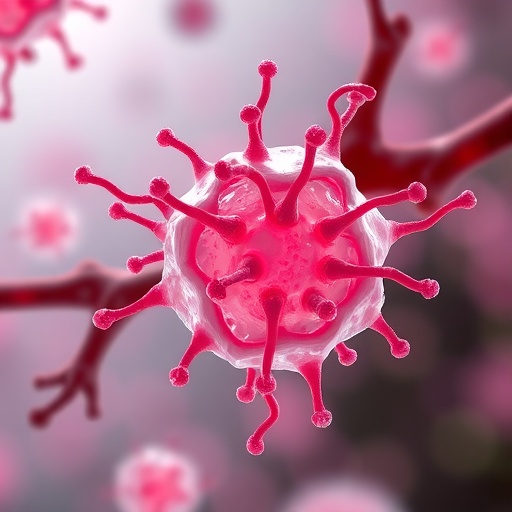
In a remarkable advancement in oncology research, a team led by Wang, B., Su, B., and Cai, Q. has unveiled novel insights into the molecular mechanisms driving breast cancer progression, published in the prestigious journal Cell Death Discovery this year. Their investigation reveals that exosomes originating from polymorphonuclear myeloid-derived suppressor cells (PMN-MDSCs) carry the protein S100A9, which plays a critical role in enhancing cancer stemness and promoting metastatic potential via CXCL5 signaling pathways. These findings elucidate previously unexplored intercellular communication dynamics within the tumor microenvironment that significantly influence malignancy evolution.
Breast cancer remains a formidable threat worldwide due to its heterogeneity and propensity for metastasis, which substantially diminishes patient survival rates. The study specifically dissects how the tumor microenvironment—comprising immune and stromal cells—interacts with cancer cells to support tumor growth and dissemination. PMN-MDSCs, a subset of immunosuppressive cells, have emerged as potent modulators of tumor progression, but the precise mechanisms through which their exosomes affect cancer biology remained elusive until now.
Exosomes are nanoscale extracellular vesicles capable of transferring bioactive molecules such as proteins, RNAs, and lipids between cells, thereby facilitating complex cellular crosstalk. In their comprehensive analysis, Wang and colleagues isolated exosomes from PMN-MDSCs extracted from breast tumor models and identified an enrichment of S100A9 protein within these vesicles. This protein is known for its involvement in inflammatory processes and cancer development but had not been previously linked through an exosomal pathway to breast cancer malignancy.
Delving deeper, the researchers demonstrated that once incorporated into breast cancer cells, these S100A9-laden exosomes instigate a cascade of molecular events that enhance cancer stem cell traits. This phenomenon is critically important because cancer stem cells possess self-renewal capabilities and resistance to conventional therapies, often serving as the root of tumor recurrence and metastatic spread. The S100A9 cargo thus acts as a potent driver of cellular plasticity and malignant potential.
Additionally, the study spotlighted the upregulation of the chemokine CXCL5 following exosomal S100A9 integration. CXCL5 is recognized for its role in recruiting neutrophils and facilitating tumor cell migration, thereby contributing to metastasis. The authors meticulously demonstrated that enhanced CXCL5 expression fueled by exosomal signaling encourages breast cancer cells to acquire increased invasive capabilities, both in vitro and in vivo. This connection reveals a critical axis linking immune cell-derived vesicles to metastatic niche formation.
What makes this discovery particularly striking is the dual effect of PMN-MDSC exosomal S100A9 on both tumor stemness and migration, establishing a feedback loop that exacerbates tumor aggressiveness. The authors suggest that interrupting this exosomal signaling pathway could offer a promising therapeutic strategy to curtail metastasis and improve treatment outcomes for breast cancer patients, emphasizing the translational potential of their findings.
Moreover, the research implicates the tumor microenvironment’s immune component as an active participant rather than a passive bystander in cancer progression. It challenges the conventional focus solely on cancer cells and underscores the importance of targeting the interplay between immune cells and tumor cells. This paradigm shift broadens the spectrum of anti-cancer therapies, potentially introducing interventions aimed at modulating exosome production or blocking specific cargo elements like S100A9.
The methodologies employed in the study were robust and multifaceted, including exosome isolation protocols, proteomic analyses, gene expression profiling, and functional assays to assess stemness and metastatic behaviors. The inclusion of both cellular and animal models lent substantial credence to the biological relevance of the findings and their anticipated impact in clinical contexts.
Interestingly, the implications of exosomal S100A9 extend beyond breast cancer alone. Given the protein’s known involvement in inflammatory diseases and other tumor types, this mechanism may represent a broader oncogenic pathway operative in diverse malignancies. This possibility invites further exploration into exosomal communications in various cancers, potentially unveiling universal therapeutic targets.
The identification of CXCL5 as a mediator linking S100A9 to metastatic potential also opens new investigative avenues. CXCL5’s role in shaping the tumor microenvironment, particularly in immune cell recruitment and angiogenesis, accentuates its significance as a biomarker and drug target. Future research may explore inhibitors of CXCL5 signaling or neutralizing antibodies as adjuncts to existing therapies.
Furthermore, understanding the regulation of S100A9 packaging into PMN-MDSC exosomes could yield insights into how tumor-supportive microenvironments are established and maintained. This knowledge is crucial for designing interventions that disrupt harmful cell-to-cell communication at its genesis.
The study also prompts a reevaluation of the immunosuppressive functions of PMN-MDSCs, highlighting their capacity to facilitate tumor progression not only through direct immune evasion but also by altering cancer cell phenotypes via exosomal cargo delivery. This dual role amplifies their importance as targets for comprehensive cancer immunotherapies.
From a clinical perspective, the discovery holds promise for the development of diagnostic tools based on circulating exosomal S100A9 levels, which might serve as indicators of tumor aggressiveness or metastatic risk. Such biomarkers could enable earlier intervention and personalized treatment regimens tailored to the molecular profiles of individual tumors.
In sum, the work by Wang and colleagues epitomizes the power of integrating molecular biology with immunology to unravel the complexities of cancer progression. By illuminating the contribution of PMN-MDSC-derived exosomal S100A9 in fostering breast cancer stemness and metastasis through CXCL5-mediated pathways, the study sets a new benchmark for research aimed at conquering one of humanity’s most challenging diseases.
This trailblazing research not only deepens our understanding of tumor biology but also sparks hope for novel anti-metastatic therapies that could dramatically reduce breast cancer mortality rates. The scientific community eagerly awaits further developments inspired by these findings, which may redefine therapeutic landscapes in oncology.
Cite Scienmag News
Nathaniel Bowman. (May 18, 2026). Exosomal S100A9 Fuels Breast Cancer Spread. Scienmag. https://scienmag.com/exosomal-s100a9-fuels-breast-cancer-spread/
Nathaniel Bowman. "Exosomal S100A9 Fuels Breast Cancer Spread." Scienmag, 18 May 2026, https://scienmag.com/exosomal-s100a9-fuels-breast-cancer-spread/. Accessed 4 September 2026.
Nathaniel Bowman. "Exosomal S100A9 Fuels Breast Cancer Spread." Scienmag. May 18, 2026. https://scienmag.com/exosomal-s100a9-fuels-breast-cancer-spread/


