


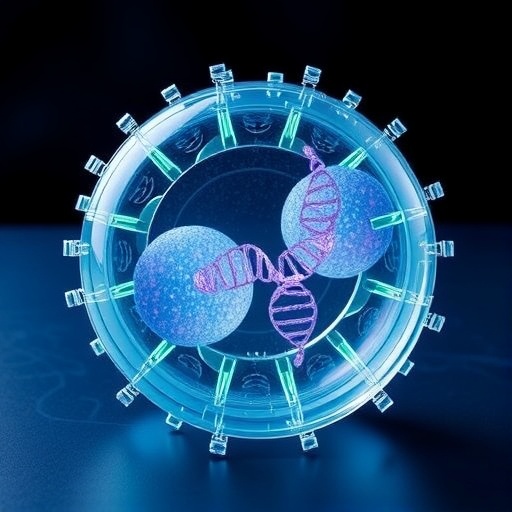
In an era defined by rapid advances in synthetic biology, researchers have unveiled a groundbreaking innovation that promises to revolutionize the design and functionality of artificial cells. A team led by Fan, Ding, and Renz has engineered a synthetic cell microreactor equipped with two interacting dynamic DNA-based pores, introducing a new paradigm in biomimetic systems. This development, recently published in Nature Chemistry, represents a significant stride towards the construction of programmable synthetic cells that emulate complex biological processes with unprecedented precision.
Synthetic biology has long sought to replicate the intricate machinery of living cells, aiming to harness their capabilities for a host of applications including drug delivery, biosensing, and enzymatic synthesis. Central to cellular functionality are membrane pores—protein structures that regulate molecular traffic, permitting selective exchange between a cell’s interior and its environment. The team’s innovative approach replaces traditional protein pores with DNA nanostructures, exploiting the programmability and dynamic behavior of DNA to create responsive synthetic channels.
At the heart of this technology lie two distinct types of DNA-based pores embedded within a synthetic membrane. Each pore type is designed to fulfill specific transport and regulatory roles, mimicking the diversity and cooperative behavior of natural membrane channels. These pores are not static; rather, they possess the ability to interact dynamically, orchestrating molecular passage based on environmental cues. This design strategy endows the synthetic microreactor with a level of control and adaptability seldom achieved in artificial systems.
The fabrication process utilized DNA origami techniques, a powerful method to fold DNA strands into precise three-dimensional shapes. These nanostructures were meticulously engineered to form pores that could integrate seamlessly into lipid vesicles, the synthetic cell membranes. The vesicles act as microreactors, encapsulating enzymatic reactions while the DNA pores regulate substrate influx and product efflux. This spatial confinement coupled with selective permeability transforms the vesicles into functional units capable of complex biochemical processing.
What sets this system apart from previous synthetic cell models is the dynamic interplay between the two pore types. The researchers demonstrated that these pores could communicate through molecular signals, modulating their opening and closing states in concert. Such interactivity allows the microreactor to fine-tune internal conditions, thereby optimizing reaction kinetics and ensuring homeostasis reminiscent of living cells.
Experimental validation involved sophisticated imaging and spectroscopy techniques to monitor pore behavior and molecular transport in real time. The team employed single-molecule fluorescence microscopy to visualize substrate passage through individual DNA pores, confirming their selective permeability and dynamic gating mechanisms. Furthermore, the vesicle-confined enzymatic reactions were shown to proceed with enhanced efficiency, highlighting the functional synergy between molecular transport and biochemical catalysis.
Beyond fundamental research, this synthetic cell microreactor holds immense potential for practical applications. In biosensing, for instance, the ability to detect analytes and respond dynamically via pore gating could lead to highly sensitive and specific sensors. In drug delivery, the programmable pores offer a controlled release mechanism, minimizing off-target effects and maximizing therapeutic efficacy. Additionally, the modularity of DNA nanostructures facilitates the customization of pore properties to suit diverse biomedical and industrial needs.
The conceptual leap of combining multiple interacting dynamic pores marks a new frontier in synthetic biology. It challenges the traditional view of artificial cells as mere vessels, instead portraying them as sophisticated reactors capable of autonomous regulation and adaptive responses. This advancement bridges the gap between static synthetic constructs and the dynamic complexity of living systems, paving the way for fully synthetic cells with life-like functionalities.
Importantly, this system aligns with increasing efforts to minimize the complexity and unpredictability often associated with protein engineering. DNA nanotechnology offers unparalleled precision, programmability, and reproducibility, circumventing many challenges posed by protein-based designs. The success of these DNA-based pores demonstrates the maturation of nucleic acid nanotechnology as a versatile toolkit for bioengineering.
Moreover, the dynamic nature of the pores suggests exciting possibilities for integrating synthetic microreactors into larger networks, where inter-vesicular communication and coordinated activity could emulate tissue-level behaviors. This could herald the development of synthetic multicellular systems capable of higher-order functions, with applications spanning tissue engineering, biosynthesis, and artificial intelligence interfaces.
The research team acknowledges that despite its promise, the synthetic microreactor is an initial step towards the creation of fully autonomous synthetic cells. Future iterations will likely explore enhanced pore responsiveness, integration of additional functional modules, and improved stability under physiological conditions. Such refinements will be essential for translating this technology from the laboratory to real-world applications.
In conclusion, the work presented by Fan, Ding, Renz, and colleagues illuminates a transformative approach to synthetic cell engineering. By harnessing the dynamic interplay of two types of DNA-based pores within a microreactor, they have constructed a system that not only mimics key aspects of cellular transport but also introduces a level of programmable control that surpasses current models. This breakthrough underscores the profound potential of DNA nanotechnology to redefine the boundaries of synthetic biology and opens a promising pathway toward intelligent, adaptable artificial cells.
As the synthetic biology community digests this innovative accomplishment, anticipation grows for the myriad of possibilities it unlocks. From programmable biosynthesis to smart therapeutics, the implications of dynamic DNA-based pore systems are expansive, promising a future where synthetic cells are not just simple machines but dynamic entities capable of nuanced biochemical orchestration.
Cite Scienmag News
Bethany Barker. (May 15, 2026). Synthetic Cell Microreactor with Dual Dynamic DNA Pores. Scienmag. https://scienmag.com/synthetic-cell-microreactor-with-dual-dynamic-dna-pores/
Bethany Barker. "Synthetic Cell Microreactor with Dual Dynamic DNA Pores." Scienmag, 15 May 2026, https://scienmag.com/synthetic-cell-microreactor-with-dual-dynamic-dna-pores/. Accessed 4 September 2026.
Bethany Barker. "Synthetic Cell Microreactor with Dual Dynamic DNA Pores." Scienmag. May 15, 2026. https://scienmag.com/synthetic-cell-microreactor-with-dual-dynamic-dna-pores/


