


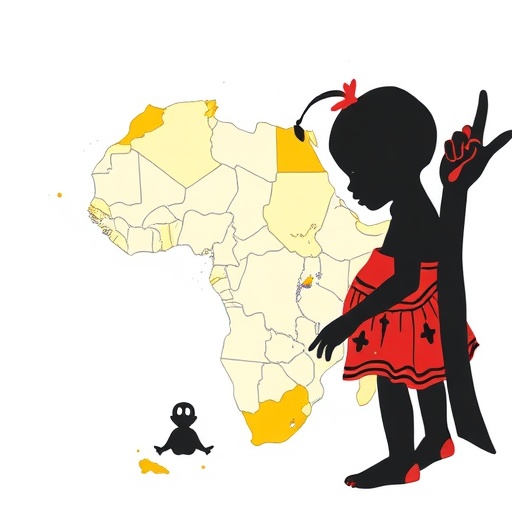
In the evolving discourse on climate change and its far-reaching impacts on human well-being, a novel and alarming dimension has emerged linking ambient heat exposure to child maltreatment. Recent research conducted across sub-Saharan Africa intricately reveals that soaring temperatures are not just an environmental or public health concern but also a potent social hazard that disproportionately affects vulnerable children. This groundbreaking study illuminates the complex and nonlinear dynamics between rising temperatures and the incidence of various forms of child abuse, urging a re-examination of climate adaptation strategies through a child protection lens.
The investigation, encompassing data from an impressive cohort of 114,051 children and adolescents across eight diverse sub-Saharan African countries, painstakingly identifies a J-shaped association between ambient temperature and child maltreatment. This nuanced curve indicates that child maltreatment risks do not increase linearly with heat; instead, there is a threshold or inflection point at the 27th temperature percentile, below which the risk is minimal. Beyond this critical point, especially nearing the 95th percentile, the likelihood of child abuse surges dramatically. The odds ratio for any form of abuse at this upper temperature threshold was quantified at 1.50, with a 95% confidence interval ranging from 1.35 to 1.67, signifying a robust statistical link.
This research is exceptionally notable for differentiating between psychological and physical forms of abuse, revealing that the heat-related escalation is more pronounced for psychological abuse. The increased vulnerability to emotional harm under extreme heat conditions points toward psychosocial stress as a crucial mediator. The exacerbation of psychological maltreatment under heat stress suggests that caregivers and family environments may be severely pressured during hotter periods, leading to greater incidences of detrimental behavior towards children.
Delving deeper, the study uncovers significant effect modification rooted in entrenched social inequalities and household characteristics. Low maternal education emerges as a critical modifier, amplifying the risk of heat-associated maltreatment. This finding underscores the intersection of educational disparity and climate vulnerability, highlighting that limited access to knowledge and resources in caregiving profoundly affects child welfare under thermal stress. Maternal endorsement of physical punishment similarly intensifies risk, pointing to culturally embedded disciplinary practices that may be exacerbated by climate-induced strain.
Household structure also plays a pivotal role. Female-headed households, often confronting economic and social hardships, showed heightened susceptibility to climate-driven maltreatment. Rural residence, typically associated with greater exposure to environmental extremes and fewer protective resources, further compounds this risk. The absence of air conditioning—a clear indicator of material deprivation—and social support networks also significantly mediates the relationship between heat exposure and child maltreatment, suggesting that economic and communal safety nets are vital buffers against the social ramifications of climate change.
A particularly insightful element of the study is its exploration of mediation pathways, where indirect effects of heat exposure are parsed out through intermediate factors. Occupational heat exposure among working adolescents accounted for nearly 19% of the indirect effect leading to maltreatment, illustrating how labor conditions and economic survival mechanisms are intertwined with heat-related social harms. Similarly, household water shortages, a common consequence of escalating temperatures and drought, explained over 7% of the indirect pathway towards maltreatment. These findings elevate the discourse on climate impacts, connecting environmental stressors to socioeconomic vulnerabilities that trickle down to affect child protection outcomes.
Methodologically, the research employs advanced statistical modeling to capture the nonlinear temperature-child maltreatment curve, leveraging large-scale cross-country data to enhance generalizability while controlling for confounding factors. The use of odds ratios with precise confidence intervals lends credence to the robustness of the associations observed. By integrating effect modification and mediation analyses, the study transcends simple correlational findings, advancing a multifaceted understanding of how climate stress feeds into social harm.
Contextualizing these findings in sub-Saharan Africa is particularly important given the region’s disproportionate burden of both climate change and child protection challenges. Children in these settings face endemic risks from poverty, conflict, and malnutrition alongside increasingly frequent and intense heatwaves. This confluence of vulnerabilities produces a dangerous synergy that magnifies the consequences of global warming on sensitive populations. The study’s empirical evidence thus serves as a clarion call for region-specific climate adaptation policies that embed child protection mechanisms.
From a policy perspective, these revelations mandate the integration of child welfare frameworks within broader climate resilience strategies. Traditional climate adaptation approaches have predominantly focused on infrastructure, agriculture, and health, often overlooking social dimensions such as family dynamics and child abuse. This study’s insights illuminate the urgent necessity for cross-sector collaborations that tag child protection as a critical component in climate risk management, ensuring that interventions mitigate the social fallout of heat exposure.
Furthermore, the interplay between social determinants—like education, household composition, and socioeconomic status—and climate impacts underscores the need for equity-centered adaptation efforts. Programs that elevate maternal education, challenge harmful disciplinary norms, provide economic support to female-headed households, and improve rural infrastructure for cooling or water access can collectively reduce the risk of heat-induced child maltreatment. Recognizing and addressing these intersecting vulnerabilities is vital to crafting effective, sustainable interventions.
From a research standpoint, this study breaks new ground by being among the first to quantify the relationship between temperature extremes and child abuse in Africa at scale, using comprehensive, population-based data. It also paves the way for future inquiries to explore causal mechanisms, longitudinal trajectories, and intervention efficacy. Expanding similar research to other regions can help map global patterns, enabling the development of universal as well as context-specific mitigation and prevention strategies.
The psychological impact of heat identified here calls for further exploration into how heat exposure affects caregiver mental health and behavior, child resilience, and family dynamics. Specialized psychosocial support programs may be essential adjuncts to physical adaptations like air conditioning or improved water access. Understanding the biological, psychological, and social pathways through which heat translates into abusive behavior will enhance the precision of prevention efforts.
Additionally, the role of adolescent work, which mediates nearly a fifth of the heat-maltreatment link, highlights child labor as an urgent intervention point. Protective labor policies, climate-smart occupational safety standards, and economic alternatives for families could alleviate these risks. Addressing water insecurity, which is also implicated in the pathways, must remain a priority through improved water management and infrastructure investment.
In conclusion, this landmark research solidifies the understanding that climate change’s social repercussions extend far beyond environmental or health metrics, penetrating the intimate and critical realm of child protection. The robust association between elevated temperatures and increased risk of child maltreatment in sub-Saharan Africa compels an urgent reevaluation of climate policy frameworks to incorporate social vulnerabilities and protections. Failure to do so risks exacerbating existing inequalities and perpetuating cycles of trauma for millions of children caught in the heat’s merciless grip. This integrative perspective represents a new frontier in climate research and action—where safeguarding the next generation becomes an indispensable goal of sustainable development in a warming world.
Cite Scienmag News
Sloane Callahan. (May 15, 2026). Social Inequalities Link Heat to Child Abuse in Africa. Scienmag. https://scienmag.com/social-inequalities-link-heat-to-child-abuse-in-africa/
Sloane Callahan. "Social Inequalities Link Heat to Child Abuse in Africa." Scienmag, 15 May 2026, https://scienmag.com/social-inequalities-link-heat-to-child-abuse-in-africa/. Accessed 3 September 2026.
Sloane Callahan. "Social Inequalities Link Heat to Child Abuse in Africa." Scienmag. May 15, 2026. https://scienmag.com/social-inequalities-link-heat-to-child-abuse-in-africa/


