


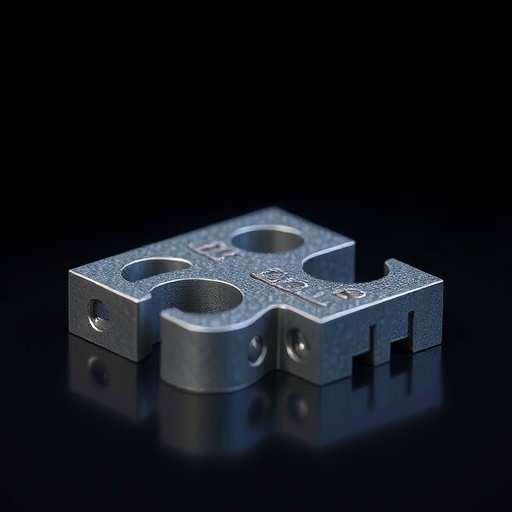
Metal additive manufacturing (AM) has emerged as a transformative technology in modern engineering, promising the fabrication of lightweight, complex geometries unattainable by traditional manufacturing methods. However, the widespread adoption of metal 3D printing—particularly laser powder bed fusion (LPBF)—has been hindered by persistent microscopic internal defects that escape visual detection yet severely undermine the mechanical integrity of finished components. These intrinsic flaws, primarily porosity in the form of tiny voids, have posed a significant obstacle in sectors where safety and reliability are non-negotiable, such as aerospace and automotive manufacturing. A pioneering breakthrough by Professor Hyoung Seop Kim’s team at Pohang University of Science and Technology (POSTECH) now signals a paradigm shift by employing artificial intelligence (AI) to fundamentally comprehend and predict these hidden material imperfections.
By casting aside the traditional and costly approach of exhaustive experimental tests to quantify defect influence, the POSTECH research group has forged a novel AI-assisted predictive framework that captures the complex interplay among process parameters, microstructural features, and defect characteristics in LPBF-fabricated metal alloys. Integrating expertise from the Graduate Institute of Ferrous & Eco Materials Technology with insights from Dr. Jeong Min Park’s team at the Korea Institute of Materials Science (KIMS), the group crafted an advanced Data Selection Machine Learning (DSML) methodology that efficiently filters data, concentrating only on the most impactful variables within a vast dataset. This method not only enhances predictive accuracy but also circumvents the pitfalls of conventional black-box AI systems by offering interpretable, physically meaningful models.
Laser powder bed fusion, the dominant metal AM technique, constructs three-dimensional parts by selectively melting fine metal powders using a controlled laser beam, layer by coherent layer. This painstaking process, while enabling unmatched geometrical freedom, inadvertently fosters the formation of microscopic pores dispersed throughout the material—akin to entrapped air bubbles that compromise load-bearing capacity. Under high-stress environments endemic to aircraft structures or automotive engines, the presence of even sparse porosity can precipitate catastrophic failure, underscoring the urgency of predictive defect assessment at the design stage.
Traditional methodologies to tackle this challenge typically demand protracted experimental campaigns involving destructive testing and comprehensive characterization, rendering rapid product development cycles untenable. Instead, the novel DSML framework capitalizes on integrating multi-dimensional data encompassing process settings, microstructural observations, porosity metrics, and mechanical performance parameters to train an AI system. This data-centric approach empowers the model to forecast yield strength with unprecedented precision while capturing underlying physical phenomena—something critical to advancing metal AM beyond an empirical trial-and-error paradigm.
Unlike opaque machine learning models, the POSTECH team emphasized scientific transparency by employing symbolic regression techniques, which distill AI predictions into transparent mathematical formulas comprehensible to researchers and engineers alike. These equations quantify the inverse relationship between porosity and effective cross-sectional load-bearing area, elegantly embodying the foundational principles of material mechanics. This transparency fosters trust and interpretability, enabling stakeholders to validate and refine models grounded in physical reality rather than inscrutable algorithmic outputs.
The research validation involved the AlSi10Mg alloy, a prevalent aluminum-based material in aerospace and automotive additive manufacturing due to its favorable strength-to-weight ratio and processability. Experimental specimens were fabricated under a diverse array of LPBF process conditions to generate comprehensive datasets on porosity and mechanical response. Remarkably, the DSML-driven predictive framework yielded yield strength estimates with a mean absolute error of merely 9.51 MPa, a more than fourfold improvement over prior models, and achieved these results within seconds—dramatically accelerating design workflows.
This predictive capability unlocks the potential to develop a “defect-aware design map,” a forward-looking tool enabling engineers to anticipate and optimize component performance under variable process conditions. By embedding defect consideration directly into early-stage design, this technology eliminates the protracted trial-and-error iterations that traditionally delay product development and certification in critical industries. The ability to foresee and incorporate microscopic flaws into performance forecasts offers a pathway to safer, more reliable metal 3D printed components.
The implications of this research stretch beyond incremental improvements; it heralds a foundational shift in how metal additive manufacturing technologies can be scaled and industrialized. By scientifically elucidating the role of microscopic defects, this framework empowers manufacturers to confidently integrate metal AM into demanding applications such as aerospace structural elements and automotive powertrain components—where certification standards are stringent and margins for error vanish.
Jeong Ah Lee, the integrated M.S.-Ph.D. student and first author, accentuated the synergy between AI and materials science in overcoming entrenched challenges: “Our work demonstrates that AI is not just a predictive tool, but a scientific instrument to fundamentally understand and control defects in metal 3D printing.” Professor Hyoung Seop Kim further highlighted the practical impact: “This technology is poised to enhance the reliability of metal 3D printed parts and speed up their market deployment, especially in sectors where material performance is critical to safety and function.”
The research was generously supported by the National Research Foundation of Korea’s Leading Research Center Program, the KIMS Institutional Research Program, and Hyundai Motor Group, underscoring the collaborative effort bridging academia and industry. The Next Generation of Researchers Fellowship program notably supported Jeong Ah Lee, signifying investment in cultivating the talent driving additive manufacturing innovation forward.
In summary, the integration of data-selective machine learning with interpretable AI models marks a watershed moment for metal additive manufacturing. By transforming microscopic internal defects from unpredictable liabilities into quantifiable design variables, this approach propels the field toward more robust, predictable, and ultimately, safer engineering practices. The fusion of AI with materials science showcased by POSTECH elucidates a future where 3D-printed metal parts can be reliably deployed in critical infrastructure, fundamentally reshaping manufacturing landscapes across aerospace, automotive, and beyond.
News Publication Date: 1-May-2026
Web References: DOI link
Keywords
Additive manufacturing, laser powder bed fusion, metal 3D printing, porosity, microscopic defects, yield strength, AlSi10Mg alloy, artificial intelligence, data selection machine learning, symbolic regression, materials engineering, aerospace, automotive engineering
Cite Scienmag News
Denise Maddox. (May 15, 2026). Unveiling the Unseen: POSTECH Team Creates AI Framework to Detect Hidden Defects in Metal 3D Printing. Scienmag. https://scienmag.com/unveiling-the-unseen-postech-team-creates-ai-framework-to-detect-hidden-defects-in-metal-3d-printing/
Denise Maddox. "Unveiling the Unseen: POSTECH Team Creates AI Framework to Detect Hidden Defects in Metal 3D Printing." Scienmag, 15 May 2026, https://scienmag.com/unveiling-the-unseen-postech-team-creates-ai-framework-to-detect-hidden-defects-in-metal-3d-printing/. Accessed 4 September 2026.
Denise Maddox. "Unveiling the Unseen: POSTECH Team Creates AI Framework to Detect Hidden Defects in Metal 3D Printing." Scienmag. May 15, 2026. https://scienmag.com/unveiling-the-unseen-postech-team-creates-ai-framework-to-detect-hidden-defects-in-metal-3d-printing/


