


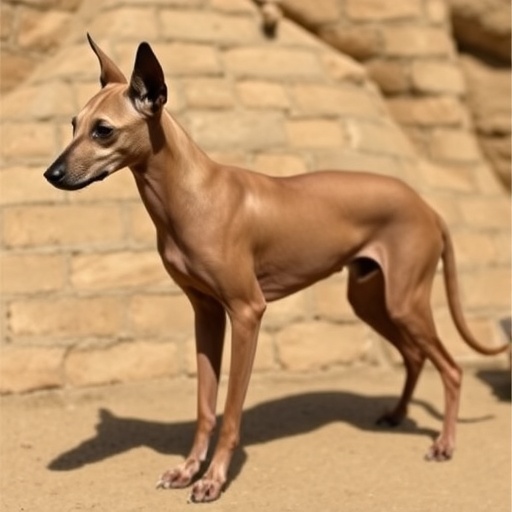
In the arid landscape of northern Peru, an extraordinary archaeological discovery has shed new light on the complex relationship between ancient Andean civilizations and their canine companions. At the Wari Empire site of Castillo de Huarmey, a sprawling 110-acre administrative and funerary complex dating between 600 and 1050 CE, researchers have unearthed physical remains that definitively confirm the presence of Peruvian hairless dogs, a breed long celebrated in Indigenous iconography and pottery but until now lacking direct osteological evidence.
This revelation is pivotal as it situates these distinctive dogs, ancestors of the modern Peruvian Inca Orchid recognized by the American Kennel Club, firmly within the sociocultural fabric of the Wari Empire—a civilization predating the Inca by several centuries. The site of Castillo de Huarmey, situated approximately 190 miles north of Lima, is renowned for its exceptionally preserved elite tombs and artifacts, providing a rare glimpse into the provincial governance and ritual practices of the Wari people.
The research, recently published in the Journal of Anthropological Archaeology, represents the first comprehensive zooarchaeological and isotopic investigation focused on dog remains from this site. It underscores the nuanced and sometimes contradictory human-animal dynamics that characterized ancient Andean society. While dogs were undoubtedly companions to some, they might have been viewed as nuisances or resources by others, revealing a spectrum of interactions that defy simplistic categorization.
Among the most compelling finds were three distinct sets of dog skeletal remains strategically discovered in the site’s northern ceremonial precinct. Notably, one was a naturally mummified skull of a Peruvian hairless dog, its desiccated skin and distinctive pointy ears remarkably intact and adorned with cinnabar pigment—a vivid red mineral often used in funerary rituals. This pigmentation suggests the dog held a special symbolic status, potentially paralleling the esteem afforded to human elites.
The identification of these remains as Peruvian hairless dogs was further substantiated by dental analysis. Researchers observed the absence of first premolars and, in some cases, last molars—traits genetically linked to the breed’s characteristic hairlessness. This genetic marker provided crucial corroboration that the skeletal fragments indeed belonged to this unique canine lineage, rather than to other local canids.
Isotopic analyses of carbon, nitrogen, oxygen, and strontium isotopes conducted on the dog bones and teeth revealed intriguing insights into their diet and origins. Notably, the isotopic signatures indicated a diet that included maize, a dietary staple shared with humans in the region, pointing to close proximity and shared resources. The dietary profiles varied between puppies and adult dogs, with juveniles exhibiting a diet similar to human children, implying a degree of human care and potentially intentional breeding practices.
Radiocarbon dating of the mummified dog revealed an astonishing age of over 1,200 years, establishing it as the oldest radiocarbon-dated specimen from Castillo de Huarmey. This temporal context confirms the deep historical roots of dog-human relationships in the Wari Empire and offers refined chronology for the site’s monumental phase.
Furthermore, the differential burial contexts—ranging from elite craftsmen’s tombs to shallow pits—illuminate a complex societal relationship with dogs. Some dogs were ceremonially interred, exemplified by the juvenile puppy buried alongside the “Master Basketmaker,” signifying possible roles as companions or status symbols. Others seemed to have been discarded or treated as refuse, underscoring varied social attitudes towards these animals.
The preservation of the site’s organic materials owes much to the hyper-arid coastal desert climate, which has safeguarded perishable materials such as hair, leather, and even skin. This exceptional preservation has enabled detailed morphological and biochemical examinations that are rarely possible in other archaeological contexts, enhancing our understanding of ancient animal domestication and cultural symbolism.
While the direct emotional bonds between the Wari people and their dogs remain elusive due to methodological constraints, the study compellingly argues that these animals occupied multifaceted roles in society. Their presence in high-status burials, dietary management, and symbolic depictions in pottery all point to a sophisticated human-animal interaction network that transcends simplistic pet or utility categories.
This research is a testament to the power of multidisciplinary approaches, combining rigorous archaeological excavation, zooarchaeology, and isotopic geochemistry to reconstruct past lives of not only humans but their animal companions. The findings from Castillo de Huarmey enrich our understanding of pre-Columbian Andean cultures and highlight the enduring significance of dogs within indigenous heritage.
The study team, led by Weronika Tomczyk of Dartmouth College, alongside collaborators from the University of Warsaw and the University of Pittsburgh, continues to explore the implications of these findings, aiming to unravel further complexities in the social and symbolic lives of ancient South American animals.
As scientists continue to investigate Castillo de Huarmey’s treasures, the story of these ancient hairless dogs unfolds as a poignant chapter in the broader narrative of domestication, cultural identity, and the intertwined fates of humans and animals in the Andes.
- Journal of Anthropological Archaeology: https://www.sciencedirect.com/science/article/pii/S0278416526000206?via%3Dihub
- Castillo de Huarmey Wari Empire site: https://www.archeologia.uw.edu.pl/en/castillo-de-huarmey-the-wari-empire-centre-on-the-northern-coast-of-peru/
References:
- Tomczyk, W., Giersz, M., Więckowski, W., Pimentel Nita, R., Ebert, C. “The many lives of companion species: a zooarchaeological and isotopic research on Wari dog remains from Castillo de Huarmey, Peru.” Journal of Anthropological Archaeology, 2026. DOI: 10.1016/j.jaa.2026.101767
Cite Scienmag News
William Thompson. (May 13, 2026). Ancient Site Yields Remarkable Discovery of Peruvian Hairless Dogs. Scienmag. https://scienmag.com/ancient-site-yields-remarkable-discovery-of-peruvian-hairless-dogs/
William Thompson. "Ancient Site Yields Remarkable Discovery of Peruvian Hairless Dogs." Scienmag, 13 May 2026, https://scienmag.com/ancient-site-yields-remarkable-discovery-of-peruvian-hairless-dogs/. Accessed 3 September 2026.
William Thompson. "Ancient Site Yields Remarkable Discovery of Peruvian Hairless Dogs." Scienmag. May 13, 2026. https://scienmag.com/ancient-site-yields-remarkable-discovery-of-peruvian-hairless-dogs/


