


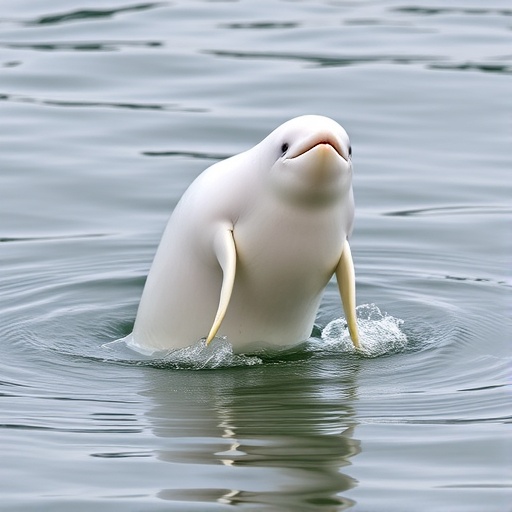
In the frigid waters of Alaska’s Cook Inlet, a population of beluga whales is facing a dire ecological crisis. Once numbering nearly 1,300 in the late 1970s, these striking white cetaceans have dwindled to around 300 individuals today, despite years of concerted conservation efforts. The precarious state of Cook Inlet belugas has puzzled scientists and conservationists alike, particularly because traditional recovery strategies have yielded limited success. A key emerging factor complicating their survival is the escalating presence of anthropogenic noise—especially from commercial shipping—which is increasingly drowning out the whales’ vital communications.
Beluga whales are renowned for their vocal complexity, using a sophisticated repertoire of calls for social cohesion, navigation, and predator avoidance. In a groundbreaking new study conducted by the University of Washington, researchers employed passive acoustic monitoring to eavesdrop on these elusive marine mammals over numerous behavioral encounters. Collecting over 1,700 distinct calls spanning 21 behavioral contexts, the study provides an unprecedented window into the social lives of Cook Inlet belugas and the ways human-generated noise interferes with their acoustic signals.
Sound is the primary sensory modality for many marine mammals because light attenuates rapidly underwater, especially in glacially turbid environments like Cook Inlet. These whales rely on frequent vocal exchanges not just to maintain group cohesiveness but also to coordinate activities such as foraging and migration. The research elucidates, for the first time, how specific call types correspond with particular social behaviors and group dynamics. This refined understanding is crucial because previous studies had demonstrated noise masking effects without clarifying the functional importance of the masked calls.
One of the most alarming findings of this study concerns the so-called combined calls that beluga mothers emit when calves are present. These complex calls appear integral to mother-calf bonding and coordination. Unfortunately, these calls are among those most susceptible to masking by low-frequency shipping noise prevalent in the northern inlet. This acoustic interference risks disrupting the communication necessary for maintaining contact between mothers and their vulnerable calves, raising concerns about calf survival and overall population recruitment.
Researchers observed that the frequency of calling increases significantly just prior to shifts in group behavior, such as transitions from social interaction to directed travel. This suggests that vocalizations play an active role in coordinating group movements and reinforcing social bonds. Further analysis revealed an inverse relationship between call rate per individual and group size; whales in larger assemblages tended to vocalize less, likely to avoid signal overlapping and acoustic clutter, an effect known as the “cocktail party problem” in auditory science.
Cook Inlet provides a uniquely challenging acoustic environment for belugas. Since colonizing the inlet around 10,000 years ago after the last glaciation, these whales have adapted to its dynamic and silty waters, which are influenced by powerful tidal forces and turbulent currents. Their reliance on echolocation and vocal communication has been key to navigating this complex habitat. However, anthropogenic noise represents a relatively recent and disruptive variable, potentially undermining millennia of evolutionary adaptation.
The heightened noise levels stem primarily from commercial shipping activities centered near Anchorage, close to critical beluga foraging grounds. Vessel traffic, military operations, and airport proximity compound the acoustic disturbance in this already sensitive habitat. Unlike some marine mammal populations that have shown adaptive shifts in acoustic strategies—such as the St. Lawrence Estuary belugas, which have evolved higher frequency calls and demonstrated Lombard effects (increasing call amplitude in noise)—Cook Inlet belugas appear less capable of compensating for the noise intrusion, intensifying their vulnerability.
In other regions, targeted noise mitigation strategies have proven effective. For instance, the Puget Sound initiative to slow commercial ships when orcas are present exemplifies how modifying human behavior in critical habitats can lessen acoustic impacts and improve conservation outcomes. Given these precedents, there is hope that similar measures could be implemented around the Port of Alaska to reduce noise pollution during sensitive periods for Cook Inlet belugas, especially when mothers and calves are present.
The study’s findings underscore the urgent need for integrative management approaches that balance industrial activity with wildlife conservation. Noise pollution, while not the sole threat, exacerbates challenges faced by this endangered stock, including limited genetic diversity and habitat degradation. A comprehensive strategy incorporating acoustic habitat protection, behavioral monitoring, and community engagement will be essential for reversing the population’s decline.
Funded by the University of Washington School of Aquatic and Fishery Sciences and NOAA’s Cooperative Institute for Climate, Ocean, and Ecosystem Studies, this research marks a pioneering step in decoding the acoustic ecology of Cook Inlet belugas. Future work will aim to more precisely quantify the impacts of noise on critical beluga behaviors and explore technological solutions for real-time noise monitoring and management.
As human footprint expands even into remote marine environments, studies such as this highlight the complex interdependencies between wildlife and anthropogenic change. They also illuminate pathways for science-driven conservation that respects the nuanced lives of non-human species. Preserving the rich acoustic landscape of Cook Inlet is not only vital for its belugas but also emblematic of broader efforts to maintain ocean health amid rapidly shifting global conditions.
For further collaboration and details, researchers emphasize that ongoing multidisciplinary efforts involving behavioral ecology, acoustics, and conservation policy will be pivotal. By deepening our auditory insights into beluga communication, scientists hope to forge informed strategies that sustain these emblematic marine mammals for generations to come.
News Publication Date: 7-May-2026
Web References:
References:
Brewer, A., Van Cise, A., Converse, S., Berdahl, A., Castellote, M., Goetz, K., Garner, C., & Gilstad, A. (2026). Cook Inlet beluga whale calling varies by group characteristics, behavior, and tidal state. Behavioral Ecology and Sociobiology. https://doi.org/10.1007/s00265-026-03740-6
Cite Scienmag News
Margaret Porter. (May 13, 2026). UW Researchers Decode Beluga Vocalizations to Advance Conservation Strategies. Scienmag. https://scienmag.com/uw-researchers-decode-beluga-vocalizations-to-advance-conservation-strategies/
Margaret Porter. "UW Researchers Decode Beluga Vocalizations to Advance Conservation Strategies." Scienmag, 13 May 2026, https://scienmag.com/uw-researchers-decode-beluga-vocalizations-to-advance-conservation-strategies/. Accessed 4 September 2026.
Margaret Porter. "UW Researchers Decode Beluga Vocalizations to Advance Conservation Strategies." Scienmag. May 13, 2026. https://scienmag.com/uw-researchers-decode-beluga-vocalizations-to-advance-conservation-strategies/


