


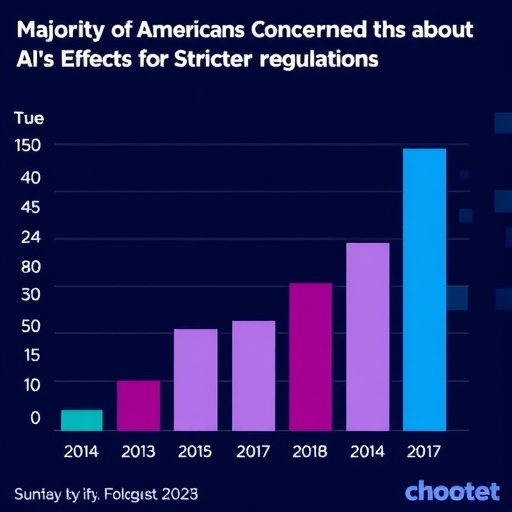
In an era where artificial intelligence (AI) continues to reshape the technological landscape, a striking new survey reveals a prevailing pessimism among Americans regarding AI’s impact over the next decade. Conducted by the Annenberg Public Policy Center (APPC) at the University of Pennsylvania, this comprehensive national survey underscores a collective concern about AI’s future, emphasizing the public’s desire for stronger regulatory measures. The findings, drawn from a carefully sampled group of 1,330 U.S. adults surveyed from February to March 2026, paint a detailed picture of a society cautiously navigating the emerging AI frontier.
The survey exposes a critical gap between awareness and optimism about AI’s trajectory. While a remarkable majority of respondents—78%—report having heard at least a moderate amount about AI, and 67% acknowledge using AI technology multiple times in the recent month, the general sentiment is far from optimistic. Merely 17% believe AI will exert a somewhat or very positive influence on the United States within the next ten years. In stark contrast, 42% express apprehensions, anticipating AI’s effect will be largely negative. This broad skepticism signals a public that is both attentive and uneasy about the consequences that AI advancements may precipitate.
One of the clearest consensus points emerging from the data is the bipartisan demand for more rigorous AI regulation. Nearly two-thirds of Americans, cutting across political affiliations, affirm that the government’s efforts to regulate AI have been insufficient. This includes 77% of Democrats, 72% of independents, and 53% of Republicans. Intriguingly, this alignment transcends traditional partisan divides, highlighting AI regulation as a rare domain of shared concern amid a deeply polarized political climate. Over half the population supports federal leadership in this arena, reflecting recognition of the technology’s nationwide implications.
Digging deeper into sector-specific perceptions, medical research is identified as a unique exception where AI’s impact is viewed positively. More than 57% of respondents expect AI to drive meaningful advances in medical research and discovery, illuminating a technically promising domain for AI integration. However, optimism rapidly dwindles when considering AI’s influence on other key societal areas including governance, the arts, and the economy. For example, only 24% foresee improvements in government effectiveness, and a mere 19% anticipate positive economic effects, signaling doubts about AI’s capabilities to foster broad societal benefits.
The survey’s findings also reveal collective concerns over AI’s implications for mental health, household expenses, and international relations. Respondents rate AI’s potential impact on mental health and well-being quite poorly, with only 17% expecting positive outcomes. Household utility costs show even lower optimism at 14%, possibly reflecting anxieties over energy consumption and infrastructure pressures connected to AI data centers. The domain of U.S.-China relations garners the least positivity, with a scant 5% anticipating beneficial effects, hinting at geopolitical apprehensions around AI technology deployment and its influence on global power dynamics.
Public apprehension extends beyond general sentiment to tangible concerns about employment security. Around 41% of currently employed Americans express worry that AI may jeopardize their jobs or reduce working hours. Notably, this fear resonates more strongly among Democrats and independents than Republicans, underscoring demographic nuances within the workforce’s perception of AI’s economic threat. This anxiety converges with broader unease regarding the expansion of AI data centers, which nearly half of the populace opposes when proposed within their local communities.
The resistance to data center construction is grounded in worries about energy use and local impact, illustrating a paradox in public attitudes toward the AI infrastructure fueling technological progress. Only very few, roughly 21%, endorse new data center development near them, while a significant 31% express strong opposition. This local-level pushback emphasizes the complexities faced when balancing AI innovation with community concerns and environmental considerations, introducing additional layers of policy debate on the sustainability and social acceptance of AI technologies.
An interesting political dynamic emerges from the survey concerning how Americans view the potential handling of AI issues by political leaders. Unlike the heavily polarized views seen on issues like immigration or the economy, AI regulation shows a relatively muted division between supporters of former Democratic presidential candidate Kamala Harris and Republican former President Donald Trump. Many respondents, 24%, consider their approaches to AI regulation “about the same,” reflecting that AI policy remains a nascent issue with fluid partisan identities, potentially offering fertile ground for bipartisan policy innovation.
This tentative bipartisan agreement on AI contrasts sharply with sharper divides over other policy domains and suggests a political opportunity. According to Matthew Levendusky, a prominent political scientist at the University of Pennsylvania, the lack of entrenched political polarization on AI represents a valuable opening. Public demand for effective AI governance is a unifying force, and political entities that demonstrate credible regulatory strategies stand to gain significant public support, should they seize this emerging consensus.
Methodologically, the survey’s robustness is bolstered by its meticulous sampling techniques, drawing from a nationally representative group that includes weighted demographics matching U.S. Census benchmarks. Conducted primarily online with supplemental phone interviews, the methodology ensures broad accessibility and validity in capturing American attitudes. The margin of error, calculated at approximately ±3.5 percentage points, lends strong confidence to the survey’s statistical interpretations and the conclusions drawn.
These findings emerge amid ongoing debates across the United States concerning data center proliferation and the broader governance of AI technologies. As AI continues to infiltrate many aspects of life and work, public demands for oversight highlight a crucial societal reckoning. The survey’s revelation—that regulation is not just a partisan issue but a collective yearning—signifies a pivotal moment for policymakers grappling with how to safely and effectively harness artificial intelligence’s transformative potential.
In sum, while Americans exhibit technical sophistication and engagement with AI technologies, their outlook remains marked by wariness and reservation. Positive expectations are concentrated narrowly on medical advancements, while broader concerns prevail about economic, social, and geopolitical consequences. Importantly, this skepticism does not translate into disengagement but rather galvanizes a significant call for expanded government oversight. As AI develops at a rapid pace, the political and regulatory landscapes will likely be shaped profoundly by these emergent public attitudes.
- https://www.annenbergpublicpolicycenter.org/wp-content/uploads/AI_Topline.pdf
- https://www.annenbergpublicpolicycenter.org/wp-content/uploads/APPC_AIOD_Methodology_2024-2026.pdf
Image Credits: The Annenberg Public Policy Center
Keywords: Artificial intelligence, AI regulation, public opinion, bipartisanship, data center construction, medical research, economic impact, political polarization, AI governance, survey research
Cite Scienmag News
Courtney Benton. (May 13, 2026). Majority of Americans Concerned About AI’s Effects Call for Stricter Regulations. Scienmag. https://scienmag.com/majority-of-americans-concerned-about-ais-effects-call-for-stricter-regulations/
Courtney Benton. "Majority of Americans Concerned About AI’s Effects Call for Stricter Regulations." Scienmag, 13 May 2026, https://scienmag.com/majority-of-americans-concerned-about-ais-effects-call-for-stricter-regulations/. Accessed 4 September 2026.
Courtney Benton. "Majority of Americans Concerned About AI’s Effects Call for Stricter Regulations." Scienmag. May 13, 2026. https://scienmag.com/majority-of-americans-concerned-about-ais-effects-call-for-stricter-regulations/


