


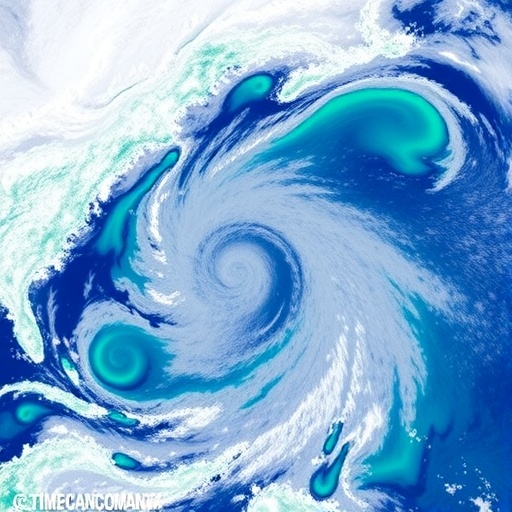
In the dynamic and often destructive climate of the Western Pacific, typhoons stand as some of the most formidable natural phenomena, posing significant threats to Japan and the broader East Asian region. As global temperatures climb, the intensity and frequency of these storms have been observed to escalate, amplifying risks for millions of inhabitants in coastal and inland areas. Addressing this critical challenge requires not only improved forecasting but also a nuanced understanding of the underlying climatic drivers that influence typhoon behavior over both short and long-term periods.
Researchers at Kyoto University’s Disaster Prevention Research Institute have made a pivotal breakthrough in decoding the complex relationships between sea surface temperatures (SST) and typhoon intensification. SST plays a vital role in fueling typhoons by providing the necessary heat energy that powers these storms. Yet, previous methods have struggled to probabilistically link spatial variations in these ocean temperatures to typhoon intensity, especially when factoring in broader climate variability. This limitation has often led to underestimation or oversimplification in typhoon risk assessments.
To overcome these barriers, the team integrated a slab-ocean model with the sophisticated Global Atmospheric Climate Model developed by the Japan Meteorological Agency’s Meteorological Research Institute. This innovative coupling allows for enhanced simulation of atmosphere-ocean feedback mechanisms on a global scale, thereby granting researchers a significantly more realistic framework for studying how SST patterns influence typhoon formation and strength. Such modeling endeavors are computationally intensive and technically demanding, yet they offer unparalleled insights.
The team conducted a series of ensemble experiments, carefully designed to explore the probabilistic impacts of different SST spatial distributions on typhoon intensity. These experiments were run under historical climate conditions to establish baseline variability and future climate scenarios to detect changes attributable to warming trends. By performing these simulations at both traditional resolutions of 60 kilometers and a fine-grained 20-kilometer scale, the researchers were able to interrogate detail-dependent dynamics, revealing subtleties in storm energetics and intensity modulation invisible to coarser models.
Results from these simulations are illuminating. The analyses demonstrate that roughly 50 to 60 percent of the variability in typhoon intensity can be attributed to SST influences, including both natural spatial temperature distributions and overall increases in mean SST linked to anthropogenic climate change. This fraction represents a substantial portion of intensity variability, underscoring the critical role oceans play in modulating typhoon activity and hinting at the potential for improved forecasting through nuanced SST measurements.
Perhaps most alarming, the team’s probabilistic assessments indicate a considerable increase in the frequency of extreme typhoons. While current climatology suggests that such powerful storms might occur once every century, future projections reveal a dramatic escalation, predicting four to five such events per century. This rise not only places additional strain on disaster preparedness infrastructures but also signals the intensification of climate risks for vulnerable coastal populations.
Lead investigator Nobuhito Mori emphasizes the unexpected clarity of SST’s impact on typhoon intensification, noting that the influence of warming oceans is more pronounced than previously appreciated. These findings resonate profoundly given the dire social and economic repercussions that follow destructive typhoons each year, pointing to the urgent need for incorporating such advanced modeling into policy and infrastructure planning processes.
Beyond immediate risk prediction, this research establishes a robust platform for global-scale, high-resolution ensemble climate experiments that amalgamate atmospheric and oceanic processes. By refining these methods, scientists can reduce uncertainty in future climate projections, providing a more scientifically credible basis for decision-makers tasked with long-term resilience and adaptation strategies. This is particularly relevant for sectors reliant on infrastructure longevity and robustness, such as coastal defense systems and urban planning.
Looking forward, the Kyoto University team is committed to advancing their modeling techniques to capture even greater fidelity in typhoon simulation. First author Yoshiki Matsuo highlights the importance of understanding extreme weather evolution through both engineering and sociological lenses. This interdisciplinary approach aims to not only improve physical predictions but also to integrate societal responses, thereby fostering comprehensive climate adaptation frameworks.
Methodologically, the coupling of slab-ocean models with atmospheric climate models represents a frontier in climate science, offering new pathways for investigating coupled physical phenomena. This approach allows researchers to dissect the intertwined effects of local SST anomalies and overarching warming trends while preserving the complex feedback loops inherent in the Earth system. Such precision is indispensable for deciphering the multifaceted dynamics of tropical cyclones.
Furthermore, the use of ensemble simulations exemplifies the shift in climate research toward probabilistic rather than deterministic forecasting. This paradigm acknowledges the inherent variability and uncertainty in climate systems, promoting risk assessments that better reflect possible ranges of outcomes. For typhoon-prone regions, this means authorities can develop flexible, data-driven contingency plans that accommodate diverse future scenarios.
In conclusion, Kyoto University’s innovative research marks a critical advance in understanding typhoon dynamics amid a warming world. By leveraging state-of-the-art coupled atmosphere-ocean models and high-resolution simulations, the team has provided compelling evidence that both spatial SST patterns and anthropogenic warming substantially influence typhoon intensity and frequency. These insights carry profound implications for scientific inquiry, disaster risk management, and policy formulation aimed at safeguarding populations in an era of escalating climate extremes.
News Publication Date: April 16, 2026
Web References: http://dx.doi.org/10.1175/JCLI-D-25-0274.1
References: Journal of Climate, Volume and Issue details as per publication date April 16, 2026.
Cite Scienmag News
Violet Maxwell. (May 13, 2026). Forecasting Typhoon Strength Through Ocean Surface Temperature Analysis. Scienmag. https://scienmag.com/forecasting-typhoon-strength-through-ocean-surface-temperature-analysis/
Violet Maxwell. "Forecasting Typhoon Strength Through Ocean Surface Temperature Analysis." Scienmag, 13 May 2026, https://scienmag.com/forecasting-typhoon-strength-through-ocean-surface-temperature-analysis/. Accessed 4 September 2026.
Violet Maxwell. "Forecasting Typhoon Strength Through Ocean Surface Temperature Analysis." Scienmag. May 13, 2026. https://scienmag.com/forecasting-typhoon-strength-through-ocean-surface-temperature-analysis/


