

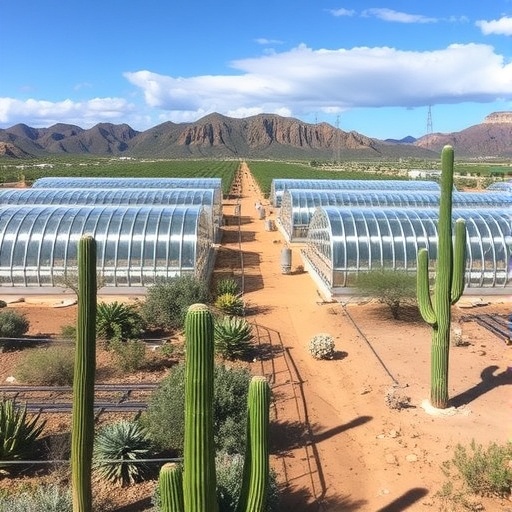
In a groundbreaking advancement that could redefine the future of sustainable agriculture, researchers have successfully integrated direct air capture (DAC) technology into desert-based greenhouse crop production to achieve carbon-neutral, and potentially carbon-negative, agricultural systems. The endeavor, recently detailed by Lopez-Reyes et al. in npj Sustainable Agriculture, leverages sophisticated CO2 enrichment strategies to not only improve crop yields but also drastically reduce the carbon footprint traditionally associated with greenhouse farming in arid environments. This pioneering approach addresses two converging global challenges: agricultural productivity in increasingly hostile climates and climate change mitigation through innovative carbon management frameworks.
Desert agriculture has long represented a paradoxical challenge. On one hand, it offers vast expanses of underutilized land that could bolster food production without encroaching on fertile areas or rainforests. On the other hand, cultivating crops in these harsh environments demands intensive energy inputs, primarily for climate control and CO2 supplementation, which historically results in high carbon emissions. The integration of DAC technology into this paradigm transforms the challenge by capturing CO2 directly from the atmosphere and repurposing it as a growth stimulant inside controlled-environment greenhouses. This strategy not only closes the carbon loop but also produces a localized source of CO2 that enhances photosynthesis efficiency in crops.
The technical underpinnings of this innovation rely heavily on advancements in DAC systems capable of extracting CO2 even from low-concentration air streams typical of arid environments. These systems utilize chemical sorbents or solid adsorbents engineered to optimize CO2 capture rates while minimizing energy consumption. Once captured, the purified CO2 is compressed and injected into greenhouse atmospheres, where its concentration is carefully modulated to optimize plant growth without risking toxicity or detrimental stress responses. This targeted enrichment contrasts sharply with conventional greenhouse practices that utilize fossil-fuel-derived CO2, which contributes further to net carbon emissions.
One of the critical innovations illuminated in the study is the coupling of DAC technology with renewable energy sources. By powering the capture and delivery systems with solar energy abundant in desert regions, the researchers demonstrate a closed-cycle carbon strategy that virtually eliminates fossil-based inputs. The synergy between solar power and DAC creates a resilient, off-grid agricultural model that reduces reliance on centralized energy infrastructures. This approach is vital for desert agriculture, where electrical grids are often sparse or overwhelmed by extreme environmental conditions.
This research situates itself squarely within the domain of carbon circularity in food production. By orchestrating a carbon capture, enrichment, and sequestration loop at the farm level, the system achieves a dual purpose. Not only does it enhance crop output per unit of water and energy, but it also contributes to negative emissions by capturing atmospheric CO2 that would otherwise exacerbate global warming. The authors highlight that such a system could serve as a blueprint for global-scale application, particularly in regions where desertification threatens food security and where DAC technology can be deployed at scale.
The experimental design detailed by Lopez-Reyes et al. articulates the use of diverse crop species suited for desert climates, including tomatoes, cucumbers, and leafy greens, cultivated under varying CO2 enrichment regimes. Through rigorous phenotyping and physiological assessments, the researchers evidenced substantial gains in biomass accumulation and nutrient density, underscoring that CO2 enrichment does not merely increase quantity but also enhances crop quality parameters essential for market value and dietary benefits. These outcomes are pivotal given the global demand for nutrient-rich produce amidst changing climates.
Energy optimization also constituted an essential axis of the research. The deployment of DAC units was engineered to balance maximal CO2 capture with minimal net energy use through innovative heat exchange systems and sorbent regeneration processes. Maintaining this balance ensures economic and environmental viability, which has historically been the Achilles’ heel of DAC technologies due to their energy-intensive nature. The work advances novel engineering controls and operational protocols that can serve as a foundation for industrial-scale implementation.
Furthermore, the study extensively analyzes the lifecycle emissions associated with this carbon-managed greenhouse system. Through comprehensive computational modelling and empirical data, the team quantified net greenhouse gas emissions across all stages of the agricultural value chain. Results revealed a significant reduction in CO2 equivalent emissions compared to traditional greenhouse operations, with potential pathways towards net-zero or net-negative agricultural footprints. This positions DAC-integrated greenhouses as critical infrastructures in future climate policies oriented toward sustainable food systems.
Water use efficiency, a perennial challenge in arid zone agriculture, also benefited from the system’s innovative design. By enhancing photosynthetic rates through CO2 enrichment, plants exhibited improved biomass yields per unit of water transpired, enabling more efficient use of scarce water resources. Coupled with advanced irrigation technologies, such as drip irrigation and hydroponic systems integrated into the greenhouse design, the approach champions a holistic resource optimization framework that is vital for resilience under water-limited conditions.
Importantly, the researchers explored economic aspects and scalability potential, addressing common skeptics who question the cost-effectiveness of coupling DAC with agriculture on a commercial scale. Preliminary cost-benefit analyses indicated that the synergy of carbon credits from negative emissions, enhanced crop yields, and energy savings through solar integration could create viable business models. This financial feasibility is crucial for attracting investment and fostering public-private partnerships necessary for widespread adoption.
The broader implications of this work resonate strongly with sustainable development objectives that emphasize climate action, zero hunger, and responsible production. Desert agricultural systems fortified by DAC-operated CO2 enrichment can transform barren lands into productive outlets supporting local economies and food sovereignty while simultaneously contributing to carbon sequestration goals. Moreover, the model aligns with global imperatives to decarbonize sectors traditionally seen as emission-intensive, such as agriculture and energy production.
From a technological innovation standpoint, this research also signals new frontiers in climate-smart agriculture where atmospheric carbon management transcends mitigation to become an enhancer of agricultural productivity and ecosystem services. The interfacing of cutting-edge chemical engineering with biological systems in constrained environmental conditions sets a precedent for future research integrating nanomaterials, sensor networks, and AI-driven control systems to further refine resource use efficiency and crop performance under desert conditions.
Looking forward, the authors identify key challenges related to long-term system durability, sorbent material lifecycle, and environmental footprint beyond carbon emissions, such as potential impacts on soil microbiomes and local biodiversity. They emphasize the importance of multidisciplinary collaborations and policy frameworks that support innovation diffusion while ensuring ecological safety and social acceptance of such integrated technologies.
In summary, the integration of direct air capture-based CO2 enrichment into desert greenhouse crop production represents a transformative step toward sustainable, carbon-neutral agriculture. The careful orchestration of renewable energy integration, advanced CO2 management, and optimized crop cultivation holds promise for revolutionizing how food security and climate goals can be simultaneously advanced in some of the planet’s most extreme environments. This conceptual and practical leap not only demonstrates technological feasibility but also heralds new paradigms for ecological stewardship and climate-responsive agriculture.
As global climate models predict increasing desertification and the urgency for decarbonization intensifies, the innovations presented by Lopez-Reyes and colleagues provide a hopeful blueprint. Their work underscores how interdisciplinary science and engineering can unlock opportunities within environmental constraints, turning challenges into sustainable innovations. The nexus of DAC technology and green agriculture may very well become a cornerstone of 21st-century strategies to feed a growing population while actively combating climate change.
Subject of Research: Decarbonizing desert greenhouse crop production using direct air capture-based CO2 enrichment technology.
Article Title: Decarbonizing desert greenhouse crop production with direct air capture–based CO₂ enrichment.
Article References:
Lopez-Reyes, Z., Hopwood, W., Jones, J. et al. Decarbonizing desert greenhouse crop production with direct air capture–based CO₂ enrichment. npj Sustain. Agric. 4, 39 (2026). https://doi.org/10.1038/s44264-026-00149-6
Image Credits: AI Generated


