


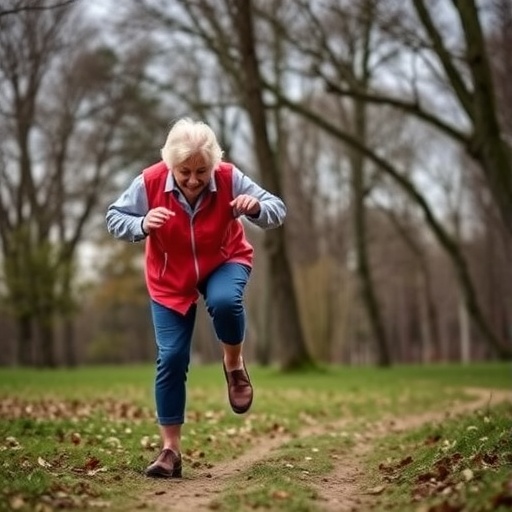
As the global population ages, understanding the intricate factors that influence the well-being of older adults has become a pivotal area of scientific inquiry. Among these factors, fear of falling and physical activity levels emerge as crucial determinants that significantly shape the quality of life of seniors living independently in community settings. Recent research by Tsai, Yang, and colleagues, published in BMC Geriatrics in 2026, offers profound insights into the nuanced relationship between these variables and the overall health outcomes among community-dwelling older adults. This landmark study combines epidemiological rigor and behavioral science to map out the landscape of geriatric health risks and potentials, providing new pathways for intervention and care.
Fear of falling is more than a mere apprehension among the elderly; it constitutes a debilitating psychological barrier that can profoundly alter daily behaviors and physical capabilities. Defined as a lasting concern about falling that leads to the avoidance of activities, this fear subtly but persistently undermines mobility and independence. The implications are far-reaching, as it often initiates a vicious cycle: fear leads to reduced physical activity, which in turn contributes to muscle weakness and impaired balance, ultimately increasing the very risk of falls that individuals dread. Tsai and colleagues elaborately dissect how this fear acts as a hidden yet potent factor lowering the quality of life, manifesting in reduced social engagement, diminished mental health, and a decline in physiological resilience.
Physical activity represents a cornerstone of healthy aging, facilitating not only the maintenance of muscle strength and balance but also promoting cardiovascular health, cognitive function, and emotional well-being. However, in the context of fear of falling, physical activity levels typically dwindle, exacerbating health decline. The researchers employed comprehensive, validated scales to measure both the intensity of fear of falling and the extent of physical activity undertaken by participants. Their findings underscore a critical threshold beyond which reductions in physical activity begin to correlate strongly with declines in quality of life metrics. The phenomenon is not simply about the quantity of movement, but also its quality, regularity, and the mental state underpinning participation in physical endeavors.
The study’s methodology involved a robust sample of community-dwelling older adults, whose daily experiences encapsulate real-world challenges. Employing cross-sectional and longitudinal data, the authors were able to delineate patterns that highlight how psychological factors such as anxiety around falling intersect with physical behavior to impact health outcomes. Advanced statistical modeling revealed that even moderate fear can precipitate significant decreases in physical activity levels, which in turn compromise physical health and psychosocial functioning. These insights illuminate the multifactorial nature of aging, emphasizing the need for holistic assessments in geriatric care that transcend simplistic risk categorizations.
Importantly, Tsai et al.’s work also explores the bidirectional relationship between these variables. While fear of falling predicts lower physical activity, it is equally true that sustained reductions in physical activity can elevate fear and anxiety by impairing balance and musculoskeletal strength. This reciprocal dynamic creates an insidious feedback loop, one that can quickly spiral into immobilization and social isolation if unaddressed. The research advocates for early intervention strategies that simultaneously target psychological reassurance and physical rehabilitation, aiming to break this cycle before it severely compromises quality of life and functional independence.
In addition to psychological assessments, the team incorporated objective physical performance tests, including gait speed, muscle strength, and balance evaluations. These tests corroborated self-reported data, reinforcing the conceptual framework linking fear, activity levels, and health outcomes. The correlation between these objective measures and subjective perceptions of fear establishes a credible foundation for clinical recommendations. It suggests that interventions must be multifaceted, leveraging both physical therapy and cognitive-behavioral approaches to effectively mitigate the risk factors associated with low activity and fear of falling.
One particularly innovative aspect of the study is its incorporation of environmental and social factors, recognizing that quality of life is influenced not only by individual physiology and psychology but also by contextual variables. The authors analyzed variables such as living arrangements, social support, and accessibility of community resources, highlighting how these factors modulate the interplay between fear and physical activity. For instance, older adults who live alone or in neighborhoods with limited safe walking spaces reported higher fear levels and lower activity, underscoring the critical role of community infrastructure in public health strategies for aging populations.
The study’s implications extend beyond the individual level into healthcare systems and policy frameworks that must adapt to the shifting demographic landscape. As older adults strive to age in place rather than relocate to institutional care, the prevention of falls and maintenance of active lifestyles become essential public health priorities. Tsai and colleagues call for the integration of routine fear assessments and physical activity monitoring into primary care protocols, advocating for a preventive rather than reactive approach to elder care. Such initiatives could dramatically reduce healthcare costs by preventing falls and associated injuries while enhancing the autonomy and dignity of seniors.
From a technological perspective, the research points toward the burgeoning field of digital health solutions tailored to elder care. Remote monitoring devices, virtual balance training programs, and telehealth mental wellness support offer unprecedented opportunities to address the intertwined challenges of fear and inactivity at scale. The authors highlight preliminary evidence suggesting that these technologies, when personalized and accessible, can build confidence and physical capacity, thus disrupting the fear-activity decline cycle. Future investigations are encouraged to explore the efficacy and scalability of such interventions, aiming to blend human-centered care with state-of-the-art innovation.
In the broader context of gerontology, the findings illuminate a paradigm shift toward embracing psychological and behavioral dimensions as integral to physical health outcomes. Fear of falling, traditionally viewed as a secondary concern, now commands recognition as a central determinant of wellness, demanding allocation of research and clinical resources. The study’s comprehensive approach models a best-practice framework for holistic aging research—one that transcends biomedical models to incorporate emotional and social dynamics, thereby furnishing a richer understanding of the aging process and its modulation.
Moreover, the insights gained inform community and family caregiving strategies. Through enhanced awareness, caregivers can better support older adults in confronting and managing fear, encouraging sustained physical engagement with empathy and evidence-based practices. Educational programs tailored for caregivers could thus serve as pivotal tools to promote healthier aging trajectories. The study implicitly advocates for an interprofessional approach where clinicians, social workers, and community organizers collaborate to create nurturing environments that bolster confidence and physical capacity.
The cultural dimensions of fear of falling and physical activity bear consideration as well, given varying societal attitudes toward aging and independence across populations. Tsai et al. incorporate data reflecting diverse backgrounds, shedding light on how cultural norms and values shape perceptions of risk and activity. Understanding these variances is critical for designing culturally sensitive interventions that resonate effectively and achieve behavioral change within specific populations, thereby maximizing impact and adherence.
In conclusion, the 2026 study by Tsai, Yang, and colleagues represents a seminal contribution to aging research, elucidating the complex nexus between fear of falling, physical activity, and quality of life among community-dwelling older adults. By integrating psychological, physiological, social, and environmental factors, it advances the field toward comprehensive models that mirror the lived realities of aging individuals. The practical ramifications are profound, offering pathways to enhance longevity, autonomy, and well-being in global aging societies facing unprecedented demographic shifts.
As we look toward the future, this research sets a clarion call for scientists, clinicians, policymakers, and communities to collaboratively innovate interventions, infrastructures, and educational paradigms that address the intertwined challenges outlined. Only through such a concerted, multidisciplinary effort can we hope to unlock the full potential of aging populations, ensuring that fear does not become a barrier but rather a call to transformative action and healthful aging.
Tsai, YJ., Yang, DC., Yang, YC. et al. Association of fear of falling and low physical activity with the quality of life of community-dwelling older adults.
BMC Geriatr (2026). https://doi.org/10.1186/s12877-026-07632-2
Cite Scienmag News
Beatrice Stafford. (May 11, 2026). Fear of Falling and Activity Affect Elderly Life Quality. Scienmag. https://scienmag.com/fear-of-falling-and-activity-affect-elderly-life-quality/
Beatrice Stafford. "Fear of Falling and Activity Affect Elderly Life Quality." Scienmag, 11 May 2026, https://scienmag.com/fear-of-falling-and-activity-affect-elderly-life-quality/. Accessed 3 September 2026.
Beatrice Stafford. "Fear of Falling and Activity Affect Elderly Life Quality." Scienmag. May 11, 2026. https://scienmag.com/fear-of-falling-and-activity-affect-elderly-life-quality/


