


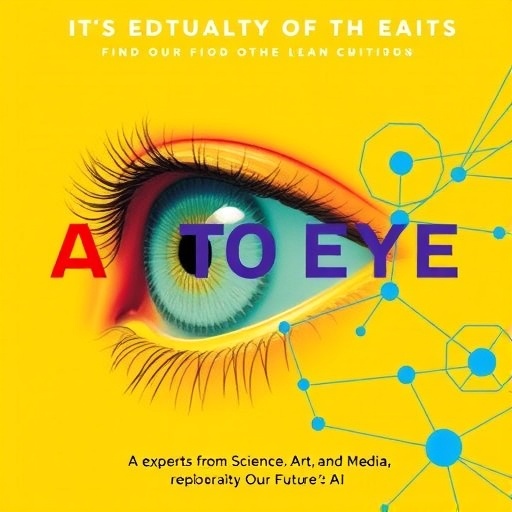
Artificial intelligence (AI) is revolutionizing society at an unprecedented rate, permeating every facet of our daily lives from healthcare and education to workplace environments and creative enterprises. The accelerated integration of AI technologies has provoked polarized public discourse, oscillating between euphoric expectations and dystopian anxieties. In this volatile climate, a nuanced and balanced conversation grounded in diverse human experiences is imperative. Prof. Robert Riener’s new book, AI TO EYE: Between Code and Conscience, courageously navigates this complex terrain, offering a multifaceted exploration of AI’s societal impact beyond technical jargon and singular viewpoints.
AI TO EYE is not a conventional technical manual nor a repository of academic research; rather, it is a curated anthology that captures the present AI epoch through a rich polyphony of voices. Comprising contributions from more than forty influential individuals—a spectrum that spans international leaders, scientists, journalists, artists, and technologists—the book offers a kaleidoscopic perspective on how AI is reshaping human self-understanding. Crucially, many contributors hail from California’s Silicon Valley and Silicon Beach, emblematic hubs of technological innovation where digital culture and cutting-edge AI development intersect.
At its core, the book debates the intricate interplay between humanity and machine intelligence, emphasizing cultural and societal dimensions alongside the technical. Unlike specialized treatises, it positions AI as a cultural phenomenon with profound ethical implications. The contributors neither converge on a singular thesis nor propagate unequivocal endorsements of technology; instead, their intersecting narratives reveal tensions, contradictions, and unforeseen consequences that invite readers to engage in reflective dialogue about AI’s societal role.
The literary framework of AI TO EYE is reminiscent of early cinematic portrayals of machine intelligence, notably Stanley Kubrick’s HAL 9000 from 2001: A Space Odyssey. Kubrick’s portrayal oscillated between marvel at computational perfection and the eerie unraveling of artificial consciousness, foregrounding central questions that remain critically relevant today: Where does the machine end, and where does the human begin? This enduring inquiry resonates throughout the book’s essays, which grapple with AI’s increasingly inseparable integration into human life and the consequent challenges to identity, agency, and autonomy.
The fifteen thematic essays dissect AI’s influence across crucial domains. Prof. Riener’s opening essay traces the evolution of artificial intelligence from mythic conceptions to computational realities, providing a technical yet accessible foundation. Subsequent essays venture into applied facets of AI, such as its transformative potential in healthcare through advancements in diagnostics and personalized treatments, explored by Julia Vogt. Education is analyzed from a student’s vantage point, with Luke Reinkensmeyer critiquing the pedagogical shifts ushered by intelligent tutoring systems and automated assessment.
Moreover, the book addresses the socioeconomic ramifications of AI, investigating whether it disrupts or democratizes the path from academia to employment, a theme examined by Ursula Renold. The impact on creative fields is equally scrutinized; Kelli Sharp’s reflections reveal AI’s dual role as a creative assistant and a source of ethical concern, while Steven Walter delves into AI’s capacity to generate music, interrogating notions of artistic originality. Renée Reizman provocatively explores “Aura Farming,” contemplating whether AI can synthesize charisma or “rizz,” a concept deeply embedded in social dynamics.
Privacy and security emerge as pivotal issues in the AI discourse, with Verena Zimmermann methodically unpacking the vulnerabilities and regulatory deficits that accompany AI’s proliferation. Ethical dimensions are further discussed by Haewon Jeong, who challenges the oft-cited fear of runaway AI (“the paperclip obsession”) and articulates hopeful prospects for embedding ethics in algorithmic design. Markus Hauschild’s essay navigates the intricate terrain of intellectual property in the AI era, where machine-generated works disrupt traditional legal paradigms.
Journalistic accountability in an age of automated content creation and algorithmic bias comprises another focal point explored by Lukas Görög. From a societal engineering perspective, Dirk Helbing contemplates the feasibility and risks of leveraging generative AI to steer human behavior and public policy. The concluding essay by Prof. Riener provocatively examines what remains intrinsically human after intelligence, urging readers to reflect on consciousness, creativity, and moral responsibility in a world shared with increasingly sophisticated machines.
The methodological approach underlying AI TO EYE is distinctive. Rather than imposing a monolithic narrative, the book embodies a dialogic process reminiscent of ethnographic inquiry, where juxtaposed perspectives create a dynamic, living portrait of AI’s multifarious effects. This approach aligns with emergent interdisciplinarity in AI research, which acknowledges that purely technical frameworks are insufficient to grapple with AI’s broader societal repercussions.
Technically, the book indirectly addresses critical AI architectures, including machine learning, neural networks, and generative models, since they underpin applications discussed in essays on healthcare, arts, and journalism. These technologies, characterized by pattern recognition and probabilistic reasoning, are interrogated not merely for their capabilities but for their ethical, legal, and social ramifications. For example, the deployment of AI in diagnostics relies on complex data aggregation and model interpretability, raising questions about transparency and bias.
In the educational domain, adaptive learning systems leverage real-time student data and reinforcement algorithms to personalize instruction, transforming traditional teacher-student dynamics. Similarly, generative AI’s incursion into creative arenas involves sophisticated generative adversarial networks (GANs) and transformer-based models that challenge conventional authorship and originality contested in intellectual property debates.
Overall, AI TO EYE transcends conventional analyses by presenting AI as a mirror reflecting societal values, anxieties, and aspirations. Its mosaic of voices illuminates the externalities of AI development, from algorithmic accountability to the cultural metaphors that shape public perceptions. It is a clarion call for interdisciplinary engagement, fostering an informed, critical, and empathetic discourse. Readers are invited not only to observe AI’s progress but to participate in shaping its trajectory—meeting this new intelligence eye to eye, with both caution and curiosity.
Prof. Robert Riener’s work represents a timely and essential contribution in an era where rapid technological advances risk outpacing ethical contemplation. By integrating insights from diverse experts and embedding AI within its cultural context, the book provides a crucial compass for navigating AI’s evolving landscape. It underscores that the future of AI is not shaped by code alone but by the conscience and collective imagination of society.
As AI continues to permeate more aspects of human existence, from the microcosm of neural network computations to the macrocosm of societal transformation, AI TO EYE offers an indispensable resource for scholars, practitioners, and curious readers alike. It reminds us that understanding AI requires a synthesis of technical expertise and humanistic inquiry—ultimately revealing what it means to be human in an age of intelligent machines.
News Publication Date: Not specified.
Web References:
https://vdf.ch/ai-to-eye.html
https://www.amazon.de/AI-EYE-Between-Code-Conscience/dp/372814228X/
Cite Scienmag News
Courtney Benton. (May 8, 2026). New Book ‘AI TO EYE’ Unites 40+ Experts from Science, Art, and Media to Explore Our Future with AI. Scienmag. https://scienmag.com/new-book-ai-to-eye-unites-40-experts-from-science-art-and-media-to-explore-our-future-with-ai/
Courtney Benton. "New Book ‘AI TO EYE’ Unites 40+ Experts from Science, Art, and Media to Explore Our Future with AI." Scienmag, 8 May 2026, https://scienmag.com/new-book-ai-to-eye-unites-40-experts-from-science-art-and-media-to-explore-our-future-with-ai/. Accessed 5 September 2026.
Courtney Benton. "New Book ‘AI TO EYE’ Unites 40+ Experts from Science, Art, and Media to Explore Our Future with AI." Scienmag. May 8, 2026. https://scienmag.com/new-book-ai-to-eye-unites-40-experts-from-science-art-and-media-to-explore-our-future-with-ai/


