


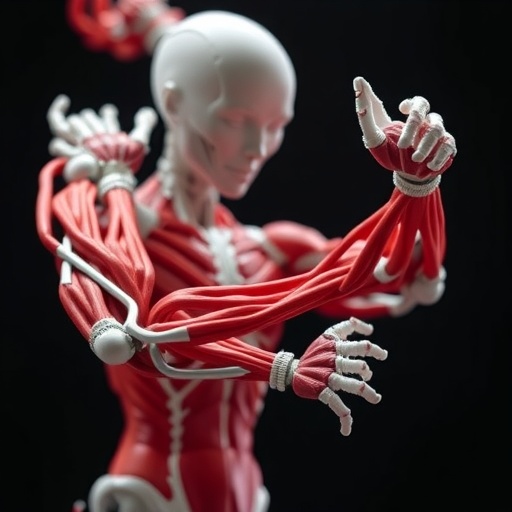
In a pioneering leap for materials science and soft robotics, researchers at Harvard University have unveiled a revolutionary 3D printing technology that fabricates filaments with pre-programmed shape-changing abilities. Utilizing a method known as rotational multimaterial 3D printing, the team engineered filaments comprised of juxtaposed “active” liquid crystal elastomers (LCEs) and “passive” elastomers. This nuanced material architecture allows the filaments to bend, twist, contract, or expand in response to thermal stimuli, mimicking the sophisticated mechanical functions of biological muscles.
These filaments epitomize an innovative class of artificial muscles, signifying a transformative stride toward replicating the intricate fiber bundles found in natural musculature. Unlike conventional materials that deform passively, the active LCE component responds dynamically to temperature changes by contracting along a molecularly aligned axis when heated above a critical transition temperature. Meanwhile, the passive elastomer sustains structural support, preserving shape fidelity and heterogeneously guiding motion. By extruding these two materials side by side through a precisely rotating nozzle, the research team embedded a helical molecular alignment into the filament’s cross section, effectively encoding curvature and twist without post-processing or multilayer assembly.
The genius of this approach lies in its seamless integration of rotational multi-material extrusion, which allows unprecedented control over the spatial distribution of active and passive domains within a singular filament. As the composite filament warms, the LCE shrinks directionally, creating bending moments resisted by the passive side, thus producing programmed shape morphing. This methodology eliminates common challenges faced in soft robotics, such as the complexity of assembling multiple layers or embedding external actuation components. It opens the door to scalable manufacturing of architected soft materials with predictable and customizable actuation.
The researchers meticulously validated their designs with rigorous mechanical modeling and collaborated with experts in structure mechanics and molecular characterization to optimize filament behavior. Utilizing advanced X-ray scattering techniques at Brookhaven National Laboratory, they confirmed the fidelity of molecular alignment essential for predictable actuation. These interdisciplinary efforts provided a robust framework not only predicting but also tailoring filament deformation under thermal conditions, thereby enabling rational design of complex soft robotic elements.
In demonstrating their novel filament technology, Harvard’s team created sinusoidal filament structures exhibiting remarkable shape transformations. Depending on the positional arrangement of the active LCE within the wave’s curvature, heating either induced expansion and straightening or contraction and shrinkage. This dual behavior exemplifies the versatility achievable through selective placement of active domains, allowing for a rich repertoire of mechanical responses from seemingly identical structural units.
Building on this foundational capability, the team assembled flat lattices composed of alternating filaments with controlled expansion and contraction properties. Such lattices operate as thermally responsive filters capable of modulating porosity to selectively allow or trap particles upon heating or cooling. Further inspiration was drawn from biological gripping mechanisms, culminating in the fabrication of free-standing lattice “grippers” that can clasp, lift, and release multiple rod-like objects with temperature-controlled precision—a promising advance for soft robotic manipulation.
One of the most compelling demonstrations involved a lattice immersed in an oil bath, which morphed into a dome shape upon heating. This dynamic form change aligned closely with computational simulations, underscoring the precision of the programmable shape morphing and the power of combining computational design with advanced material printing techniques. The fidelity between model predictions and physical behavior indicates potential for designing even more sophisticated reconfigurable structures for applications in diverse fields.
Addressing scalability, the team has successfully printed filaments as fine as approximately one-tenth of a millimeter in diameter and anticipates pushing these dimensions further with refinements in nozzle design and ink formulations. Future iterations may incorporate additional functionalities such as embedded liquid metal channels to facilitate electrical actuation or integrated sensing capabilities, paving the way for multifunctional soft devices that respond to myriad stimuli beyond temperature.
Although liquid crystal elastomers are currently nascent in commercial applications, their promise in sectors such as soft robotics, biomedical devices, and energy absorption materials is rapidly gaining recognition. The ability to manufacture filamentary artificial muscles that operate autonomously without mechanical or electronic intervention marks a paradigm shift. These materials hold transformative potential for developing reconfigurable soft components capable of gentle, adaptive interaction with delicate objects—key for healthcare, wearable technologies, and adaptive filters in fluid flow systems.
Harvard’s rotational 3D printing framework thus represents a milestone in translating artificial muscle-like materials from laboratory curiosities into scalable, customizable technologies suitable for real-world applications. The team envisions porous, high-surface-area constructs formed by entangled, injectable filaments capable of rapid locking—a feature valuable in biomedical contexts such as tissue repair where controlled clotting is essential. By marrying materials engineering with precision additive manufacturing, this research ushers in new horizons for programmable materials that seamlessly blend form, function, and responsiveness.
Looking ahead, the intersection of rotational multimaterial printing with complementary advances in polymer chemistry and computational design promises to spark an era of smart, adaptable materials. The synthesis of active-passive architectures engineered at the microscale into cohesive, multifunctional macroscopic devices could revolutionize how soft robots are designed and operated. As these “artificial muscles” evolve, they will redefine the boundaries of manipulation, interaction, and environment-responsive behavior in synthetic systems, closely emulating the exquisite capabilities perfected by natural evolution.
This breakthrough not only revitalizes the vision of materials capable of programmed shape transformations but also establishes a versatile platform for exploring new realms in additive manufacturing, soft robotics, and bio-inspired engineering. As the research community builds on these foundational concepts, the seamless integration of function and form at the filament level will accelerate the advent of next-generation smart materials tailored for complex dynamic environments.
News Publication Date:
22-Apr-2026
Web References:
http://dx.doi.org/10.1073/pnas.2537250123
References:
Proceedings of the National Academy of Sciences, DOI: 10.1073/pnas.2537250123
Cite Scienmag News
Denise Maddox. (May 8, 2026). Advancing Artificial Muscles Capable of Bending and Twisting on Demand. Scienmag. https://scienmag.com/advancing-artificial-muscles-capable-of-bending-and-twisting-on-demand/
Denise Maddox. "Advancing Artificial Muscles Capable of Bending and Twisting on Demand." Scienmag, 8 May 2026, https://scienmag.com/advancing-artificial-muscles-capable-of-bending-and-twisting-on-demand/. Accessed 3 September 2026.
Denise Maddox. "Advancing Artificial Muscles Capable of Bending and Twisting on Demand." Scienmag. May 8, 2026. https://scienmag.com/advancing-artificial-muscles-capable-of-bending-and-twisting-on-demand/


