


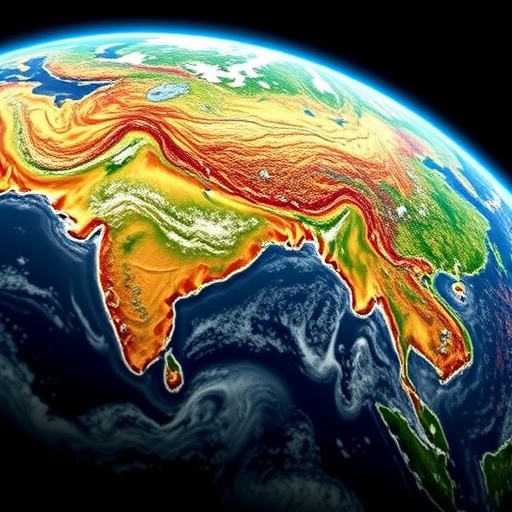
Earth’s earliest continents may have played a pivotal role in creating the chemical environment necessary for life’s origin by regulating boron concentrations in ancient oceans, according to a groundbreaking study published in Terra Nova. For decades, scientists have considered the role of boron as essential to the stability of ribose sugars, critical components of RNA molecules that likely preceded DNA in the evolutionary timeline. These fragile sugars are notoriously unstable without boron, making the element indispensable in life’s primordial chemistry.
Boron’s significance, however, lies in its precise balance. Excessive boron levels are toxic to biological organisms, while an insufficient amount could have precluded the formation of life’s foundational molecules. Thus, understanding geological processes that modulated boron availability is crucial for unraveling Earth’s abiogenesis puzzle. Recent findings introduce the concept of a geological “control system” that shaped early ocean chemistry and ultimately favored the chemical conditions conducive to life.
Dr. Brendan Dyck, Associate Professor of Earth and Environmental Sciences at UBC Okanagan’s Irving K. Barber Faculty of Science, elucidates that the growth of the Earth’s continental crust was more than a mere reshaping of the planet’s surface. Rather, it was a transformative event that altered Earth’s surface chemistry in fundamental ways, enabling life to emerge. Dr. Dyck, along with Dr. Jon Wade from the University of Oxford, uncovered evidence that prior to the emergence of substantial landmasses over 3.7 billion years ago, boron concentrations in primordial oceans were alarmingly high.
Their research focuses on the vital role played by granite-rich continental crust, which drastically altered the geochemical cycle of boron. Central to this process is the mineral tourmaline, a boron-bearing crystalline mineral widely recognized as a semi-precious gemstone but, more importantly, abundant in continental rock formations. Tourmaline was instrumental in sequestering boron from ocean water into the continental crust over geological timescales.
Tourmaline’s unique ability to incorporate boron into its crystal lattice allowed large amounts of boron to be locked away within growing continental crusts. This process reduced the oceanic boron concentrations from an initially toxic excess to levels comparable to those in present-day seawater. As continents weathered and eroded, boron was released gradually into surface waters, thereby stabilizing its bioavailability within a range suitable for life.
This geochemical stabilization had profound implications for prebiotic chemistry. The controlled release of boron likely prevented the rapid degradation of ribose sugars—molecules essential for RNA stability and replication. Without this delicate balance, complex biochemical structures fundamental to life’s origin would have disintegrated before ever assembling. The study offers compelling evidence that life’s chemical prerequisites were as much a product of geological evolution as biological processes.
The implications of these findings extend beyond Earth’s history and into the broader search for extraterrestrial life. Planets with surface water but lacking granite-rich continental crust—such as Mars—may be deficient in suitable boron chemistry, rendering their environments less hospitable for life as we understand it. This new perspective emphasizes that planetary habitability depends not only on orbital parameters or water presence but also on the intricate geological pathways governing chemical availability.
This research underscores the importance of the progressive geological evolution of terrestrial planets in shaping habitable conditions. The slow accretion and weathering of continents can modulate surface chemistry in ways that directly impact biochemical potentials. Understanding these processes enriches our models of life’s emergence on Earth and informs the criteria used to evaluate other planetary bodies in our solar system and beyond.
Future studies will likely delve deeper into the complex interactions between continental crust formation, mineral chemistry, and biogeochemical cycles in early Earth’s history. Investigating analogous mineral processes and boron dynamics on other rocky planets could enhance our understanding of habitability prerequisites. Furthermore, these insights may guide the design of astrobiological missions aimed at detecting biosignatures and interpreting planetary environments in light of geological evolution.
In summary, the emergence of continents was not merely a geological milestone but a chemical and biological turning point. By stabilizing boron bioavailability through the sequestration in minerals such as tourmaline, Earth’s early crust set the stage for life’s delicate chemical orchestra. This remarkable interplay between Earth’s interior, surface, and nascent biosphere provides a fascinating glimpse into the interconnectedness of planetary processes and life itself.
News Publication Date: 20-Apr-2026
Web References: 10.1111/ter.70040
References: Published study in Terra Nova
Cite Scienmag News
Violet Maxwell. (May 6, 2026). How the Emergence of Continents Shaped the Origins of Life on Earth. Scienmag. https://scienmag.com/how-the-emergence-of-continents-shaped-the-origins-of-life-on-earth/
Violet Maxwell. "How the Emergence of Continents Shaped the Origins of Life on Earth." Scienmag, 6 May 2026, https://scienmag.com/how-the-emergence-of-continents-shaped-the-origins-of-life-on-earth/. Accessed 4 September 2026.
Violet Maxwell. "How the Emergence of Continents Shaped the Origins of Life on Earth." Scienmag. May 6, 2026. https://scienmag.com/how-the-emergence-of-continents-shaped-the-origins-of-life-on-earth/


