


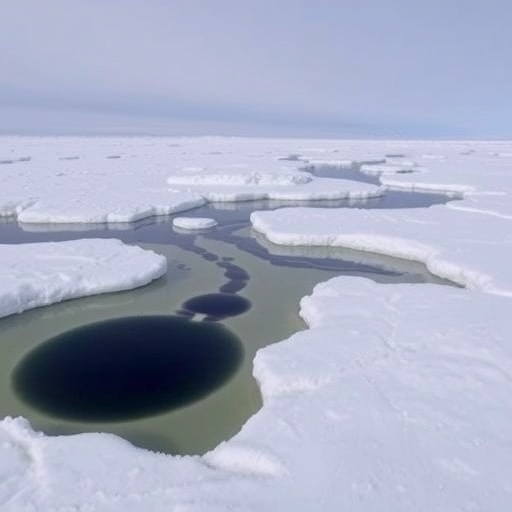
In a groundbreaking international study, scientists have unveiled new insights into the extraordinary sensitivity of the Greenland Ice Sheet to climatic warming—an alarmingly greater vulnerability than previously understood through existing models. For the first time, researchers have studied methane emissions along the entire margin of a massive ice sheet rather than isolated glacial sites, illuminating the potential feedback mechanisms embedded deep beneath the ice.
Methane, a greenhouse gas more potent than carbon dioxide over short timescales, has been detected at retreating glacier fronts worldwide, yet the Greenland Ice Sheet’s subglacial methane dynamics remained largely unexplored until now. This collaborative research involving experts from Charles University in Czechia and the University of Oulu in Finland embarked on an extensive investigation, collecting geochemical and isotopic data along a remarkable 2000-kilometer stretch of the ice sheet’s western boundary.
The team’s methodology combined stable isotope analysis with precise radiocarbon dating to trace the origins and age of methane released from subglacial meltwater. This effort revealed that the methane emanating today beneath the ice is not ancient abiotic gas but instead biologically produced, ranging from 1500 to 4500 years old. Such methane formation occurs under anaerobic conditions, driven by microbes that metabolize organic carbon trapped within sediments below the ice where oxygen supply is limited or absent.
This discovery delivers a compelling narrative about the ice sheet’s behavior during the Holocene Thermal Maximum, a period around 4000 years ago characterized by elevated Arctic temperatures similar to those currently experienced. Evidence suggests a significant retreat of the Greenland Ice Sheet during this warmer climatic phase, exposing large expanses of terrain that facilitated the growth of boreal and tundra ecosystems. These ecosystems contributed organic matter to sediments later buried as the ice readvanced in cooler subsequent periods, effectively trapping the methane-producing microbes in anoxic environments beneath the ice.
Such an insight carries profound implications. The Greenland Ice Sheet, once considered somewhat inert on millennial timescales, is shown to be remarkably dynamic and reactive to temperature shifts. This heightened susceptibility challenges prevailing glaciological models and accentuates the risk of accelerated ice mass loss in response to ongoing anthropogenic warming.
According to Professor Alun Hubbard from the University of Oulu, a co-author of the study, the feedback mechanism deepens the climate crisis paradox. As the ice retreats due to warming, it facilitates methane emissions from subglacial environments, thereby potentially amplifying greenhouse gas concentrations and accelerating further ice loss. This process highlights an intrinsic coupling between ice sheet dynamics and subglacial biogeochemical cycles that had not been fully appreciated before.
The phenomenon aligns with a growing body of discourse on so-called “hidden methane reservoirs” beneath glaciated regions. Historically sequestered beneath thick ice, these reservoirs might soon play a non-negligible role in global methane budgets as warming and deglaciation rates intensify. The current emissions from these methane sources remain minor at the planetary level; however, the trend warrants close monitoring given the exponential nature of climate feedback loops.
Jade Hatton, lead author from Charles University, emphasizes how these new findings underscore the significance of ice margin fluctuations on subglacial carbon fluxes. With continued melting, subglacial hydrological networks gain connectivity, enhancing the transport pathways for methane from the sediment-laden beds toward the atmosphere. Importantly, this mechanism is not limited to Greenland. The Antarctic Ice Sheet, hosting even more substantial organic carbon reservoirs under its vast ice cover, could be a future hotspot for similar methane releases as global temperatures rise.
This expanding understanding reshapes how scientists model both ice sheet stability and greenhouse gas emissions in a warming world. It also poses critical challenges for climate mitigation efforts, as these latent methane pools could accelerate rates of global warming beyond anticipated scenarios. The research calls for enhanced integration of subglacial biogeochemistry into climate models to better predict future sea-level rise and atmospheric composition.
The comprehensive study, published in the May 5, 2026, issue of Nature Geoscience, represents an important multidisciplinary achievement bridging glaciology, microbiology, geochemistry, and climate science. It leverages sophisticated sampling techniques and innovations in isotope geochemistry to excavate the temporal story imprinted within methane molecules released by ancient microbial life beneath the ice.
Beyond the scientific community, these revelations reinforce the urgency for global greenhouse gas emissions reductions. The Greenland Ice Sheet’s responsiveness to climatic shifts and its capacity to release potent greenhouse gases add a layer of complexity to climate projections, compelling a dual focus on both emission control and ongoing monitoring of cryospheric methane dynamics.
Future research will aim to quantify the precise volume of methane released under various climate scenarios and extend these findings to other glaciated regions worldwide. Understanding the interplay between ice sheet retreat, microbial methane production, and atmospheric feedback will be critical to anticipating the trajectory of future climate change impacts and informing adaptive strategies.
In summary, the Greenland Ice Sheet emerges not only as a barometer of global warming but also as an active participant in climate regulation through microbial methane release. This paradigm shift underscores the interconnectedness of Earth’s systems—where ice, microorganisms, and atmospheric chemistry coalesce to influence planetary health in unprecedented ways.
News Publication Date: 5-May-2026
Web References:
References: Nature Geoscience, 2026, DOI: 10.1038/s41561-026-01976-5
Cite Scienmag News
Sloane Callahan. (May 6, 2026). Methane Released from Beneath Greenland’s Ice Highlights Region’s Climate Change Vulnerability. Scienmag. https://scienmag.com/methane-released-from-beneath-greenlands-ice-highlights-regions-climate-change-vulnerability/
Sloane Callahan. "Methane Released from Beneath Greenland’s Ice Highlights Region’s Climate Change Vulnerability." Scienmag, 6 May 2026, https://scienmag.com/methane-released-from-beneath-greenlands-ice-highlights-regions-climate-change-vulnerability/. Accessed 3 September 2026.
Sloane Callahan. "Methane Released from Beneath Greenland’s Ice Highlights Region’s Climate Change Vulnerability." Scienmag. May 6, 2026. https://scienmag.com/methane-released-from-beneath-greenlands-ice-highlights-regions-climate-change-vulnerability/


