


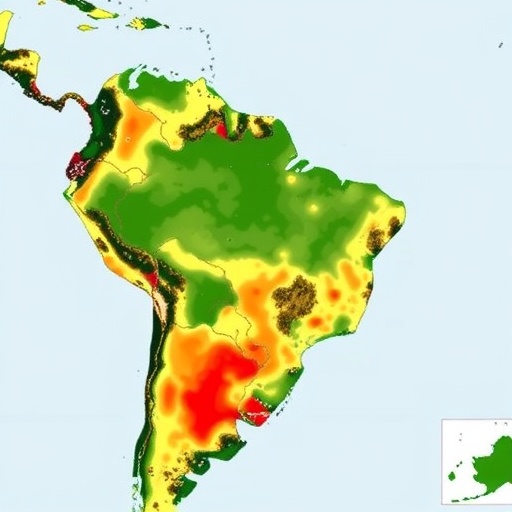
A groundbreaking study from the Potsdam Institute for Climate Impact Research (PIK) has unveiled alarming insights into the vulnerability of the Amazon rainforest under the dual threats of climate change and deforestation. Published recently in the prestigious journal Nature, the research reveals that approximately two-thirds of the Amazon could transition into degraded forest or savannah-like ecosystems at global warming levels as low as 1.5 to 1.9°C if deforestation rates escalate to around 22-28 percent of the forest’s total area. This finding starkly contrasts with previous assumptions that such a fundamental ecological shift would only be triggered at much higher temperatures, around 3.7 to 4°C, in the absence of further deforestation.
The Amazon, often regarded as the lungs of our planet, plays a critical role in stabilizing Earth’s climate system. Its unique capability to generate and recycle its own rainfall through evapotranspiration is integral not only for maintaining local biodiversity but also for regulating atmospheric moisture on a continental scale. The new research emphasizes how deforestation disrupts this hydrological feedback mechanism drastically. Trees emit water vapor that condenses and precipitates back as rain, sustaining the forest ecosystem. When forests are cleared, this cycle weakens, decreasing regional rainfall and increasing the likelihood of persistent droughts.
Nico Wunderling, the lead author and a prominent Earth system scientist at Goethe University Frankfurt, articulates the gravity of these dynamics. His team’s climate models demonstrate that ongoing deforestation intensifies atmospheric drying, weakening the resilience of the forest, and thereby substantially lowering the temperature threshold at which irreversible ecosystem degradation may occur. “Even moderate additional warming can provoke cascading ecological impacts across extensive parts of the Amazon,” Wunderling warns, underscoring how deforestation coupled with modest temperature rises can act synergistically to destabilize this critical biome.
The innovative approach employed by the researchers integrates climate projections with hydrological modeling and atmospheric moisture transport networks. These sophisticated models simulate not only local but also large-scale inter-regional moisture transport disruptions caused by forest loss. Arie Staal, assistant professor and co-author from Utrecht University, explains that deforestation in one part of the Amazon does not merely affect the immediate vicinity; instead, it weakens atmospheric moisture flows across distances spanning hundreds or thousands of kilometers, potentially triggering widespread drought stress and forest degradation far beyond the areas directly impacted by logging.
Currently, nearly 17-18 percent of the Amazon forest has been cleared, edging the entire ecosystem perilously close to the critical deforestation thresholds identified by this study. The consequences of breaching these thresholds could extend well beyond ecological degradation. Johan Rockström, PIK Director and co-author, elaborates on the profound planetary implications, emphasizing the Amazon’s pivotal role as a carbon sink and biodiversity reservoir. Its tipping point would not only accelerate global climate feedback loops but severely jeopardize biodiversity conservation and indigenous livelihoods across the region.
The research findings powerfully illuminate how land-use changes amplify climate risks, reinforcing the urgent necessity for aggressive deforestation curbs. The authors highlight that immediate and sustained action to halt forest clearance and implement large-scale ecological restoration could bolster the Amazon’s resilience to already unavoidable values of heating predicted by global climate models. Such measures are integral to preserving the forest’s self-sustaining moisture recycling processes, thereby maintaining precipitation patterns and mitigating drought frequency.
Beyond the ecological insights, this study enhances our understanding of tipping points in complex Earth systems, where gradual anthropogenic pressures may precipitate abrupt and often irreversible ecosystem transformations. This interaction of warming and deforestation represents a nonlinear threat to the Amazon’s stability, where incremental changes in either factor could precipitate cascading environmental crises. The modeling framework designed by the team marks a significant advance in predicting these feedback effects, offering policymakers crucial tools to assess both local and cross-regional consequences of environmental interventions.
Deforestation-induced moisture reductions initiated in one Amazonian sector trigger a domino effect, weakening neighboring ecosystems through interconnected atmospheric moisture transport networks. Consequently, mitigation strategies that focus solely on isolated conservation zones may prove insufficient. Instead, integrated landscape-level approaches that recognize the interdependence of forest patches and atmospheric processes are imperative to sustain the basin-wide hydrological cycle and ecological integrity.
The study also underscores the broader implications of Amazon degradation on global climate regulation. As the forest’s carbon sequestration capacity diminishes with escalating droughts and biomass loss, atmospheric greenhouse gas concentrations could rise more rapidly, compounding global warming. This feedback mechanism exacerbates climate impacts worldwide, making Amazon conservation an issue of paramount international significance that transcends regional boundaries.
In conclusion, the research delivers a vital call to action, asserting that these cascading impacts are not foregone inevitabilities. Coordinated international efforts involving rapid emission reductions and vigorous forest conservation and restoration initiatives offer a plausible pathway to maintain the Amazon’s resilience in the face of climate change. Far from being a remote or abstract problem, the stability of the Amazon rainforest is intricately linked to global environmental health, underscoring the interconnectedness of human actions and planetary boundaries.
Web References:
DOI link to original article
Cite Scienmag News
Russell Cooper. (May 6, 2026). Amazon Degradation Triggered Below 2°C Warming Due to Deforestation. Scienmag. https://scienmag.com/amazon-degradation-triggered-below-2c-warming-due-to-deforestation/
Russell Cooper. "Amazon Degradation Triggered Below 2°C Warming Due to Deforestation." Scienmag, 6 May 2026, https://scienmag.com/amazon-degradation-triggered-below-2c-warming-due-to-deforestation/. Accessed 3 September 2026.
Russell Cooper. "Amazon Degradation Triggered Below 2°C Warming Due to Deforestation." Scienmag. May 6, 2026. https://scienmag.com/amazon-degradation-triggered-below-2c-warming-due-to-deforestation/


