


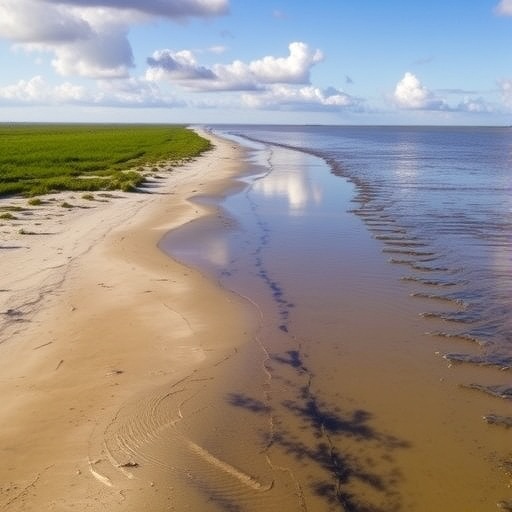
As climate change accelerates the loss of coastal environments worldwide, few regions illustrate the complex interplay of environmental degradation and human adaptation more starkly than Louisiana. The state’s coastline, already the most vulnerable and rapidly receding in the United States, is projected to undergo dramatic transformations, threatening to displace entire communities and reshape a social and ecological landscape that has evolved over millennia. By 2070, it is anticipated that Louisiana will lose approximately 75% of its remaining wetlands, with the shoreline retreating more than 30 miles inland of New Orleans, rendering much of its coastal area uninhabitable. This unfolding crisis demands urgent and innovative approaches to adaptation, including what researchers term “managed relocation,” a strategic multi-generational transition of populations and infrastructure seeking refuge on higher ground.
Central to understanding this dilemma is the work of a multidisciplinary group of scientists, including Yale’s assistant professor of urban sustainability Brianna Castro, whose research has recently been published in the journal Nature Sustainability. Their study offers a critical window into the unfolding crisis of climate-driven depopulation in coastal Louisiana, framing the region as a “canary in the coal mine” for global climate impacts. Unlike many regions where retreat from the coast is still theoretical, Louisiana’s experience is tangible and accelerating, exacerbated by compounding social and economic pressures. The implications of their findings extend beyond the region, offering insights into how other coastal areas worldwide might navigate similar challenges.
The study highlights the concept of ‘pulse retreat,’ a phenomenon observed in Louisiana’s coastal communities where catastrophic events such as Hurricane Katrina in 2005 triggered sharp population declines that have not rebounded to prior levels. Orleans Parish witnessed a 25% reduction in its population, while rural Cameron Parish saw more than half of its residents relocate. Such acute depopulation underscores the dual nature of climate change impacts: immediate disaster-driven displacement coupled with persistent, gradual environmental decline. This reality complicates traditional urban planning and disaster response because it is not merely about rebuilding after events but managing the long-term, inevitable retreat from increasingly unlivable zones.
Drawing on an interdisciplinary approach, the research team synthesized data from contemporary censuses with archaeological records and geological analyses dating back to the Last Interglacial period, approximately 125,000 years ago. This retrospective lens reveals that mobile indigenous communities inhabiting the Mississippi Delta operated dynamic settlement patterns, adapting to shifting shorelines long before the onset of modern climate change. Contrasting with these earlier communities were later European settlers who established more permanent, fixed infrastructures, ingraining a deeply rooted attachment to place. As the landscape morphs under the pressures of rising sea levels and subsidence, these historical shifts underscore the challenge modern communities face in balancing long-term habitation with necessary mobility.
From a technical perspective, the Louisiana coastline is subject to processes such as subsidence, sediment deprivation due to river management, and increased storm surge amplification. The interplay of these processes accelerates wetland loss and shoreline erosion. Wetlands serve as critical buffers against storm impacts and as vital ecosystems supporting biodiversity. The loss of these natural defenses not only threatens human settlements but also undermines the ecological integrity of the Mississippi Delta. Consequently, managed retreat is no longer a mere policy option but a pressing imperative that could inform a blueprint for climate adaptation strategies globally.
Yet, not all coastal regions in the United States are approaching the retreat paradigm with the same urgency or planning rigor. The study contrasts Louisiana’s potential for organized, managed relocation with areas like Florida and Alabama, where development continues unabated in high-risk coastal zones. The “if you build it, they will come” mentality perpetuates vulnerability, setting the stage for chaotic, crisis-driven evacuations rather than orderly transitions. Thus, Louisiana’s experience could serve as a vital case study demonstrating the benefits of proactive policy design prioritizing social welfare alongside environmental realities.
The researchers emphasize that accepting the inevitability of retreat opens a narrow but critical window for innovation in infrastructure and housing. This approach could spawn affordable, resilient communities tailored for populations on the move, rather than reactive rebuilding in places destined to succumb to climate threats. Managed relocation, they argue, is not simply about physical movement but about fostering social continuity and equity in adaptation processes. This shifts the paradigm from loss and displacement to strategic transition and opportunity.
Furthermore, multi-disciplinary collaboration among urban planners, environmental scientists, and sociologists is essential for addressing the complex implications of coastal retreat. Understanding demographic trends alongside ecological modeling informs where and how communities might resettle while maintaining social cohesion and cultural heritage. For example, relocation strategies must account for economic accessibility, employment opportunities, and community networks to avoid merely transferring vulnerability from one locale to another.
The urgency of Louisiana’s coastal crisis also underlines the importance of large-scale, long-term policy frameworks that extend beyond emergency response to encompass generational planning. This requires coordinated actions among federal, state, and local governments, alongside community engagement and investment in sustainable economic alternatives. Without such comprehensive planning, the risk escalates for abrupt, uncontrollable population displacements precipitated by escalating storm events and environmental degradation.
In conclusion, Louisiana’s coastal transformation is an instructive microcosm of the global challenges wrought by climate change. The state exemplifies how rising seas, land subsidence, and human settlement patterns create a perfect storm of vulnerability, necessitating thoughtful and forward-looking adaptation strategies. Managed relocation presents a paradigm shift towards resilience by design—addressing not only the physical necessity of moving but also the social, economic, and cultural dimensions. While the challenges remain immense, the ongoing research and collaborative efforts offer a hopeful pathway for Louisiana and similarly imperiled coastal zones worldwide to adapt with foresight and equity rather than reaction and loss.
News Publication Date: 4-May-2026
Cite Scienmag News
Sloane Callahan. (May 5, 2026). Louisiana’s Disappearing Coast Highlights Urgency for Managed Retreat Strategies. Scienmag. https://scienmag.com/louisianas-disappearing-coast-highlights-urgency-for-managed-retreat-strategies/
Sloane Callahan. "Louisiana’s Disappearing Coast Highlights Urgency for Managed Retreat Strategies." Scienmag, 5 May 2026, https://scienmag.com/louisianas-disappearing-coast-highlights-urgency-for-managed-retreat-strategies/. Accessed 3 September 2026.
Sloane Callahan. "Louisiana’s Disappearing Coast Highlights Urgency for Managed Retreat Strategies." Scienmag. May 5, 2026. https://scienmag.com/louisianas-disappearing-coast-highlights-urgency-for-managed-retreat-strategies/


