


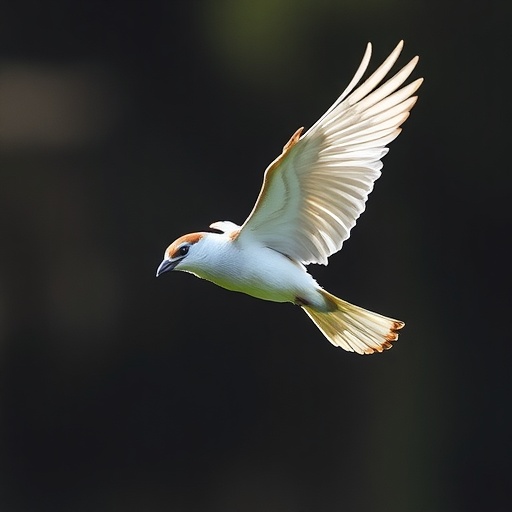
Recent groundbreaking research from the University of Bristol has upended long-held beliefs regarding the adaptation of bird wing shapes to their flight capabilities. In a surprising revelation published in the prestigious journal Nature Communications, the study demonstrates that the iconic and massive wings of some avian species such as albatrosses are not necessarily the “optimal” shapes for their extraordinary long-distance migrations. This finding challenges conventional adaptationist thinking and opens new avenues for examining evolutionary biology and biomechanics of flight.
The investigation centered on whether birds, as a large and diverse group, have evolved wings that are ideally shaped for the specific styles of flight they perform. To address this question, the researchers implemented a sophisticated method known as theoretical morphospace. This modeling technique allowed scientists to conceptualize a comprehensive grid of all possible wing shapes that could exist in nature, transcending the constraints of currently observed forms. The researchers then analyzed the aerodynamic performance of these theoretical wings, creating a performance landscape akin to a topographic map where peaks indicate superior flight efficiency.
By overlaying real bird wing samples onto this theoretical map, the team quantitatively assessed how closely natural wing morphologies approach theoretical optima. The data encompassed an extensive collection of 1,139 modern bird wings, encompassing a broad representation of avian diversity. The integration of theoretical and empirical data enabled researchers to objectively measure the degree of adaptation in wing morphology relative to the aerodynamic demands of different flight styles.
Intriguingly, the study revealed a mosaic pattern of optimization rather than uniform adaptation across bird species. Some groups, such as hummingbirds and penguins, exhibited wing shapes closely aligned with the theoretically optimal designs for their specialized flight styles. Hummingbirds, known for their hovering prowess, possess wing architectures that maximize aerodynamic efficiency for their unique flight mode. Penguins, while flightless in air, demonstrated wings optimally shaped for aquatic propulsion, highlighting an unexpected versatility in wing evolution.
Contrastingly, many passerines—the most abundant and familiar group of birds—have wings that fall into mid to lower tiers of aerodynamic performance. This suggests that a strategy of “good enough” functionality predominates among these species, where selection pressures have not driven evolution toward absolute optimality. This insight signifies a shift from the simplistic view that natural selection invariably sculpts perfect design toward understanding that evolutionary outcomes often reflect compromises and constraints.
One of the most striking findings was that famed long-distance globetrotters such as albatrosses and Arctic terns exhibit wing designs that are not optimally aerodynamic for their epic migrations. Despite their legendary endurance flights spanning Arctic to Antarctic regions, their wing morphologies are suboptimal according to the performance landscape. This challenges the assumption that extraordinary performance indicators necessitate correspondingly optimized anatomical structures and suggests ecological or evolutionary trade-offs may shape these wing morphologies.
Lead author Benton Walters, a doctoral researcher at Bristol’s School of Earth Sciences, emphasized that their findings counter the entrenched assumption of perfect morphological adaptation: “Our research allowed us to decisively test optimality and uncovered many instances of suboptimal wing shapes in birds. Evolution, it seems, favors functionally sufficient over theoretically ideal designs in many contexts.”
The methodology employed—an innovative melding of theoretical modeling with extensive empirical sampling—provides a powerful new framework for studying shape-function relationships in evolutionary biology. It affords a lidar-like view of potential morphological space, enabling an understanding not only of existing biological forms but also of those that could exist but do not. This, in turn, allows scientists to infer the selective pressures and constraints influencing morphological evolution.
Looking forward, the research team plans to extend this analytical framework beyond birds to examine wing shapes in other flying vertebrates like bats, as well as extinct groups such as pterosaurs. Since powered flight evolved independently in these taxa, comparing their wing morphologies against theoretical optima could yield profound insights into convergent or divergent evolutionary pathways and the influence of functional demands on morphological innovation.
An especially tantalizing prospect is the inclusion of fossil bird species like Archaeopteryx. Integrating fossil data into the morphospace analysis may clarify how wing shapes evolved during the earliest stages of avian flight evolution and could reveal how these iconic transitional species performed aerodynamically. Such insights promise to deepen our understanding of the evolutionary origins of flight and the biomechanical constraints shaping it.
Besides its evolutionary significance, this work has notable implications for bioinspired engineering. Walters notes that the findings highlight the importance of choosing appropriate natural archetypes when designing biomimetic aircraft. Rather than indiscriminately copying nature, engineers should consider which species’ morphological adaptations best suit specific flight requirements, potentially leading to more efficient and innovative aerospace designs.
In conclusion, this research recasts the narrative of avian wing evolution, illuminating a complex landscape of morphological optimization punctuated by trade-offs, surprises, and diverse evolutionary solutions. It stands as a compelling example of how integrating theoretical modeling with extensive empirical data can challenge assumptions, refine our understanding of adaptation, and inspire innovation in technology and biology alike.
Cite Scienmag News
Gavin Prescott. (May 5, 2026). Study Reveals Most Birds Have Yet to Evolve Optimal Wing Shapes for Flight. Scienmag. https://scienmag.com/study-reveals-most-birds-have-yet-to-evolve-optimal-wing-shapes-for-flight/
Gavin Prescott. "Study Reveals Most Birds Have Yet to Evolve Optimal Wing Shapes for Flight." Scienmag, 5 May 2026, https://scienmag.com/study-reveals-most-birds-have-yet-to-evolve-optimal-wing-shapes-for-flight/. Accessed 5 September 2026.
Gavin Prescott. "Study Reveals Most Birds Have Yet to Evolve Optimal Wing Shapes for Flight." Scienmag. May 5, 2026. https://scienmag.com/study-reveals-most-birds-have-yet-to-evolve-optimal-wing-shapes-for-flight/


