


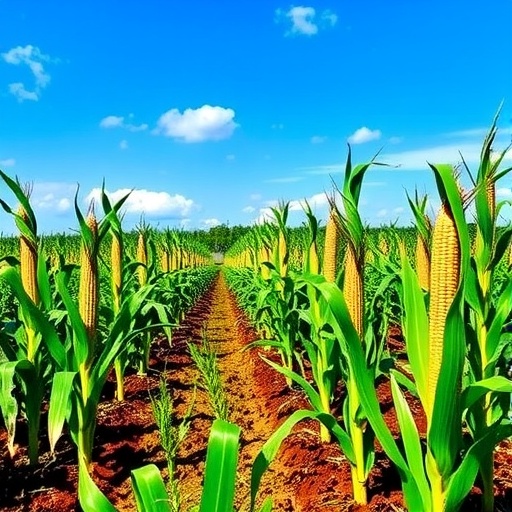
In a groundbreaking study that holds significant promise for sustainable agriculture in the Congo Basin, researchers have revealed that intercropping maize with legumes substantially enhances maize yields without increasing greenhouse gas emissions. This finding provides a crucial piece of the puzzle in addressing the dual challenges of food security and climate change resilience in one of Africa’s most vital agricultural regions.
The Congo Basin, characterized by its rich biodiversity and extensive rainforests, supports the livelihoods of millions of people who depend heavily on subsistence farming. Maize, as a staple crop, plays an essential role in the regional diet and economy. However, traditional monoculture practices have often led to soil degradation, reduced yields, and increased vulnerability to climate variability. Intercropping, an ancient agricultural practice involving the simultaneous cultivation of two or more crops, has resurfaced as a sustainable alternative to monoculture farming systems.
This latest research focused on the impacts of intercropping maize with legumes, a crop family known for their nitrogen-fixing capabilities, in a bid to analyze productivity gains and environmental sustainability. The nitrogen fixation by legumes has the potential to enrich soil fertility naturally, reducing the necessity for synthetic fertilizers, which are costly and environmentally damaging. The team conducted extensive field trials across diverse agroecological zones in the Congo Basin, carefully monitoring yield metrics alongside greenhouse gas emissions, specifically nitrous oxide (N2O), methane (CH4), and carbon dioxide (CO2).
Data collection revealed that maize yields increased markedly in plots where legumes were intercropped, with improvements observed across both wet and dry seasons. This yield enhancement is attributed primarily to improved soil nitrogen availability facilitated by the legumes, which reduces nutrient competition and supports more vigorous maize growth. Importantly, the intercropping system also enhanced biodiversity at the plot level, promoting beneficial insect populations and improving ecosystem functionality.
Equally notable was the observation that, despite the increased biomass production, the greenhouse gas emissions from intercropped plots did not significantly exceed those from monoculture maize systems. This result challenges the prevailing assumption that intensification invariably leads to higher emissions. Methane emissions remained negligible across treatments, while nitrous oxide and carbon dioxide fluxes were comparable, suggesting that the biological nitrogen fixation process creates a nitrogen input that is more environmentally benign than synthetic fertilizers.
The implications extend beyond productivity metrics. The study underscores how integrating legumes into maize cropping systems can buffer the agroecosystem against climatic stressors, particularly erratic rainfall. By improving soil structure and moisture retention, legumes help stabilize yields amidst climatic variability. This synergy not only supports food security but also aligns with climate-smart agriculture principles, enhancing the adaptive capacity of smallholder farmers in the Congo Basin.
Furthermore, these findings advocate for a reduction in dependence on inorganic nitrogen fertilizers, which are both prohibitively expensive for most small-scale farmers and a significant source of greenhouse gas emissions globally. By harnessing natural biological processes, intercropping can transform agricultural landscapes into carbon sinks rather than carbon sources, aiding broader climate mitigation efforts.
The study also sheds light on the socio-economic dimensions of adopting intercropping practices. Improved maize yields translate directly to enhanced household food availability and potential income through surplus production. Additionally, legumes, often used as food or forage, contribute nutritional diversity and livestock feed, broadening livelihood opportunities.
Nonetheless, the researchers caution that successful implementation requires attention to local contexts, including farmer knowledge, labor availability, and access to quality legume seeds. Extension services and participatory approaches are essential to disseminate this knowledge effectively and ensure the scalability of intercropping systems. Continued research into optimizing species combinations, planting densities, and management practices will further enhance the benefits realized by farmers.
Environmental monitoring protocols employed in the study involved eddy covariance techniques and static chamber sampling, providing high-resolution data on gas fluxes. The rigorous methodological approach boosts confidence in the findings and sets a precedent for future multidisciplinary studies that integrate agronomic performance with environmental impact assessments.
Another consequential aspect highlighted by this research is the role of intercropping in preserving soil health. Legumes contribute organic matter inputs through root biomass and leaf litter, fostering microbial diversity and activity. Enhanced microbial processes improve nutrient cycling, pest suppression, and soil carbon sequestration—foundations for long-term agricultural sustainability.
Given the urgency of climate change and food insecurity challenges in sub-Saharan Africa, this evidence supports policy shifts toward promoting legume intercropping and other agroecological innovations. Governments, NGOs, and international bodies would do well to invest in scaling these practices, ensuring they are embedded within national agricultural development frameworks and climate action plans.
In sum, the innovative study offers a compelling blueprint for sustainable intensification tailored to the Congo Basin’s unique ecological and socio-economic context. It demonstrates that increasing food production and protecting the environment are not mutually exclusive goals but rather complementary pathways achievable through scientifically informed farming practices. The potential to replicate such outcomes in similar tropical regions worldwide marks a pivotal step towards global food and climate resilience.
As this research circulates within academic and policy circles, it is anticipated to inspire renewed interest in legume-based intercropping and catalyze investments in agroecological research. The convergence of ecological wisdom and contemporary science embedded in this approach embodies the future of sustainable agriculture—a future where productivity and climate stewardship walk hand in hand.
Cite Scienmag News
Alan Morgan. (May 4, 2026). Legume Intercropping Boosts Congo Maize Yields Emission-Neutral. Scienmag. https://scienmag.com/legume-intercropping-boosts-congo-maize-yields-emission-neutral/
Alan Morgan. "Legume Intercropping Boosts Congo Maize Yields Emission-Neutral." Scienmag, 4 May 2026, https://scienmag.com/legume-intercropping-boosts-congo-maize-yields-emission-neutral/. Accessed 3 September 2026.
Alan Morgan. "Legume Intercropping Boosts Congo Maize Yields Emission-Neutral." Scienmag. May 4, 2026. https://scienmag.com/legume-intercropping-boosts-congo-maize-yields-emission-neutral/


