


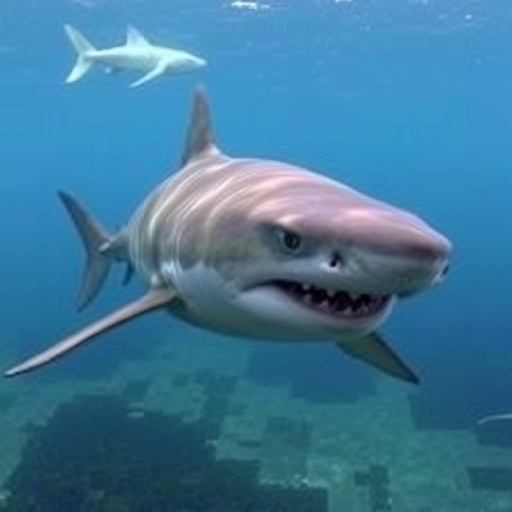
In a groundbreaking study published in the journal npj Climate and Atmospheric Science, researchers have unveiled a novel approach to enhancing ocean climate forecasting by utilizing data collected from electronically tagged sharks. This innovative research demonstrates how marine predators, particularly blue sharks, can function as dynamic, mobile sensors, collecting critical oceanographic data from regions traditionally under-sampled by conventional ocean observation networks. This pioneering effort not only broadens our understanding of marine biology and climate science but also proposes a transformative tool to improve the accuracy of climate models where it is most needed.
The study was spearheaded by Dr. Laura H. McDonnell during her doctoral research at the University of Miami’s Rosenstiel School of Marine, Atmospheric, and Earth Science, alongside the Leonard and Jayne Abess Center for Ecosystem Science and Policy. By leveraging satellite-tagged sharks equipped to transmit location, temperature, and depth data in near real time, the team established a unique data stream from the Northwest Atlantic Ocean—a highly dynamic marine environment, rich in complex physical processes like ocean fronts and mesoscale eddies, which often challenge conventional models due to sparse observational data.
Sharks, inherently drawn to these oceanographic features as they hunt and migrate, serve as natural explorers of the sea’s intricate thermohaline landscape. The research focused on the blue shark (Prionace glauca) along with one shortfin mako shark (Isurus oxyrinchus), tagging a total of 19 individuals. Their movements were documented through sophisticated satellite tags capable of not only tracking precise geographic locations but also capturing high-resolution vertical profiles of temperature and depth down to nearly 2,000 meters. The collected data yielded over 8,200 temperature-depth profiles, providing a rich, multi-dimensional dataset previously unavailable from such a mobile, autonomous source.
This unique data integration is significant because dynamic coastal and shelf waters experience rapid shifts in temperature and momentum fluxes, where traditional observation platforms—such as fixed buoys, ship surveys, or satellite remote sensing—often cannot adequately capture conditions beneath the surface or on timescales necessary for seasonal climate forecasting. By inserting these shark-borne data into the Community Climate System Model (CCSM), a sophisticated coupled ocean-atmosphere model widely used in operational seasonal climate prediction including NOAA’s North American Multi-Model Ensemble (NMME), the team observed a dramatic enhancement in forecast accuracy.
Specifically, the assimilated data reduced errors in predicted sea surface temperatures by as much as 40 percent in certain regions of the Northwest Atlantic. This error reduction is vital because precise ocean temperature forecasts influence weather patterns, hurricane intensity predictions, marine ecosystem functioning, and fisheries sustainability. The improved resolution of ocean thermal structure also supports better understanding of ocean-atmosphere interactions, which govern climate variability on seasonal and longer time scales, ultimately influencing coastal economies and community resilience.
The interdisciplinary collaboration was essential to the success of this study. Shark ecologist Dr. Neil Hammerschlag and atmospheric scientist Dr. Ben P. Kirtman, now dean of the Rosenstiel School, initially identified the untapped climate data potential in animal telemetry research used for ecological studies. Their partnership, later bolstered by oceanographer Dr. Camrin D. Braun from Woods Hole Oceanographic Institution, enabled seamless integration of biological, oceanographic, and atmospheric expertise, breaking traditional disciplinary boundaries to innovate climate science methodologies.
One of the technical breakthroughs enabling this research was the deployment of advanced satellite tags that could simultaneously gather and transmit multi-parameter oceanographic data alongside geolocation. Typically, animal-borne instruments have been limited to tracking movement patterns, but these enriched tags provide comprehensive environmental context. Critically, this allows scientists to link the vertical and horizontal oceanographic conditions directly to shark positions with known accuracy, enabling rigorous incorporation of these data points into numerical models.
While the study establishes proof of concept, the researchers emphasize that tagged sharks and other marine predators are not a substitute for established ocean observing systems. Instead, they serve as complementary sensors filling critical observational gaps, especially in subsurface environments beneath dynamic ocean fronts and eddies, where traditional instruments may fall short both spatially and temporally. This concept echoes the growing trend in Earth sciences embracing novel bio-logging techniques to augment remote sensing and in situ measurements.
The implications for marine ecosystem management and climate adaptation are profound. Small but meaningful improvements in forecast reliability can empower fisheries management agencies and coastal planners to make better-informed decisions about sustainable harvesting, resource allocation, and disaster preparedness. Enhanced predictions help mitigate economic impacts, improve human safety, and facilitate resilience in the face of changing climate and ocean conditions.
Moreover, this approach highlights a compelling synergy between wildlife biology and climate science, opening new avenues for leveraging animal behavior and telemetry data beyond ecological inquiry. By tapping into the routine migratory patterns of sharks, researchers gain unobtrusive, cost-effective monitoring capabilities that circumvent limitations of expensive, ship-based data collection campaigns or sparse autonomous sensor deployments.
This forward-looking study also catalyzes further exploration of marine predator telemetry as a tool for understanding not only physical oceanography but also biogeochemical cycles and habitat utilization under evolving climate scenarios. Such interdisciplinary frameworks promote integrative environmental stewardship that holistically considers biological and physical ocean systems.
Funded by Cisco Systems and supported by institutional partnerships, this research marks a pioneering milestone demonstrating how science at the intersection of ecology, oceanography, and atmospheric physics can yield practical climate solutions. Dr. McDonnell, now a postdoctoral investigator at the Woods Hole Oceanographic Institution, and her collaborators envision expanding these methodologies globally to leverage other marine megafauna as sentinels of ocean health and climate dynamics.
This first-ever integration of animal-borne sensor data into a seasonal climate forecasting model paves the way for operational deployment in existing forecasting frameworks and encourages further development of biologically informed observational networks. As climate variability intensifies and observation challenges persist, such innovative strategies promise to enhance our predictive capabilities and deepen our connection to the marine world.
News Publication Date: 28-Apr-2026
Web References:
https://www.nature.com/articles/s41612-026-01394-9
Cite Scienmag News
Russell Cooper. (May 4, 2026). Study Finds Sharks Could Enhance Climate Forecast Accuracy. Scienmag. https://scienmag.com/study-finds-sharks-could-enhance-climate-forecast-accuracy/
Russell Cooper. "Study Finds Sharks Could Enhance Climate Forecast Accuracy." Scienmag, 4 May 2026, https://scienmag.com/study-finds-sharks-could-enhance-climate-forecast-accuracy/. Accessed 4 September 2026.
Russell Cooper. "Study Finds Sharks Could Enhance Climate Forecast Accuracy." Scienmag. May 4, 2026. https://scienmag.com/study-finds-sharks-could-enhance-climate-forecast-accuracy/


