


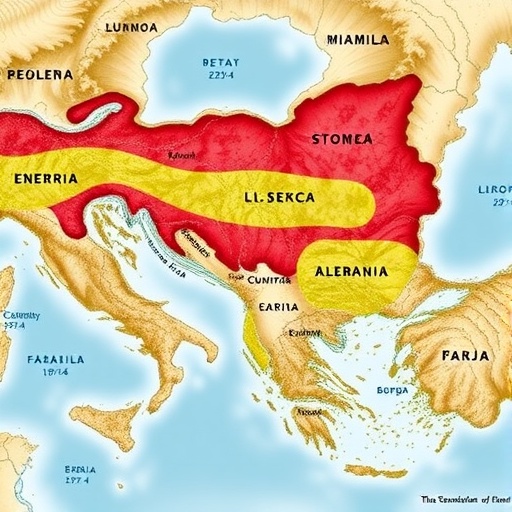
In a groundbreaking study published in Nature Human Behaviour, an international team of geneticists and historians has unveiled new insights into the enigmatic origins of the Albanian people, a group whose history has long puzzled scholars. The Albanian language, distinct from any other surviving Indo-European language, and the group’s late appearance in historical records during the eleventh century CE, have fueled intense debate regarding their ancient roots. By harnessing the power of ancient DNA analysis, the researchers have reconstructed a detailed genetic narrative that sheds light on the ancestry and migration patterns of Albanians, offering key clues about their ethno-linguistic formation and historical continuity in the Balkans.
The study involved the analysis of over 6,000 ancient genomes from West Eurasia, combined with 74 newly sequenced genomes from present-day ethnic Albanians. This vast dataset enabled the researchers to perform an unprecedented deep dive into the population structure and migration history of the region. One of the study’s core innovations was the employment of an enhanced identity-by-descent (IBD) detection protocol, which allowed the team to trace fine-scale genetic links between ancient individuals and modern populations. Through this method, they identified a significant continuity linking Late Bronze and Iron Age populations of the Western Balkans directly to Early Medieval inhabitants of Albania.
This continuity is more pronounced in Albania than in neighboring Balkan populations, suggesting that the genetic signature of the region’s ancient inhabitants has been remarkably preserved despite various historic upheavals. By approximately 800 to 900 CE, the ancestry profile observed in the Early Medieval Albanian individuals already demonstrated close affinity to modern Albanians, indicating that the genetic roots of the present-day population were largely established by that time. This finding challenges previous assumptions about large-scale population replacements or extensive genetic assimilation after the Roman Empire’s collapse in the Balkans.
In addition to this indigenous genetic layer, the team detected varying degrees of admixture from Medieval East European-related groups, which contributed approximately 10 to 20 percent of the ancestral makeup of Albanians today. This admixture was not uniform across Albania but rather showed a geographical pattern, reflecting historical migration routes and inter-population contacts facilitated by trade, warfare, and cultural exchange during the Middle Ages. This layer of ancestry reveals the dynamic demographic processes that have shaped the genetic landscape of the region while highlighting the resilience of the core paleo-Balkan genetic identity.
The study’s rigorous methodological framework combined genome-wide analyses, IBD segment detection, and chronological contextualization of archaeological sites, enabling a fine-grained temporal resolution of population changes. The researchers’ ability to link genetic continuity with specific archaeological cultures gave them unique insights into how ancient populations transitioned through the Bronze and Iron Ages into the Early Medieval period. This chronological depth is crucial for understanding how and when the ancestors of modern Albanians formed a distinct genetic and cultural identity.
Beyond genetic data, the authors discuss the linguistic implications of their findings. The Albanian language has long been classified as an isolate within the Indo-European family, with no close relatives. The genetic continuity seen supports the hypothesis that the proto-Albanian language likely developed in situ, within the Western Balkans, rather than arriving through later migrations. This positions the paleo-Balkan linguistic substrate as a likely source of Albanian, consistent with archaeological and historical records that suggest the persistence of ancient local groups through millennia.
Importantly, the study provides a clearer picture of the Balkans in a period traditionally considered obscure due to scarce written records. Using ancient DNA as a molecular archaeological tool, the team bridges gaps in the historical record, complementing scarce textual evidence and allowing a reconstruction of demographic events that shaped the populations today. This not only elucidates Albanian origins but enhances our general understanding of Balkan prehistoric and early medieval population dynamics.
One of the study’s standout revelations is the genetic distinctiveness of Albanians relative to surrounding Balkan groups, who show comparatively lesser continuity from Late Bronze and Iron Age populations. This underscores a degree of isolation or selective integration that preserved a unique genetic signature in Albania. Such differentiation could be explained by the mountainous terrain, geographic barriers, and socio-political factors that limited gene flow with neighboring populations, allowing the Albanian ancestral lineages to maintain their identity over centuries.
The researchers emphasize that the detected East European admixture corresponds to known historic movements, such as Slavic expansions and other population shifts during the early medieval period. While these admixture events introduced new genetic components, they did not overwrite the indigenous genetic foundation of the region. This nuanced picture challenges simplistic narratives of population replacement and instead reveals a mosaic of continuity and admixture, navigated through centuries of human interaction.
The research also highlights the potential for further interdisciplinary studies combining genetics with archaeology, linguistics, and history to untangle complex population histories. The approach used here could be applied to other understudied groups with unclear origins, offering a model for reconstructing the prehistoric and historic movements of ethno-linguistic populations in Eurasia and beyond. By building comprehensive genomic datasets anchored in archaeological context, scientists can illuminate invisible threads in human history.
Furthermore, this study serves as a powerful example of how ancient DNA technology has revolutionized anthropology and human history. Where traditional methods relied heavily on fragmentary artifacts and contested historical claims, genomic data provide a quantifiable and objective record of population continuity, migration, and admixture. Such molecular insights refine hypotheses about cultural and linguistic evolution, enhancing our understanding of how modern populations emerged.
By focusing on the Albanian case, the study also demonstrates the broader relevance of examining peripheral and less-studied regions in ancient DNA research. While much ancient DNA work has centered on major civilizations or “model” populations, this research underscores how smaller, historically marginal groups preserve rich genetic histories critical for understanding human diversity and evolution. It champions a more inclusive approach to the study of past populations.
In sum, the new genetic evidence presented in this study dramatically reshapes the narrative of Albanian origins. It portrays a story of remarkable genetic continuity from at least the Late Bronze Age through the Early Medieval period and into modernity, combined with selective admixture that enriched the local gene pool without diluting its core. This narrative aligns closely with archaeological and linguistic data, supporting a longstanding presence of Albanian ancestors in the Western Balkans and shedding light on the formation of a distinctive ethno-linguistic identity.
As the scientific community continues to explore ancient genomes from across Eurasia, studies like this one open the door to resolving long-standing historical enigmas. The Albanian genetic story exemplifies the power of ancient DNA to bridge millennia, revealing how past populations endured, adapted, and mingled to create the fabric of contemporary societies. This research not only elevates our knowledge of Albanian history but also underscores the transformative potential of genomic archaeology in reconstructing human pasts worldwide.
Cite Scienmag News
Gabrielle Wells. (May 4, 2026). Ancient DNA Uncovers Albanians’ Historical Origins. Scienmag. https://scienmag.com/ancient-dna-uncovers-albanians-historical-origins/
Gabrielle Wells. "Ancient DNA Uncovers Albanians’ Historical Origins." Scienmag, 4 May 2026, https://scienmag.com/ancient-dna-uncovers-albanians-historical-origins/. Accessed 3 September 2026.
Gabrielle Wells. "Ancient DNA Uncovers Albanians’ Historical Origins." Scienmag. May 4, 2026. https://scienmag.com/ancient-dna-uncovers-albanians-historical-origins/


