


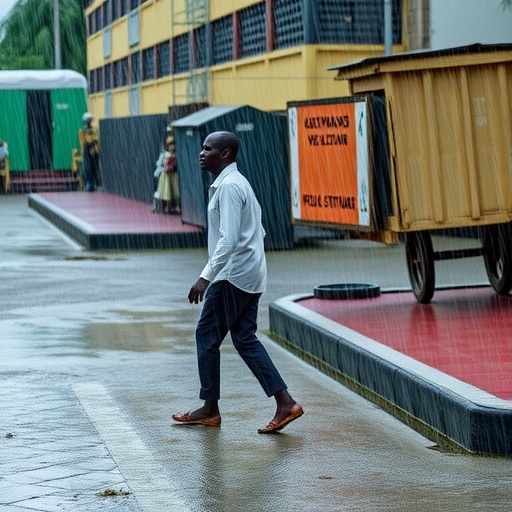
In a groundbreaking study published in Nature Communications, Ba, Hierink, Taylor, and their colleagues have revealed a profoundly concerning link between extreme precipitation events and facility-based childbirth in 21 sub-Saharan African countries. This rigorous research uncovers how climate-induced disruptions exacerbate healthcare access challenges for millions of expectant mothers across one of the world’s most vulnerable regions, transforming our understanding of climate change’s direct impact on maternal health systems.
Climate variability in sub-Saharan Africa has long been recognized as a driving force behind agricultural instability, food insecurity, and economic volatility. However, the new findings presented by this research team go one step further by identifying direct, quantifiable effects of torrential rains and flooding on the capacity and utilization of maternal healthcare facilities. The authors harness an expansive dataset spanning multiple years and countries, applying advanced statistical models to isolate the influence of extreme precipitation from other confounding factors, thereby ensuring the robustness of their conclusions.
Facility-based births, considered a key indicator of maternal healthcare quality, serve as a critical metric for monitoring progress towards reducing maternal mortality rates. The study demonstrates a striking decline in the proportion of births occurring in healthcare facilities immediately following episodes of heavy rainfall. This trend persists across diverse environments—from urban centers to rural villages—underscoring an intrinsic vulnerability in health system resilience when facing climate shock.
At the heart of the problem lies the spatial and temporal nature of precipitation extremes, which typically result in infrastructure damage, impassable roads, and disrupted transportation networks. The research team meticulously mapped health facility accessibility during and after these climatic events, revealing that more remote populations experience exacerbated barriers to reaching care. The interplay between geographical isolation and extreme weather thus compounds risks, often forcing expectant mothers to resort to home births or deliver with traditional birth attendants under potentially hazardous conditions.
The implications extend beyond mere statistics—every missed facility-based birth represents a moment of heightened danger. Skilled healthcare personnel and emergency obstetric interventions drastically reduce risks of complications such as postpartum hemorrhage, hypertensive disorders, and obstructed labor. When environmental disruptions reduce access to these services, maternal morbidity and mortality inevitably spike, undermining decades of progress in global health.
Utilizing satellite-derived rainfall data alongside national health registries, the researchers innovatively combined environmental science with public health metrics. Through this interdisciplinary approach, they captured not only where and when extreme precipitation occurs but also the resultant shifts in maternal health-seeking behavior and service delivery. This dual perspective is pivotal in designing adaptive policies capable of mitigating climate-driven health inequities.
Moreover, the study highlights an often-neglected facet of climate change—its asymmetric burden on vulnerable populations. Women in sub-Saharan Africa, already grappling with limited healthcare infrastructure and socioeconomic challenges, bear a disproportionate share of climate hazards. The authors advocate for integrating climate resilience planning into health system strengthening, emphasizing the necessity of proactive infrastructure investment, emergency preparedness, and community-based interventions.
Interestingly, the analysis reveals heterogeneity in impacts among the assessed countries, attributing variation to differences in infrastructure robustness, governance models, and community health programs. For example, some nations demonstrated quicker recovery in facility use post-precipitation events, suggesting that tailored strategies addressing local contexts can enhance system resilience. This nuanced understanding calls for multi-scalar adaptations rather than generic solutions.
The findings arrive at a critical juncture as global climate models predict increasing frequency and intensity of extreme weather events. Without strategic interventions, the trajectory threatens to reverse gains in maternal and neonatal health, effectively deepening health disparities and undermining human development goals. Consequently, this research challenges policymakers to foreground climate adaptation within health agendas and mobilize cross-sectoral action.
Future research directions emerging from this study include the exploration of adaptive technologies to maintain facility operation during floods, mobile health service deployment in inaccessible areas, and strengthening community health worker networks to provide safe delivery alternatives during crises. Equally important is the need to improve data collection infrastructures that link environmental conditions with health outcomes in real-time, fostering agile responses.
From a methodological standpoint, this study exemplifies the power of combining big data analytics, geospatial tools, and epidemiological methods to illuminate complex health-environment interactions. The pioneering use of multi-country datasets sets a new benchmark for research at the climate-health nexus, propelling the field towards predictive analytics capable of informing early warning systems and resource allocation.
The human stories underlying these statistics cannot be overlooked. Each disrupted journey to a birthing facility represents a mother’s hope deferred, the fragile timing of childbirth intersecting with the unforgiving forces of nature. In many cases, the consequences are irreversible. By bringing science, policy, and compassion together, this research opens pathways to build climate-resilient health systems that safeguard maternal lives even in the face of mounting environmental challenges.
In sum, the insights presented by Ba and collaborators signify a clarion call. Climate action and health equity are inseparably linked, and addressing extreme precipitation’s impact on maternity care must become a global priority. The hope is that this work will inspire novel strategies—from infrastructure upgrades to community education programs—that collectively ensure no mother is left behind as the climate crisis unfolds.
Cite Scienmag News
Violet Maxwell. (May 4, 2026). Extreme Rainfall Disrupts Births in Sub-Saharan Africa. Scienmag. https://scienmag.com/extreme-rainfall-disrupts-births-in-sub-saharan-africa/
Violet Maxwell. "Extreme Rainfall Disrupts Births in Sub-Saharan Africa." Scienmag, 4 May 2026, https://scienmag.com/extreme-rainfall-disrupts-births-in-sub-saharan-africa/. Accessed 5 September 2026.
Violet Maxwell. "Extreme Rainfall Disrupts Births in Sub-Saharan Africa." Scienmag. May 4, 2026. https://scienmag.com/extreme-rainfall-disrupts-births-in-sub-saharan-africa/


