


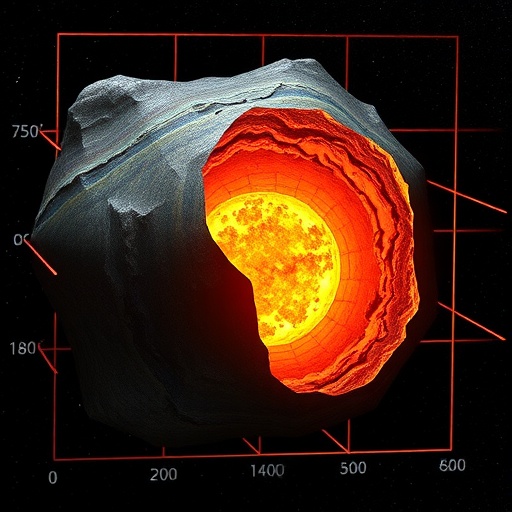
In a groundbreaking study poised to reshape our understanding of deep Earth processes, researchers have unveiled the critical role hydrogen site positions play in dictating the physical properties of hydrous magnesium silicates within the mantle transition zone. This discovery illuminates the complex interplay between water storage, mineral structure, and geodynamic behavior hundreds of kilometers beneath the surface, with profound implications for mantle convection, seismic interpretation, and the global water cycle.
The mantle transition zone, spanning depths between approximately 410 and 660 kilometers, has long been recognized as a pivotal barrier and reservoir that influences material exchange between the Earth’s upper and lower mantle. Previous investigations revealed that hydrous minerals in this region could store considerable water, yet the specific mechanisms governing their physical properties under extreme conditions remained elusive. Wang, He, Mao, and colleagues embarked on an ambitious study focusing on how variations in the atomic-scale positioning of hydrogen within magnesium silicate structures affect these minerals’ mechanical and transport characteristics.
At the heart of this investigation are hydrous magnesium silicates — compounds wherein hydrogen integrates into the crystal lattice, often substituting for or bonding with oxygen atoms. While the presence of hydrogen is known to alter mineral behavior, this new research delineates how the exact lattice sites occupied by hydrogen result in drastically different physical responses. Employing state-of-the-art spectroscopy combined with high-pressure diamond anvil cell experiments replicating mantle conditions, the team deciphered the hydrogen configurations, revealing a nuanced landscape of site-dependent properties.
One of the most striking revelations is how hydrogen location modulates the elasticity and rheology of hydrous minerals. When hydrogen occupies tetrahedral sites, the mineral exhibits enhanced elasticity, potentially facilitating seismic wave propagation through the transition zone. Conversely, hydrogen in octahedral positions tends to weaken the crystal lattice, enhancing ductility and possibly influencing localized deformation patterns within the mantle. This duality presents an intricate mosaic of geophysical behaviors previously unaccounted for in models.
Moreover, these site-dependent modifications hold significant repercussions for water transport mechanisms. Hydrogen residing in specific sites alters diffusion pathways within the mineral framework, thereby impacting how water migrates and redistributes at mantle depths. Such processes are critical for understanding mantle hydration states, influencing melting behaviors, mantle metasomatism, and ultimately, volcanic activity at the Earth’s surface. The study’s comprehensive approach melded experimental data with sophisticated computational simulations to validate these diffusion models.
Importantly, the findings also shed light on the seismic anisotropy observed in the transition zone. Variations in hydrogen placement induce subtle changes in crystal symmetry and lattice dynamics that translate to directional dependence in seismic wave velocities. This insight provides a fresh lens to reinterpret seismic tomography data, offering a more detailed and chemically informed mapping of mantle heterogeneities. Thus, the research bridges mineral physics and seismology in an unprecedented manner.
From a geochemical perspective, the work underscores the mantle transition zone’s role as a dynamic reservoir for hydrogen and, by extension, water. The preferential occupation of certain sites affects the storage capacity and release mechanisms of water during mantle convection. This can influence global water cycling over geological timescales, linking deep Earth processes to surface phenomena such as plate tectonics and climate evolution. The implication is that microscopic hydrogen arrangements have macroscopic impacts on planetary evolution.
The authors also explored the thermodynamic stability of different hydrous mineral phases considering hydrogen site variability. Their results indicate that phase boundaries are sensitive not merely to pressure and temperature but to hydrogen configuration, adding an additional dimension to phase equilibrium models. Such sensitivity may help explain abrupt seismic velocity changes correlating with transition zone boundaries as well as the presence of ultra-low velocity zones.
Technological advances played a crucial role in enabling these discoveries. The integration of synchrotron-based infrared spectroscopy and neutron scattering methods provided unprecedented resolution in identifying hydrogen positions under extreme conditions. Coupled with first-principles density functional theory calculations, the multidisciplinary approach allowed for robust quantification of how specific hydrogen environments influence lattice dynamics and energetics.
This pioneering effort sets the stage for a new paradigm in mineral physics, emphasizing the need to consider atomic-scale chemical variations when interpreting large-scale geophysical data. As the Earth’s interior remains inaccessible to direct sampling, such experimental and computational approaches offer invaluable proxies for unraveling its mysteries.
Future research directions spotlight the exploration of other hydrous phases and their hydrogen site preferences, as well as the implications for electrical conductivity and magnetic properties, which are crucial for understanding geomagnetic field generation and mantle–core interactions. Additionally, incorporating these findings into global geodynamic models holds promise for refining predictions related to mantle convection patterns, plume generation, and subduction dynamics.
In sum, the elucidation of hydrogen’s site-dependent impact on the physical properties of hydrous magnesium silicates marks a significant leap forward in deep Earth science. It enriches our conceptual toolkit, enabling a more coherent and chemically nuanced understanding of mantle behavior. As Earth scientists continue to probe the planet’s depths, such insights will be instrumental in decoding the signals that emanate from its interior, fostering advances across geology, seismology, and planetary science.
Cite Scienmag News
Violet Maxwell. (May 4, 2026). Hydrogen Effects on Mantle Transition Zone Minerals. Scienmag. https://scienmag.com/hydrogen-effects-on-mantle-transition-zone-minerals/
Violet Maxwell. "Hydrogen Effects on Mantle Transition Zone Minerals." Scienmag, 4 May 2026, https://scienmag.com/hydrogen-effects-on-mantle-transition-zone-minerals/. Accessed 5 September 2026.
Violet Maxwell. "Hydrogen Effects on Mantle Transition Zone Minerals." Scienmag. May 4, 2026. https://scienmag.com/hydrogen-effects-on-mantle-transition-zone-minerals/


