


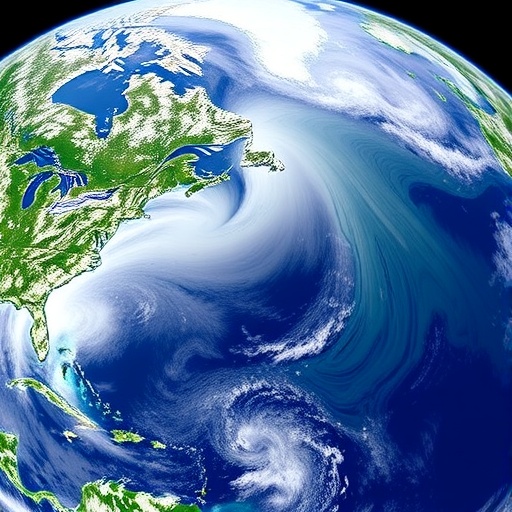
In a groundbreaking study that could reshape our understanding of climate dynamics and their far-reaching consequences, Mimi and colleagues have unveiled a critical link between the Atlantic Meridional Overturning Circulation (AMOC) slowdown and the behavior of atmospheric rivers in a warming world. This novel research, published in Nature Communications in 2026, highlights how subtle shifts in oceanic currents may significantly alter atmospheric moisture transport patterns, potentially exacerbating extreme weather events that impact millions globally.
The Atlantic Meridional Overturning Circulation, often described as a vast conveyor belt of ocean currents, plays an indispensable role in regulating Earth’s climate. It functions by transporting warm surface waters from the tropics northward, where they cool and sink to form deep waters, ultimately circulating back southward. This thermohaline circulation is not only vital for heat redistribution but also intimately connected to atmospheric processes. A weakening of the AMOC, already documented in recent decades, poses a threat to climate stability and has been suspected to influence various climatic phenomena in unforeseen ways.
Mimi and the international research team utilized an array of state-of-the-art climate models coupled with high-resolution atmospheric simulations to interrogate the future of atmospheric river behavior under the influence of AMOC slowdown scenarios projected in a warming climate. Atmospheric rivers, narrow corridors of concentrated moisture in the atmosphere, play a pivotal role in delivering precipitation, particularly to midlatitude regions such as the US West Coast and parts of Europe. They are known to cause both beneficial rainfall and devastating floods, making any changes in their nature a critical subject of study.
Their findings reveal that as the AMOC weakens, the spatial distribution, intensity, and frequency of atmospheric rivers undergo substantial modulation. Specifically, the research suggests a poleward shift and an intensification of these moisture plumes. This shift is consequential as it indicates that regions farther north, traditionally less prone to atmospheric river impacts, may start experiencing heightened risk of intense precipitation and flooding events. Such alterations compound climate vulnerability and pose new challenges for water resource management and disaster preparedness.
Central to the observed phenomenon is the role of ocean-atmosphere feedbacks. The slowdown of the AMOC leads to pronounced North Atlantic cooling relative to other ocean basins, disrupting typical temperature gradients that drive atmospheric circulation patterns. This thermal anomaly affects the jet stream position and intensity, which in turn influences the trajectories and genesis regions of atmospheric rivers. The interplay between oceanic and atmospheric shifts underscores the profound interconnectedness of Earth system components under anthropogenic pressures.
The team’s methodological approach involved analyzing multiple climate projections under different greenhouse gas emission scenarios. By isolating the effects of the AMOC slowdown from other warming-related factors, the study delineated the isolated impact of ocean circulation changes on atmospheric moisture transport mechanisms. This detailed partitioning allowed for more precise attribution of observed and projected atmospheric river changes to the evolving ocean state rather than confounding factors.
One particularly striking aspect of the study is the identification of feedback loops that may accelerate or amplify regional hydrological extremes. The enhanced poleward migration and intensity of atmospheric rivers, in conjunction with changing land surface conditions such as snowpack reduction and soil saturation states, raise the specter of more frequent and severe flooding events, especially during winter and early spring seasons in vulnerable regions. Adaptive water management strategies must therefore integrate these emerging climatological insights.
Mimi et al. also highlight the implications of their findings for understanding global climate teleconnections. Since atmospheric rivers contribute significantly to the global hydrological cycle, their modulation by Atlantic ocean circulation changes reverberates beyond the North Atlantic realm. Potential shifts in moisture transport pathways could influence monsoon systems, drought occurrences, and even hurricane behavior in interconnected climatic zones, necessitating holistic global climate assessments informed by this linkage.
The study’s results also provoke urgent questions regarding the predictability of climate extremes in mid- to high-latitude regions. Current forecasting models may require refinement to incorporate the dynamical feedbacks associated with AMOC variability and its downstream atmospheric impacts. Enhanced observational networks targeting both oceanic and atmospheric parameters are essential to validate and improve these predictive capabilities.
Crucially, the research underscores the profound impact human-driven climate change imposes on oceanic circulation patterns and, by extension, atmospheric dynamics. The AMOC, already exhibiting signs of slowdown due to polar ice melt and increased freshwater input, represents a climate system component vulnerable to tipping points. Understanding its interaction with atmospheric rivers is not merely an academic pursuit but a necessity for anticipating and mitigating climate-driven risks.
Future research trajectories proposed by the authors include exploring the potential nonlinearities and thresholds beyond which AMOC weakening could trigger abrupt atmospheric reconfigurations. Additionally, examining regional socioeconomic vulnerabilities in light of predicted atmospheric river changes can inform targeted resilience-building measures. The intersection of physical climate science and risk management emerges as a fertile ground for interdisciplinary collaboration prompted by these findings.
This study stands as a testament to the complexity and integration of Earth system processes. By elucidating the mechanistic pathways through which oceanic circulation modulates atmospheric moisture transport, Mimi et al. offer a vital piece of the puzzle in predicting future climate extremes. Their work not only advances scientific knowledge but also calls for immediate incorporation into climate adaptation frameworks worldwide.
As climate mitigation efforts strive to stabilize global temperatures, parallel strategies must address the systemic vulnerabilities exposed by such dynamic ocean-atmosphere interplays. Understanding and communicating the cascading effects from ocean circulation changes to atmospheric river behavior will be crucial to fostering informed policy decisions and public awareness.
In conclusion, this pioneering research illuminates a compelling narrative of how a weakening Atlantic Meridional Overturning Circulation, accelerated by anthropogenic warming, reshapes atmospheric river patterns, thereby altering precipitation regimes across vast regions. The study by Mimi and colleagues highlights an urgent need to refine climate models, enhance observational capabilities, and translate these scientific insights into actionable societal frameworks to safeguard communities against the intensifying hydrological hazards of a warming world.
Cite Scienmag News
Russell Cooper. (May 4, 2026). Atlantic Circulation Slowdown Alters Atmospheric Rivers. Scienmag. https://scienmag.com/atlantic-circulation-slowdown-alters-atmospheric-rivers/
Russell Cooper. "Atlantic Circulation Slowdown Alters Atmospheric Rivers." Scienmag, 4 May 2026, https://scienmag.com/atlantic-circulation-slowdown-alters-atmospheric-rivers/. Accessed 5 September 2026.
Russell Cooper. "Atlantic Circulation Slowdown Alters Atmospheric Rivers." Scienmag. May 4, 2026. https://scienmag.com/atlantic-circulation-slowdown-alters-atmospheric-rivers/


