


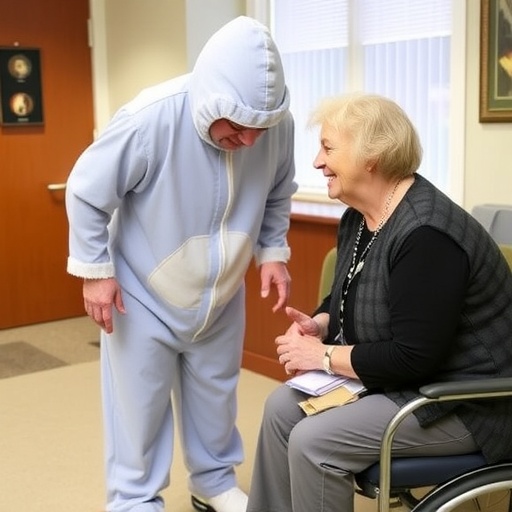
In the rapidly evolving landscape of healthcare, empathy remains a crucial yet often elusive attribute among professionals tasked with the care of aging populations. A groundbreaking study published in BMC Geriatrics in 2026 sheds new light on this challenge, investigating the transformative potential of a brief intervention using an aging simulation suit. This randomized controlled trial, led by Serrada-Tejeda and colleagues, explores how immersive experiential learning can enhance clinical empathy in healthcare workers who operate within long-term care settings. The findings hold profound implications for medical training and the future of geriatric care.
At the heart of this study lies an innovative approach to empathy training—deploying an aging simulation suit that physically mimics the sensory and motor impairments associated with aging. Designed to replicate common conditions such as reduced vision, joint stiffness, hearing loss, and decreased tactile sensitivity, the suit offers healthcare professionals a tangible and firsthand experience of the challenges confronted by their older patients. This method transcends traditional didactic or purely observational training methods, introducing a multi-sensory, embodied learning experience that bridges the empathy gap.
The trial involved healthcare professionals working in long-term care facilities, a demographic uniquely positioned to benefit from enhanced empathy given their frequent interactions with elders experiencing multifaceted health declines. Participants were randomly assigned to either the intervention group, which engaged with the aging simulation suit, or a control group, which received standard educational materials without the immersive component. Pre- and post-intervention assessments employed validated psychometric tools to quantify shifts in clinical empathy, offering robust, quantitative evidence alongside qualitative feedback.
Results from the study emphatically affirm the efficacy of the aging suit intervention. Healthcare workers who participated in the simulation demonstrated statistically significant improvements in empathy scores, reflecting a deeper understanding and appreciation of the daily struggles faced by the elderly. Notably, this empathy was not merely conceptual but manifested in caregivers’ heightened sensitivity to patients’ needs and a more patient-centered approach to care delivery. Such findings underscore the power of experiential learning in fostering a compassionate healthcare environment.
The physiological underpinnings of empathy enhancement through the aging simulation suit may involve neural mechanisms associated with embodied cognition. By physically embodying the limitations of an elderly person, caregivers engage neural networks responsible for motor and sensory processing, which are closely linked to affective and cognitive components of empathy. This embodied experience appears to facilitate a more profound emotional resonance and cognitive perspective-taking, which traditional training programs may fail to elicit as effectively.
Importantly, this study situates its findings within the broader efforts to innovate clinical training modalities. As the global population ages, the demand for healthcare providers skilled not only in geriatric medicine but also in empathetic communication skyrockets. Conventional empathy training, often relying on lectures or role-playing, may lack the impact to engender genuine perspective shifts. The introduction of aging simulation suits represents a promising paradigm shift, leveraging technology to cultivate empathy through immersive experiential learning.
Moreover, the practical applications of such interventions extend beyond empathy enhancement. Healthcare professionals attuned to patients’ sensory and motor limitations are better equipped to design tailored care plans, anticipate potential challenges, and advocate for patient needs more effectively. This holistic approach can lead to improved patient outcomes, increased satisfaction, and potentially reduced healthcare costs by preventing complications arising from overlooked impairments.
The study also offers insights into the scalability and feasibility of deploying aging simulation suits across healthcare institutions. Despite initial costs and logistical considerations, the brief duration of the intervention and the significant benefits observed argue in favor of integrating such suits into routine professional development programs. Future research may explore virtual reality adaptations of the simulation suit concept, further broadening access and customization possibilities.
Critically, the trial emphasizes ethical considerations in simulation-based empathy training. By exposing healthcare workers to the tangible hardships of aging, the intervention fosters respect and dignity towards elderly patients, which is paramount in countering ageism prevalent in some healthcare contexts. This empathy-shift contributes towards a cultural transformation in long-term care environments, promoting more humane and patient-centered care philosophies.
The broader medical education community is taking note of such emergent evidence supporting simulation-based learning tools. Institutions might consider incorporating aging simulation experiences alongside clinical rotations to better prepare new graduates for the complexities of geriatric care environments. Interdisciplinary training programs that combine physical simulation with reflective practice and communication skills workshops could maximize the intervention’s benefit.
From a scientific standpoint, Serrada-Tejeda et al.’s work advances our understanding of how multisensory experiential interventions can modulate psychosocial attributes crucial for clinical excellence. The rigorous randomized controlled trial design employed enhances the credibility of conclusions drawn and sets a benchmark for future investigations aiming to refine empathy training interventions in healthcare.
In summary, this pioneering study reveals that even brief exposure to aging simulation suits can catalyze meaningful improvements in clinical empathy among healthcare professionals in long-term care. This innovation represents a remarkable intersection of technology, psychology, and medicine, offering a potent tool in addressing one of geriatric care’s most persistent challenges. As healthcare systems worldwide confront aging populations, such research provides a beacon of hope towards nurturing empathetic, compassionate caregivers equipped to meet the evolving needs of their patients.
The path forward includes exploring integration of these simulation suits with emerging technologies like augmented and virtual reality to create even more immersive and individualized empathy training experiences. The potential to scale and adapt these methods across diverse healthcare settings, specialties, and cultural contexts beckons a new era in empathy education, one grounded in embodied understanding and experiential insight.
Ultimately, the legacy of this research transcends the immediate empirical results, inviting a reevaluation of how we educate healthcare professionals to connect with and care for the elderly. It challenges educators, policymakers, and clinicians alike to embrace innovative tools that humanize medical practice and reaffirm the centrality of empathy in health outcomes. The aging simulation suit intervention offers not just a glimpse into the lived realities of elder patients, but a crucial step towards more empathetic, effective long-term care.
Serrada-Tejeda, S., Obeso-Benítez, P., Hernández-Hernández, L. et al. Effects of a brief aging simulation suit intervention on clinical empathy in healthcare professionals working in long-term care: a randomized controlled trial. BMC Geriatr (2026). https://doi.org/10.1186/s12877-026-07564-x
Cite Scienmag News
Beatrice Stafford. (May 3, 2026). Aging Suit Boosts Empathy in Long-Term Care Staff. Scienmag. https://scienmag.com/aging-suit-boosts-empathy-in-long-term-care-staff/
Beatrice Stafford. "Aging Suit Boosts Empathy in Long-Term Care Staff." Scienmag, 3 May 2026, https://scienmag.com/aging-suit-boosts-empathy-in-long-term-care-staff/. Accessed 4 September 2026.
Beatrice Stafford. "Aging Suit Boosts Empathy in Long-Term Care Staff." Scienmag. May 3, 2026. https://scienmag.com/aging-suit-boosts-empathy-in-long-term-care-staff/


