


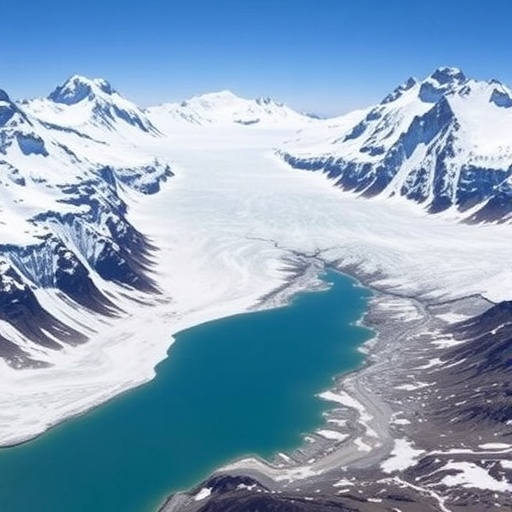
A groundbreaking new study published in Nature Communications uncovers an expansive potential for future lake formation in regions currently enveloped by glaciers, reshaping our understanding of the landscapes that await as Earth’s ice retreats. This research, spearheaded by Frank, van Pelt, Rounce, and their colleagues, leverages a novel approach by mapping glacier-free topography beneath ice cover to predict where meltwater could accumulate once these glaciers vanish. The insights provided are not only crucial for predicting future hydrological shifts but also hold profound implications for ecosystems, water resources, and hazard management worldwide.
As global temperatures continue their upward trajectory due to anthropogenic climate change, one of the most conspicuous impacts is the rapid melting of glaciers, which historically have been key repositories of fresh water. However, beyond the visible retreat of ice, the terrain that lies beneath these glaciers remains largely uncharted in fine detail. The team’s study ingeniously uses high-resolution digital elevation models combined with glacier outlines to reconstruct the exposed landscape beneath current ice masses, thereby revealing a topography primed for lake formation once the ice recedes.
The researchers’ methodology involved compiling glacier-free digital elevation models (DTMs) for all ice-covered terrains globally. These DTMs negate the presence of ice, effectively depicting the “bare Earth” beneath. This approach is innovative because it circumvents the traditional limitations encountered in glaciated regions where surface ice distorts or obscures bedrock features essential for predicting post-glacial hydrological patterns. By overlaying the glacier-free topography with existing glacier extents, the team could simulate the potential basins where water might concentrate.
Their results are astonishing in scale. The study identifies thousands of previously unrecognized depressions and basins capable of becoming proglacial lakes in the near future. These potential lake sites are not randomly distributed but cluster distinctly in certain glaciated regions, particularly in the Himalayas, the Andes, Alaska, and parts of the Arctic. This highlights the varying regional vulnerabilities to newly emerging water bodies, which could profoundly alter local environments and human activities.
Crucially, the study underscores how the formation of such lakes could modify downstream hydrology, impacting river discharge regimes and sediment transport. As glaciers withdraw, the newly formed lakes could act as buffers, storing meltwater temporarily but also posing risks of sudden outburst floods should their natural dams fail. Predicting the locations, sizes, and volumes of these lakes is therefore essential for risk assessment and adaptation planning in vulnerable mountainous communities.
Moreover, the work highlights the ecological ramifications of these new aquatic environments. Emerging lakes will create novel habitats, potentially fostering biodiversity and altering existing ecosystems abruptly. Species adapted to cold glacier-fed streams may face habitat fragmentation or loss, while new aquatic niches could emerge, challenging prevailing conservation strategies. Scientists and policymakers must anticipate these ecological cascades to mitigate negative impacts on biodiversity and ecosystem services.
The researchers emphasize the dynamic nature of glacier retreat and lake formation processes; these phenomena are not instantaneous but evolve over decades or even centuries. However, with current acceleration rates in glacier mass loss, the transition from ice-covered terrain to lake-dotted landscapes might proceed rapidly in several hotspots around the globe. This temporal insight gives urgency to mapping and monitoring efforts as hydrological infrastructures may face profound transformations within a generation.
In addition to the environmental and ecological consequences, the study provides a crucial tool for water resource management. In many regions, glacier meltwater supplements river flow during dry seasons, supporting agriculture and human consumption. The formation of stable lakes could modulate seasonal water availability, potentially buffering against drought or conversely complicating water distribution networks depending on lake longevity and outflow patterns.
The availability of detailed glacier-free topography also serves as a valuable baseline to improve climate model projections and glacio-hydrological simulations. Prior models often estimated lake potential based on incomplete or ice-covered terrain data, limiting their predictive accuracy. The new dataset, openly shared by the authors, will facilitate enhanced integrated assessments, fostering interdisciplinary collaboration among climate scientists, hydrologists, ecologists, and hazard modelers.
Interestingly, the paper also delves into the geological implications of deglaciation-induced lake formation. Newly exposed terrain beneath ice can possess complex bedrock structures, potentially influencing sedimentation processes within nascent lakes. Moreover, post-glacial rebound, the gradual uplift of land previously depressed by ice weight, may alter drainage paths and lake morphology over time, introducing another layer of complexity in predicting lake evolution.
The global scope of the study sets it apart from previous regional analyses, providing a holistic view of glacial landscapes transitioning to proglacial lake systems worldwide. This comprehensive vantage point is invaluable as it exposes global patterns and regional disparities in lake formation potential driven by diverse climatic, topographic, and geological conditions.
While the study represents a significant leap forward, the authors acknowledge limitations, such as the challenges in precisely modeling small-scale terrain features beneath extraordinarily thick ice and uncertainties associated with future climate scenarios. They advocate for continuous refinement of remote sensing technologies and ground-based observations to enhance resolution and validation of glacier-free topographies.
The implications of this research extend beyond pure science. For communities residing downstream of shrinking glaciers, early warning systems for glacier lake outburst floods will become increasingly important. Likewise, hydroelectric projects relying on glacier-fed reservoirs may need to revise risk assessments considering possible sudden lake formations or changes in meltwater dynamics.
In conclusion, Frank et al.’s innovative mapping of global glacier-free topography offers an unprecedented glimpse into the landscapes soon to emerge as glaciers fade. Their findings illuminate an extensive potential for future lakes that will reshape hydrology, ecosystems, and hazards in mountain and polar environments. This study not only advances scientific frontiers but also equips society with crucial knowledge to navigate the complex transition ahead in a warming world. Vigilant monitoring, integrated modeling, and proactive adaptation strategies will be essential to harness opportunities and mitigate risks posed by the new lakes born from disappearing ice.
Cite Scienmag News
Violet Maxwell. (May 3, 2026). Global Glacier Loss Unveils Vast Future Lake Potential. Scienmag. https://scienmag.com/global-glacier-loss-unveils-vast-future-lake-potential/
Violet Maxwell. "Global Glacier Loss Unveils Vast Future Lake Potential." Scienmag, 3 May 2026, https://scienmag.com/global-glacier-loss-unveils-vast-future-lake-potential/. Accessed 5 September 2026.
Violet Maxwell. "Global Glacier Loss Unveils Vast Future Lake Potential." Scienmag. May 3, 2026. https://scienmag.com/global-glacier-loss-unveils-vast-future-lake-potential/


