


Sickle cell disease (SCD) remains the most prevalent inherited blood disorder within the United States, implicating a significant portion of the population in chronic health challenges that profoundly impact quality of life and healthcare systems. Notably, roughly 10 percent of all individuals living with SCD nationwide reside in New York State, with New York City alone hosting the majority within the state boundaries. Despite its prominence, the delivery and outcomes of medical care for SCD patients are markedly inconsistent, as revealed by a comprehensive new investigation conducted by researchers at the NYU School of Global Public Health.
This groundbreaking study, featured in the esteemed journal JAMA Network Open, meticulously analyzed hospitalization data spanning over a decade—from 2009 to 2022—aggregated through New York State’s Statewide Planning and Research Cooperative System (SPARCS). Such a robust dataset, encompassing 42,271 hospitalizations linked to SCD, enabled an unprecedented exploration into geographic disparities and temporal trends affecting patient encounters across varied regions in the state. The findings illuminate how localized factors influence not only the intensity and cost of care but also the severity and mortality risk among this vulnerable population.
At the molecular level, SCD arises from a genetic mutation predominantly affecting those of African descent—a mutation that alters hemoglobin molecules within red blood cells. The resultant structural deformation into a crescent or “sickle” shape causes these erythrocytes to rigidly adhere within the microvasculature, obstructing normal blood flow. This pathophysiological blockade precipitates recurrent episodes of excruciating pain, termed vaso-occlusive crises, and insidious organ damage accruing over time. While therapeutic interventions like hydroxyurea have proven efficacy in mitigating pain episodes and improving life expectancy, individuals with SCD remain disproportionately burdened by frequent hospital admissions and complex care needs.
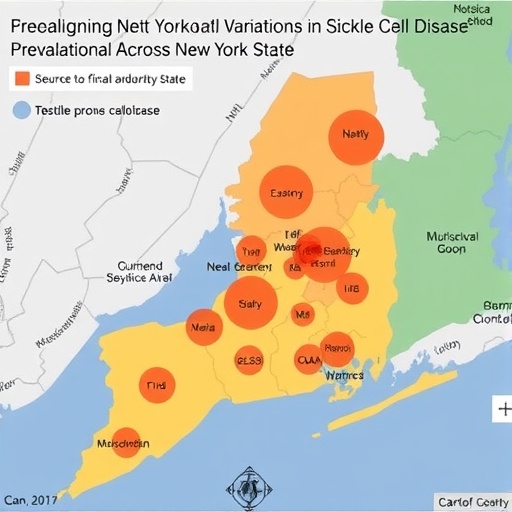
One critical insight from the study is the pronounced variation in health outcomes and resource utilization across regions. New York City—although registering the highest volume of hospitalizations—demonstrates shorter average lengths of stay at approximately 5.5 days and a relatively lower proportion of patients facing major mortality risks. In contrast, areas such as Central New York and the Hudson Valley experience prolonged hospital stays averaging over six days, signaling potential gaps in immediate care access or chronic disease management infrastructure. Long Island stands out with both the highest financial charges for hospital care and a concerningly elevated risk of mortality among hospitalized patients, suggesting intensified disease burden or disparities in specialized healthcare delivery.
Exploring demographic and clinical dimensions, the researchers corroborated previous knowledge that Black individuals represent the overwhelming majority of hospitalized SCD patients—in this study, accounting for 83 percent statewide. Age distribution was notably skewed toward young adults aged 18 to 29 years, who comprise 40 percent of hospitalizations, closely followed by those aged 30 to 49 years. Such demographic trends reflect critical vulnerabilities during the transitional phase from pediatric to adult care, a period fraught with challenges that often lead to disrupted continuity of treatment and increased morbidity.
Furthermore, the temporal analysis unveiled worrisome increases in severity markers over the years. Patients categorized under “major severity” of illness nearly doubled from 13 percent in 2009 to 27 percent in 2022. Mortality risk similarly spiked, with those classified at “major risk of death” rising from 3 to 13 percent during the same span. These escalating trends coincided with the global COVID-19 pandemic, a period during which SCD patients experienced major disruptions in routine care access and encountered heightened susceptibility to severe viral complications, underscoring the interplay between infectious threats and chronic hematologic conditions.
A pivotal explanation for regional disparities lies in the presence—or absence—of specialized SCD care teams and protocols at healthcare facilities. Expertise in hematology, especially with tailored focus on sickle cell pathophysiology, remains unevenly distributed across New York State. Access to multidisciplinary care models, including dedicated emergency department protocols for crisis management and coordinated transitional strategies linking pediatric and adult services, significantly influences outcomes. Regions with longer hospital stays or higher mortality suggest deficiencies within these critical healthcare structures.
In addition to medical system factors, social determinants of health encompass an important dimension underlying these differences. Socioeconomic factors, healthcare access barriers, and historical inequities contribute to diverse patient experiences and resource demands across urban and rural settings. For instance, New York’s pioneering adoption of a newborn screening program for SCD over five decades ago has undoubtedly improved early diagnosis and intervention, yet shifting migration patterns introduce new complexities. Immigrants from high-prevalence countries may enter the healthcare system without prior newborn screening or adequate monitoring, often presenting only when emergencies arise. This late entry into care compounds disease severity and complicates public health surveillance efforts.
Investigation authors advocate for comprehensive, region-specific strategies grounded in these insights to remedy systemic shortcomings. Enhancing access to adult hematologists, establishing regional centers of excellence, improving provider education surrounding evidence-based treatments like hydroxyurea, and expanding psychosocial support frameworks represent immediate actionable priorities. Equally vital are broader systemic reforms aimed at increasing funding allocations for sickle cell research, updating policies to reflect population shifts, and fostering healthcare equity.
Importantly, this research underscores the imperative to monitor patient-level clinical markers continuously, enabling proactive intervention before crises escalate to hospitalization. Real-time surveillance systems integrated with electronic health records could facilitate identification of high-risk patients and support personalized care plans. Additionally, integrating community-based health resources and strengthening patient education about disease management can empower individuals living with SCD to navigate healthcare systems more effectively and reduce emergency department reliance.
In conclusion, while SCD continues to impose significant health burdens on New York State’s population, this study’s nuanced elucidation of geographic and temporal hospital trends offers a robust foundation for transformative improvements. Tailoring interventions to the unique demands of each region, optimizing healthcare delivery models, and embracing systemic change will be crucial to achieving equitable care and better outcomes for individuals affected by this complex genetic disorder.
Cite Scienmag News
Phoebe Ingram. (May 1, 2026). Research Reveals Regional Variations in Sickle Cell Disease Prevalence Across New York State. Scienmag. https://scienmag.com/research-reveals-regional-variations-in-sickle-cell-disease-prevalence-across-new-york-state/
Phoebe Ingram. "Research Reveals Regional Variations in Sickle Cell Disease Prevalence Across New York State." Scienmag, 1 May 2026, https://scienmag.com/research-reveals-regional-variations-in-sickle-cell-disease-prevalence-across-new-york-state/. Accessed 1 September 2026.
Phoebe Ingram. "Research Reveals Regional Variations in Sickle Cell Disease Prevalence Across New York State." Scienmag. May 1, 2026. https://scienmag.com/research-reveals-regional-variations-in-sickle-cell-disease-prevalence-across-new-york-state/


