


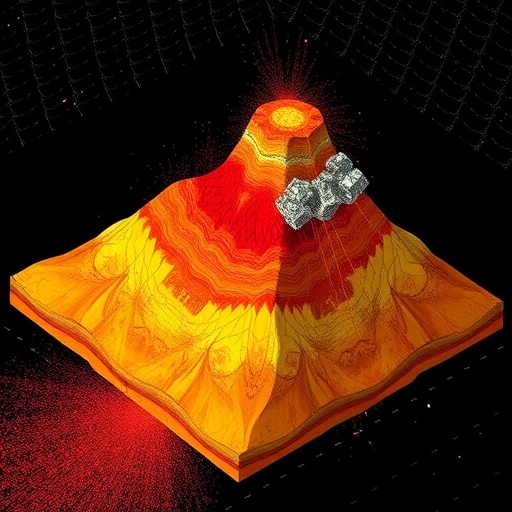
In a groundbreaking development, researchers have unveiled new insights into the enigmatic behavior of non-self-similar earthquakes, fundamentally challenging longstanding notions about fault mechanics and seismic activities. The team, led by Okubo, Yamashita, and Fukuyama, has employed a novel method involving a controlled fault asperity to illuminate the complex dynamics that govern earthquakes which deviate from traditional, self-similar scaling laws. This pioneering work, published recently in Nature Communications, marks a significant leap forward in our understanding of how earthquakes propagate along faults that possess heterogeneous structures.
For decades, earthquake science has largely operated under the assumption that seismic events follow self-similar patterns, where aspects such as rupture length, slip distribution, and stress drop scale predictably across magnitudes. However, empirical evidence accumulating from seismic observations suggests that many earthquakes, particularly those involving irregular fault surfaces or complex geological settings, diverge from this paradigm. The challenge has been to dissect the physics underlying such irregular, or non-self-similar, earthquakes in controlled experimental frameworks—a gap this study expertly addresses.
Central to the researchers’ methodology is the deliberate incorporation of a controlled fault asperity—a localized area on the fault with distinct frictional properties and geometric irregularity—within laboratory simulations. By manipulating this asperity, the team was able to replicate and observe rupture processes in unprecedented detail. Their innovative use of high-speed sensors and advanced imaging techniques allowed them to record nuanced slip behaviors and stress variations that occur when an earthquake rupture encounters such heterogeneities, offering a mechanistic explanation for non-uniform seismic energy release.
The results reveal that when rupture propagation interacts with a fault asperity, the behavior of the earthquake fundamentally shifts. Rather than exhibiting linear or predictable scaling, the rupture can slow down, speed up, or even arrest temporarily, creating complex slip patterns that depart significantly from the idealized models. These dynamic interactions foster heterogeneous stress distributions along the fault plane, leading to variations in earthquake magnitude and intensity that had hitherto been poorly understood.
Moreover, the study elucidates how the presence of asperities impacts the nucleation process of earthquakes. It appears that asperities act as barriers and facilitators, modulating the initiation of rupture depending on their size, frictional characteristics, and location along the fault. This emergent behavior suggests that earthquakes are not merely simple ruptures propagating through homogenous mediums but are highly sensitive to localized fault properties, which can determine the severity and pattern of seismic waves generated.
One particularly significant takeaway from this work is the implication for seismic hazard assessment and prediction. Traditional models often fail to capture the erratic nature of fault behavior where asperities exist, leading to uncertainties around maximum expected earthquake sizes and their associated risks. The insights gained from controlled asperity modeling suggest that incorporating such heterogeneities can improve the realism of seismic hazard models, potentially refining forecasts for earthquake occurrence and impact.
Another compelling aspect of this research is how it bridges the gap between laboratory-scale experiments and real-world fault systems. While previous experiments have struggled to replicate the complexity inherent in natural faults, the controlled asperity approach mimics geological realities more faithfully, enabling researchers to better extrapolate lab findings to tectonic settings. This methodological advancement paves the way for further experimental studies to unravel the intricate interplay between fault structure and earthquake dynamics.
From a geophysical perspective, the study also sheds light on energy partitioning during seismic events. It was observed that asperities could lead to localized energy concentration, influencing both seismic wave radiation and aftershock distribution. This nuanced understanding challenges the simplistic view of energy release and encourages a more detailed consideration of fault architecture in earthquake physics.
Crucially, the findings have ramifications for developing early-warning systems and mitigation strategies. By appreciating how fault roughness and asperities influence rupture velocity and slip patterns, seismologists can better anticipate the temporal evolution of an earthquake once rupture initiation occurs. This knowledge can refine real-time monitoring algorithms and improve response protocols aimed at minimizing human and infrastructural damage.
The researchers’ dedication to quantifying the mechanical properties of the controlled asperity also complements advances in materials science and fault frictional studies. By precisely characterizing the asperity’s stiffness and frictional strength, they linked microscale physical properties to macroscale phenomena observable during rupture. This multi-scale integration exemplifies the interdisciplinary approach necessary to unravel the complexities of nature’s most formidable forces.
Furthermore, this study presents a call to revisit existing seismic catalogs with a new lens, reanalyzing earthquakes where non-self-similar behavior was observed but poorly explained. It opens a promising avenue for reinterpreting historic data sets in light of fault asperity effects, potentially uncovering patterns that were previously masked by oversimplified models.
Looking ahead, the combination of experimental observations and computational modeling in this research sets a template for future explorations into fault mechanics. The controlled asperity paradigm can be augmented with varying fault conditions—such as fluid pressures, temperature gradients, and rock heterogeneity—to build a more comprehensive understanding of earthquake triggers and evolution across different tectonic regimes.
In sum, the work by Okubo, Yamashita, and Fukuyama represents a paradigm shift in seismology by demonstrating that the intricate topography and frictional diversity of faults cannot be ignored when assessing earthquake behavior. Their controlled fault asperity experiments capture the essence of non-self-similar earthquake dynamics, providing a robust framework that aligns laboratory modeling with geological reality.
This research not only enriches our fundamental understanding of earthquake physics but also holds promise for practical applications in seismic risk reduction. As fault asperities emerge as critical determinants of earthquake rupture dynamics, integrating such insights into monitoring and modeling frameworks stands as a promising frontier to enhance resilience against future seismic events.
As the Earth’s crust continues to deform and stress accumulates along fault lines worldwide, the complex dance of rupture and slip unveiled by this study underscores the delicate balance that governs tectonic processes. The controlled asperity, once a mere laboratory curiosity, now shines as a pivotal concept illuminating the intricate mechanics behind some of nature’s most unpredictable and powerful phenomena.
Cite Scienmag News
Violet Maxwell. (April 30, 2026). Unveiling Non-Self-Similar Earthquake Dynamics via Fault Asperity. Scienmag. https://scienmag.com/unveiling-non-self-similar-earthquake-dynamics-via-fault-asperity/
Violet Maxwell. "Unveiling Non-Self-Similar Earthquake Dynamics via Fault Asperity." Scienmag, 30 April 2026, https://scienmag.com/unveiling-non-self-similar-earthquake-dynamics-via-fault-asperity/. Accessed 1 September 2026.
Violet Maxwell. "Unveiling Non-Self-Similar Earthquake Dynamics via Fault Asperity." Scienmag. April 30, 2026. https://scienmag.com/unveiling-non-self-similar-earthquake-dynamics-via-fault-asperity/


