


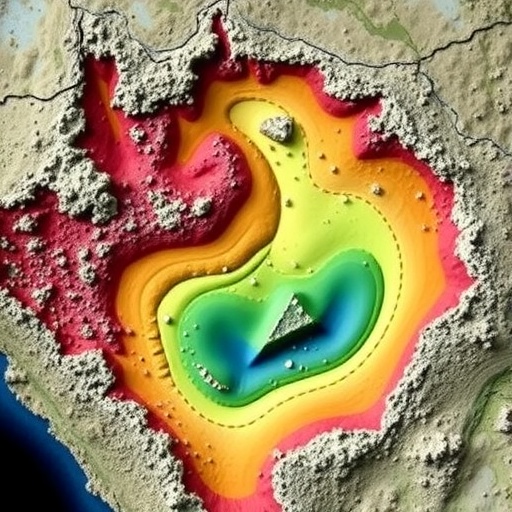
In a groundbreaking study published in Communications Earth & Environment, researchers Ng, Feng, Zhou, and colleagues have unveiled new insights into the dynamics of the Sumatran backarc region, revealing a surprisingly weak asthenosphere beneath it. By harnessing long-term postseismic geodetic records, the team has significantly advanced our understanding of mantle viscosity variations and their implications for tectonic and seismic processes in one of the most geologically active zones on Earth.
The Sumatran backarc, located behind the Sunda megathrust subduction zone, has long intrigued geoscientists due to its complex tectonic setting and frequent seismic activity. Traditionally, the mantle beneath such volcanic arcs is considered relatively strong and resistive. However, the latest observations challenge this assumption, presenting a contrast that could reshape seismic hazard models and tectonic process theories for the region and comparable subduction zones worldwide.
Central to this discovery is the application of dense geodetic monitoring over an exceptionally extended duration following a major seismic event. These postseismic deformation signals, which record the Earth’s surface movement after an earthquake, serve as a unique window into the rheological properties of deeper mantle layers. Prior investigations often relied on transient datasets that failed to capture the full temporal evolution of postseismic relaxation. By contrast, this study’s utilization of long-term geodetic observations affords unprecedented resolution in reconstructing the mantle’s mechanical behavior.
The researchers employed sophisticated inversion techniques, blending GPS and InSAR data, to map subtle yet persistent surface deformations over years following significant ruptures along the megathrust fault system. These geodetic datasets pinpointed anomalously rapid postseismic relaxation rates that are inconsistent with the traditionally assumed viscosity values of an asthenosphere beneath volcanic arcs. Instead, the inferred low-viscosity asthenosphere suggests a mantle layer that accommodates strain more readily, behaving almost as a weak, ductile zone far more pliable than previously thought.
This revelation has profound implications for how stress is transferred and dissipated during the seismic cycle. A weak asthenosphere facilitates faster postseismic mantle flow, which can modulate stress loading on locked portions of the megathrust fault. Such dynamics could potentially shorten recurrence intervals for large earthquakes or affect the magnitude of aftershock sequences, impacting seismic hazard assessments for millions of residents in Sumatra and adjacent regions.
From a geodynamic perspective, the presence of a weak asthenosphere can be tied to elevated temperatures and partial melting beneath the backarc, conditions that diminish mantle viscosity. This aligns with petrological data suggesting enriched volatile contents and complex thermal structures beneath the volcanic arc. The new findings provide quantitative geophysical evidence supporting these theoretical predictions, bridging surface tectonics with deep Earth processes in a holistic framework.
Moreover, the study challenges geodynamic models to incorporate variable asthenospheric strength rather than assuming uniform rheological constants beneath arc systems. Such refinement is essential for realistic earthquake cycle simulations, enabling better forecasts of strain accumulation and release. This progress also aids in understanding mantle convection patterns, slab rollback phenomena, and the creation of backarc basins, phenomena intricately linked to mantle characteristics beneath subduction zones.
Technologically, the utilization of long-duration geodetic data underscores the critical importance of maintaining continuous, high-precision monitoring networks in tectonically active regions. Innovations in satellite radar interferometry and dense GPS arrays have proven indispensable for capturing these subtle postseismic signatures, which can last years to decades, often overlooked in short-term investigations. This study exemplifies the merging of observational innovation with theoretical insights to tackle longstanding geoscientific enigmas.
Beyond the scientific community, these findings carry significant societal relevance. Understanding mantle weakness beneath Sumatran backarc zones informs earthquake preparedness protocols by illuminating hidden processes that control earthquake aftermaths and seismic risk distribution. Improved hazard models shaped by these insights can better guide infrastructure resilience planning, community awareness campaigns, and disaster mitigation strategies.
Furthermore, the study opens avenues for comparative analyses with other subduction systems worldwide, such as the Cascadia, Japan, and Chilean margins. Detecting whether similarly weak asthenospheres exist elsewhere could reveal universal or region-specific mantle dynamics, refining global tectonic theories. This research thus acts as a catalyst for further multidisciplinary exploration integrating seismology, geodesy, petrology, and geodynamics.
This breakthrough is timely, as volcanic arc systems remain hotspots not only for natural hazards but also for mineral resource exploration and geothermal energy exploitation. Understanding the mantle’s mechanical properties helps evaluate processes controlling magma generation, fluid migration, and thermal gradients, informing resource management and sustainable development in these vulnerable settings.
Ultimately, the discovery of a weak asthenosphere beneath the Sumatran backarc illustrates the transformative power of long-term geophysical observatories combined with cutting-edge analytical tools. It demonstrates that Earth’s interior, although remote and intangible, can be revealed with exquisite detail, reshaping our knowledge of seismicity and tectonics. The consequences of this enhanced understanding promise to ripple across Earth sciences, engineering, and public safety sectors alike.
As the research community digests these findings, the mandate for sustained investment in geoscientific infrastructure is clearer than ever. Continual monitoring and analysis of postseismic deformation will remain indispensable for decoding the Earth’s evolving dynamics, enabling society to coexist more safely with the planet’s restless geological forces.
Ng and colleagues’ work marks a pivotal step forward, transforming our conceptual and practical grasp of mantle behavior beneath arcs. Their integrated approach sets a new standard for unraveling the rheological complexities of subduction zone interiors, heralding a future where geoscientific discoveries not only expand knowledge but tangibly enhance human resilience.
Cite Scienmag News
Violet Maxwell. (April 29, 2026). Sumatran Backarc’s Weak Asthenosphere Exposed by Postseismic Data. Scienmag. https://scienmag.com/sumatran-backarcs-weak-asthenosphere-exposed-by-postseismic-data/
Violet Maxwell. "Sumatran Backarc’s Weak Asthenosphere Exposed by Postseismic Data." Scienmag, 29 April 2026, https://scienmag.com/sumatran-backarcs-weak-asthenosphere-exposed-by-postseismic-data/. Accessed 4 September 2026.
Violet Maxwell. "Sumatran Backarc’s Weak Asthenosphere Exposed by Postseismic Data." Scienmag. April 29, 2026. https://scienmag.com/sumatran-backarcs-weak-asthenosphere-exposed-by-postseismic-data/


