


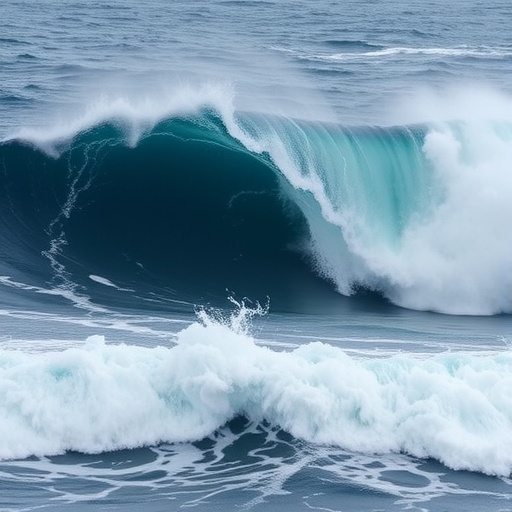
Over the past forty years, the Southern Ocean has delivered increasingly powerful swells to the Pacific coast of the Americas, a phenomenon that carries profound implications for coastal environments, marine navigation, and global climate systems. A groundbreaking study published in Nature Communications for 2026 now reveals the intensification of these swells, driven by a complex interplay of atmospheric and oceanic forces that echo the broader story of planetary change.
The Southern Ocean, encircling Antarctica, is a crucial engine of Earth’s climate system. It acts as a major sink for atmospheric carbon dioxide and helps regulate global heat distribution. The swells generated in this region are among the largest and most consistent in the world, formed by strong and persistent westerly winds known as the “Roaring Forties” and “Furious Fifties.” These swells propagate northward across thousands of kilometers, eventually impacting coastlines along the western rim of the Americas. The recent research led by Lobeto, Menendez, Semedo, and colleagues meticulously charts how the energy contained in these swells has grown year by year since the early 1980s.
To understand this phenomenon, the team employed a combination of satellite observations, buoy records, and advanced hydrodynamic modeling. This multifaceted approach allowed them to reconstruct wave climates over four decades with unprecedented resolution. Their data shows a clear and statistically significant increase in swell height and energy flux, with some coastal regions experiencing up to a 20% rise in mean wave height. This escalation is not uniform, with the strongest amplifications seen in central and northern parts of the Pacific coast from Chile to California.
The physical mechanisms underpinning these changes are rooted in alterations in the Southern Ocean’s wind patterns. Strengthening westerly winds, associated with shifting atmospheric pressure systems like the Southern Annular Mode, have increased the wind fetch—the distance over water that wind blows uninterrupted. Longer fetches amplify wave growth, resulting in larger and more powerful swells moving northward. Additionally, the intensification of storms within the Southern Ocean has contributed further energy injections into the wave field, making the swell climate more extreme and energetic.
One striking aspect of the study is its use of numerical wave models calibrated against decades of observational data. This enabled the researchers not only to confirm the historical trend but also to simulate possible future scenarios. The models predict that, assuming current trajectories in greenhouse gas emissions and climate variability, the increasing trend in swell intensity will persist and possibly accelerate. This projection raises vital questions for coastal resilience and sustainability.
The ramifications of these findings extend far beyond scientific curiosity. Coastal communities along the Pacific are particularly vulnerable to the effects of intensified swells, which exacerbate erosion, increase flooding risks, and amplify the destructive potential of storm surges. In places like California and Chile, where much of the population and infrastructure hug the shoreline, understanding long-term trends in wave dynamics is crucial for urban planning, disaster preparedness, and conservation strategies.
Marine ecosystems, too, are influenced by these wave patterns. Coastal habitats such as kelp forests, coral reefs, and sandy beaches experience altered hydrodynamic conditions due to changes in swell regimes. Such shifts can impact sediment transport, nutrient cycling, and habitat structure, ultimately affecting biodiversity and fisheries productivity. The study, while primarily focused on physical oceanography, highlights the need for integrated ecological assessments in the future.
Another dimension of this research pertains to maritime safety and navigation. The boosting intensity of Southern Ocean swells poses an increased hazard to shipping and offshore operations. Mariners encounter larger and more frequent large swell events, which heighten risks of vessel damage or accidents. The improved understanding of swell intensification offers a critical opportunity for enhancing wave forecasting models and maritime risk management protocols.
The study’s interdisciplinary methodology stands out as a model for future climate-related oceanographic research. By combining remote sensing technologies, in-situ measurements, and numerical simulations, the team achieved a robust and comprehensive portrait of a rapidly evolving natural phenomenon. Such integrative frameworks are indispensable as the scientific community strives to unravel complex Earth system processes in an era of climate change.
Perhaps one of the most compelling aspects of this research lies in its timing. It arrives amidst growing concerns over coastal vulnerabilities and global climate policy debates. The intensifying Southern Ocean swells serve as tangible indicators of anthropogenic climate influence manifesting in ocean dynamics. They reinforce the urgency for addressing greenhouse gas emissions and implementing adaptive strategies for affected coastal zones.
Furthermore, the research underscores the interconnectedness of Earth’s systems. The remote Southern Ocean’s winds and waves have ripple effects thousands of kilometers away, shaping conditions along two continents’ Pacific coastlines. This global linkage reminds us that local environmental changes are often driven by distant and large-scale climatic processes, a crucial insight for designing effective mitigation and adaptation measures.
Despite its comprehensive nature, the study opens new avenues for exploration. For example, how do decadal climate oscillations modulate the observed trends? What role do Antarctic ice melt and sea ice variability play in modulating Southern Ocean wave climates? Addressing these questions will refine predictions and help untangle natural variability from anthropogenic signals.
Similarly, translating these findings into actionable policy requires collaboration beyond scientific circles. Coastal managers, urban planners, policymakers, and local communities need to be engaged in dialogue informed by science to devise resilient infrastructure and conservation programs capable of withstanding the intensified swell regimes.
In the broader scope of climate science, findings such as these exemplify the complexity and reach of climate change impacts. They reaffirm the necessity for sustained monitoring networks, investment in high-resolution modeling, and interdisciplinary approaches that anticipate and mitigate risks emerging from Earth’s dynamic systems.
Ultimately, this pioneering research by Lobeto, Menendez, Semedo, and their team illuminates a hitherto underappreciated yet critical facet of our changing planet. The echoes of Southern Ocean storms are growing louder and stronger, reshaping the swell patterns across the vast Pacific coasts. This knowledge equips humanity with the foresight to adapt and respond to changing wave climates—an essential step in safeguarding coastal livelihoods and ecosystems against an uncertain future.
Cite Scienmag News
Violet Maxwell. (April 29, 2026). Four Decades of Growing Southern Ocean Swells. Scienmag. https://scienmag.com/four-decades-of-growing-southern-ocean-swells/
Violet Maxwell. "Four Decades of Growing Southern Ocean Swells." Scienmag, 29 April 2026, https://scienmag.com/four-decades-of-growing-southern-ocean-swells/. Accessed 31 August 2026.
Violet Maxwell. "Four Decades of Growing Southern Ocean Swells." Scienmag. April 29, 2026. https://scienmag.com/four-decades-of-growing-southern-ocean-swells/


